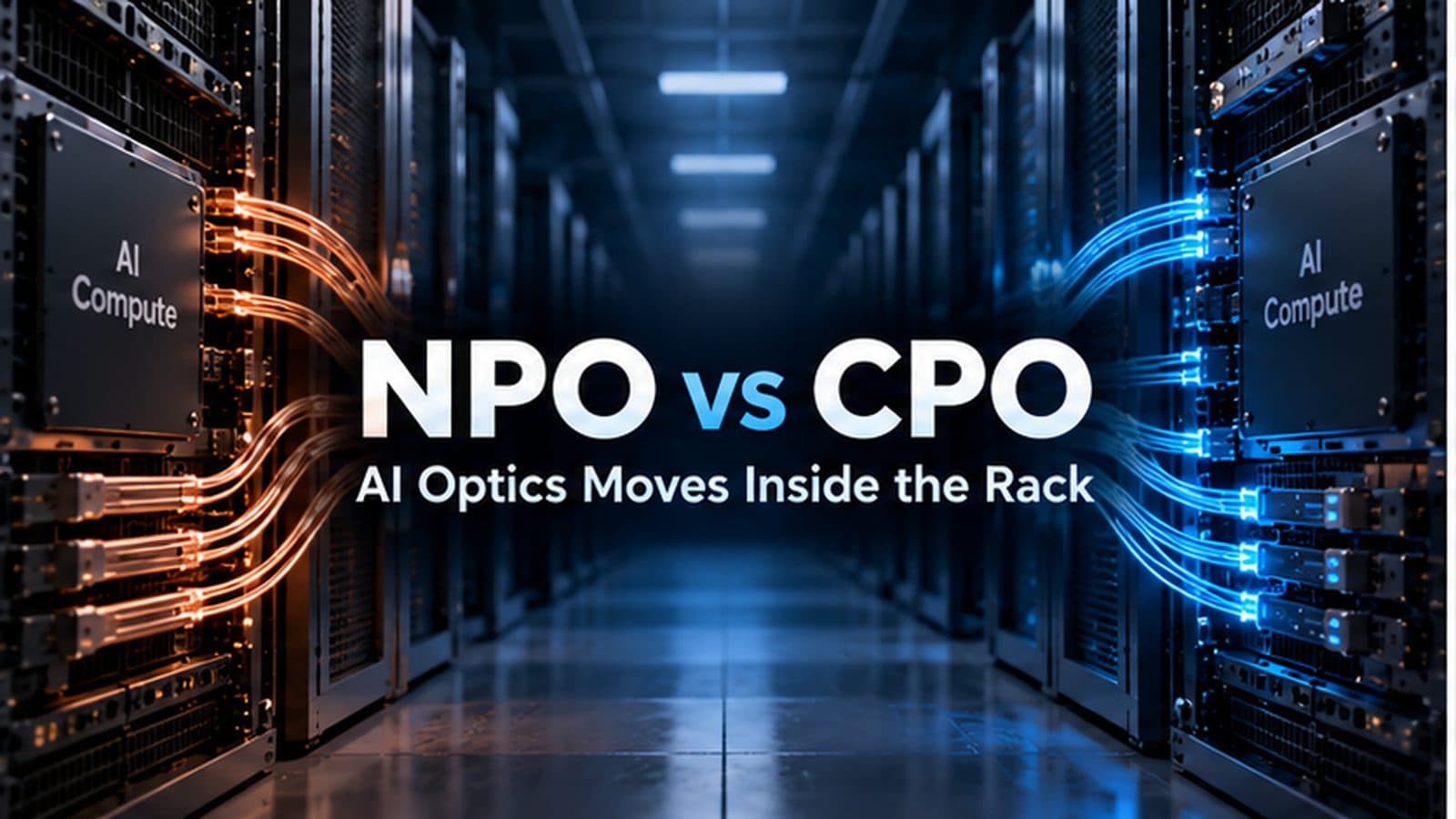
Key Takeaways
- NPO and CPO are two engineering responses to the same physical limit. As GPU and XPU scale-up domains grow, copper interconnects face constraints in distance, power and signal integrity, and optical engines are moving closer to the compute and switching ASICs.
- The investment opportunity is not only that optical modules are migrating, but that connections which used to run over copper are beginning to run over light. That expansion of optical TAM is the more important part of the thesis.
- Scale-up, scale-out, and scale-across are three different optical cycles that may coexist for years. NPO and CPO compete with copper and with each other on the scale-up side; 800G, 1.6T and 3.2T pluggable optics continue to grow on the scale-out side; longer-reach pluggable and coherent links remain important for scale-across.
- Soitec, Tower Semiconductor, and Aehr Test Systems offer architecture-neutral upstream exposure to silicon photonics, foundry capacity, and wafer-level test. Their business is less dependent on which final module architecture ultimately wins.
- Coherent, Lumentum, and MACOM sit in the middle of the value chain. Their product breadth (lasers, VCSELs, photodiodes, drivers, TIAs, optical engines) lets them benefit regardless of whether NPO, CPO, or pluggable optics captures more of the system.
- AAOI remains the clearest near-term beneficiary of the existing pluggable 800G/1.6T cycle, but is also preparing for the NPO/CPO era. Its risk profile differs from upstream silicon photonics suppliers because its near-term revenue is much more concentrated in the front-panel module market.
AI data centers are pushing optical connectivity away from the front panel and closer to GPUs and switch ASICs. NPO, CPO, and 1.6T pluggable optics may coexist for years, but the shift is already redistributing value across silicon photonics, lasers, optical engines, testing, and the broader optical module supply chain.
For the past two years, the investment case for AI optics was relatively straightforward: larger GPU clusters required more 800G and, eventually, 1.6T optical transceivers.
That thesis is still working.
Applied Optoelectronics reported second-quarter revenue of $191.9 million, up roughly 86% year over year, while 800G shipments more than doubled sequentially. The company expects demand for 800G and 1.6T products to exceed its capacity through at least mid-2027 and plans to increase combined 800G and 1.6T manufacturing capacity to roughly 650,000 units per month by year-end.
Earlier this year, AAOI also received a volume order worth more than $200 million for 1.6T transceivers from a long-standing hyperscale customer.
The current pluggable optical cycle, in other words, is not ending.
But another transition is beginning deeper inside the AI system.
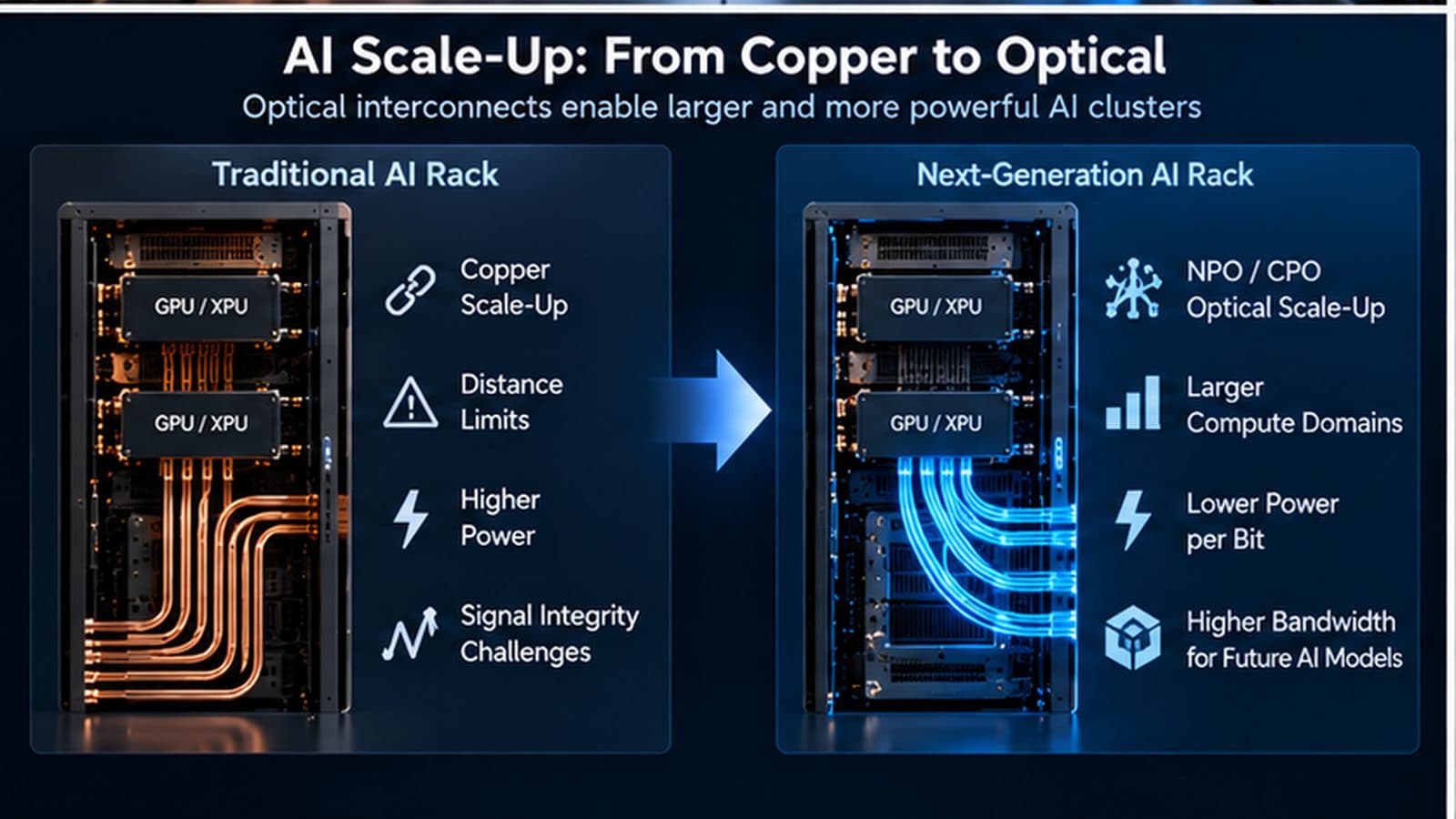
As accelerator bandwidth rises and scale-up domains expand across trays, racks, and potentially much larger compute fabrics, copper interconnects face increasingly difficult constraints in distance, power consumption, and signal integrity.
Microsoft's Maia 200, for example, exposes 2.8 TB/s of bidirectional scale-up bandwidth per accelerator, while Microsoft's scale-up network architecture is designed to extend to as many as 6,144 accelerators. (For a deeper read on how Nvidia's networking stack handles that bandwidth, see NVIDIA's Next Bottleneck Isn't GPUs. It's Data Movement.. For the underlying memory bandwidth that GPUs and AI accelerators have to feed, see HBM vs DDR5: What's the Difference—and Why AI Needs Both.)
That changes the central question for optical investors.
The industry is no longer only asking:
When will 800G transition to 1.6T?
A more important question is emerging:
What happens to the optical supply chain when connections that used to run over copper begin moving to light?
What Is NPO, and How Is It Different From CPO?
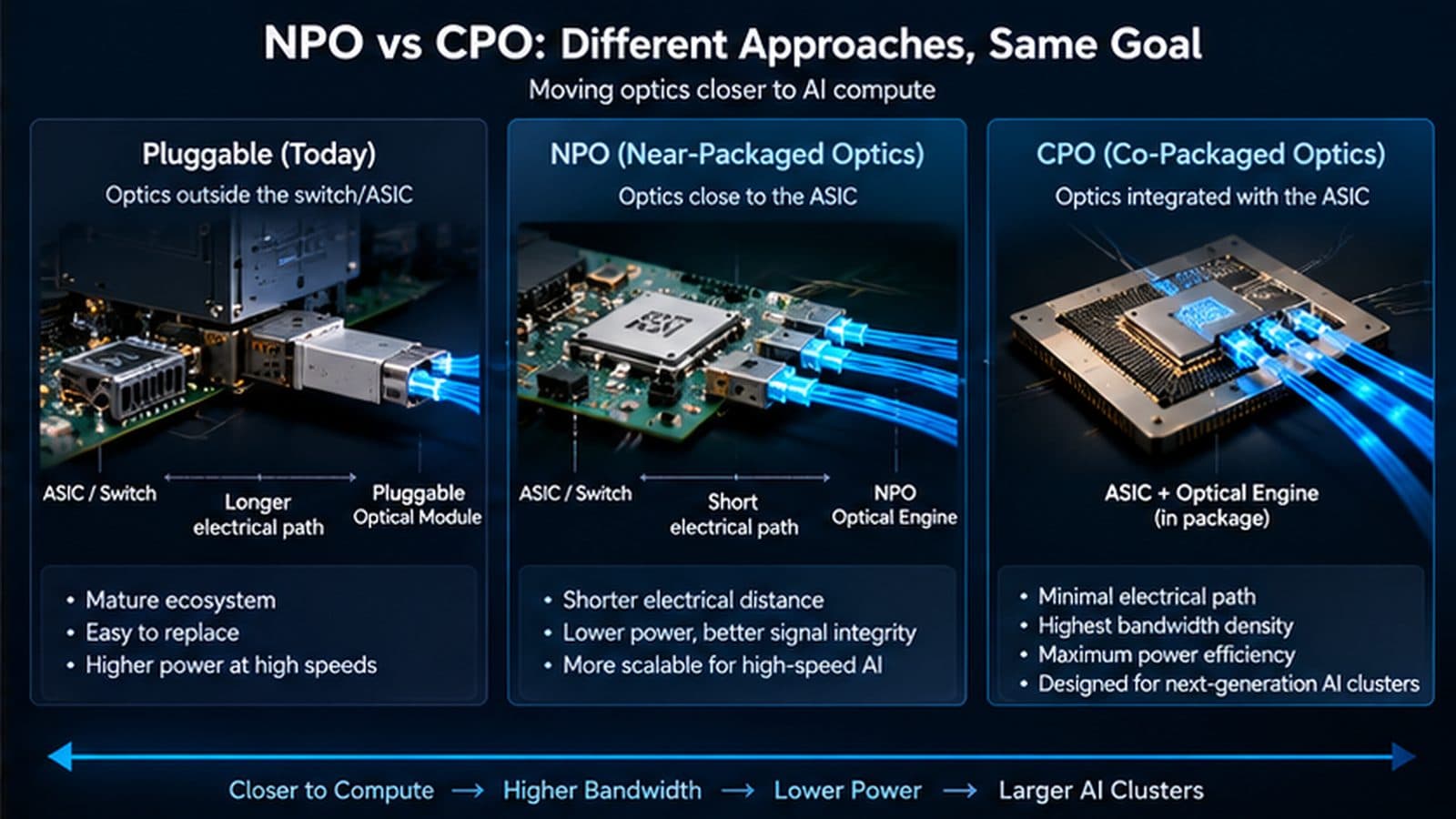
Traditional pluggable optical transceivers sit at the front panel of a switch.
High-speed electrical signals travel from the ASIC across the PCB before reaching the transceiver, where they are converted into optical signals. As lane speeds move toward 200G and beyond, these increasingly demanding electrical paths consume more SerDes, DSP, and equalization power.
Co-Packaged Optics, or CPO, moves the optical engine much closer to the switch ASIC or XPU, integrating optics with the compute or networking package.
The shorter electrical path can deliver lower power per bit and higher bandwidth density.
Near-Packaged Optics, or NPO, takes a different approach.
The optical engine still sits very close to the ASIC, but remains physically separate from the compute package.
That seemingly small architectural difference has major economic consequences.
A CPO system creates tighter coupling between the ASIC, photonic engines, advanced packaging, thermal management, yield, and testing. NPO preserves more modularity, allowing the compute silicon and optical engine to be manufactured, tested, serviced, and upgraded more independently. (For the broader history of the CPO debate, see CPO Isn't Dead. The Timeline Is..)
This is why the NPO-versus-CPO debate should not be reduced to a question of which architecture is technologically superior.
CPO is designed to push power efficiency and bandwidth density toward their physical limits.
NPO attempts to find a better system-level balance between power, cost, yield, serviceability, supply-chain flexibility, and product iteration speed.
The physically optimal architecture and the economically optimal architecture do not necessarily have to be the same.
Why Meta, Microsoft, AWS, and Tencent Are Exploring Optical Scale-Up
It is important to distinguish between support for open optical scale-up architectures and confirmed large-scale NPO deployment.
Meta and Microsoft have not publicly demonstrated that they are already deploying NPO at scale.
What they have done is help establish the Open Compute Interconnect Multi-Source Agreement, or OCI-MSA, alongside AMD, Broadcom, NVIDIA, OpenAI, and other infrastructure companies.
The objective is significant: create an open, interoperable optical PHY ecosystem for AI scale-up networks, support multiple suppliers, and reduce the industry's dependence on proprietary interconnect architectures.
That motivation helps explain why NPO is receiving more attention from hyperscalers.
At very large AI infrastructure scale, minimizing pJ/bit is only one engineering objective.
Operators also care about failure rates, repair time, inventory requirements, multi-vendor sourcing, qualification cycles, and the speed at which new generations of accelerators can be deployed.
Microsoft's Maia 200 illustrates this architectural philosophy.
The chip uses an Ethernet-based scale-up network, exposes 2.8 TB/s of bidirectional scale-up bandwidth per accelerator, and supports domains that can extend to thousands of accelerators.
This suggests that Microsoft wants compute silicon, network interfaces, protocols, and interconnect hardware to evolve within a relatively open infrastructure stack rather than depending entirely on one proprietary fabric.
Tencent provides a more direct example of NPO development.
China's ODCC has disclosed that the ETH-X Ultra project is pushing optical engines closer to the chip through NPO. The 3.2T design uses 32 lanes at 112G, targets roughly 30 meters of reach, and has a system interconnect cost target below $0.20/Gbps.
A 3.2T NPO product entered a leading industry customer in early 2026, while work on a 6.4T NPO standard is already progressing.
AWS is following a different route, but the supply-chain evidence is increasingly visible.
STMicroelectronics signed a multiyear, multibillion-dollar commercial agreement with AWS and has positioned advanced silicon photonics as part of its next-generation high-performance infrastructure strategy. ST has also discussed major expansion of its 300mm silicon photonics capacity and has explicitly identified both NPO and CPO as architectures that could bring optics deeper into AI scale-up networks.
These companies may not choose the same architecture.
What they increasingly agree on is more important:
Scale-up networks need more optics.
The Bigger Investment Thesis: NPO Is Competing With Copper, Not Just Pluggable Optics
If NPO merely took a 1.6T front-panel optical module, broke it into separate components, and moved the optical engine closer to the ASIC, the investment impact would be relatively limited.
The industry would mostly be redistributing an existing pool of optical revenue.
The more important development is that optics is beginning to enter parts of the scale-up network that were previously dominated by electrical interconnects.
Coherent has explicitly described this transition as an expansion of the serviceable market as optics replace copper. At its 2026 OFC investor event, the company estimated a CPO-related opportunity exceeding $15 billion by 2030.
That forecast should be treated as a supplier estimate rather than an established industry outcome.
But the source of the demand matters more than the exact TAM figure.
The new optical opportunity comes from connections that previously did not require optical components at all.
Coherent has repeatedly highlighted the transition from copper to optical connectivity inside AI infrastructure. Lumentum's recent results provide another early confirmation: the company has reported increasing demand for ultra-high-power CPO lasers, initial orders for external-laser-source modules, and several NPO customer engagements.
The implication is straightforward:
NPO is not simply replacing optical transceivers. It is beginning to replace copper.
That distinction changes the industry thesis.
Future optical TAM should no longer be estimated only by counting 800G and 1.6T Ethernet ports.
Incremental demand could also come from the opticalization of scale-up networks inside AI systems.
How NPO and CPO Are Reshaping the Optical Module Supply Chain
When optics primarily existed as a front-panel OSFP transceiver, a large portion of the economic value naturally accrued to the complete module supplier.
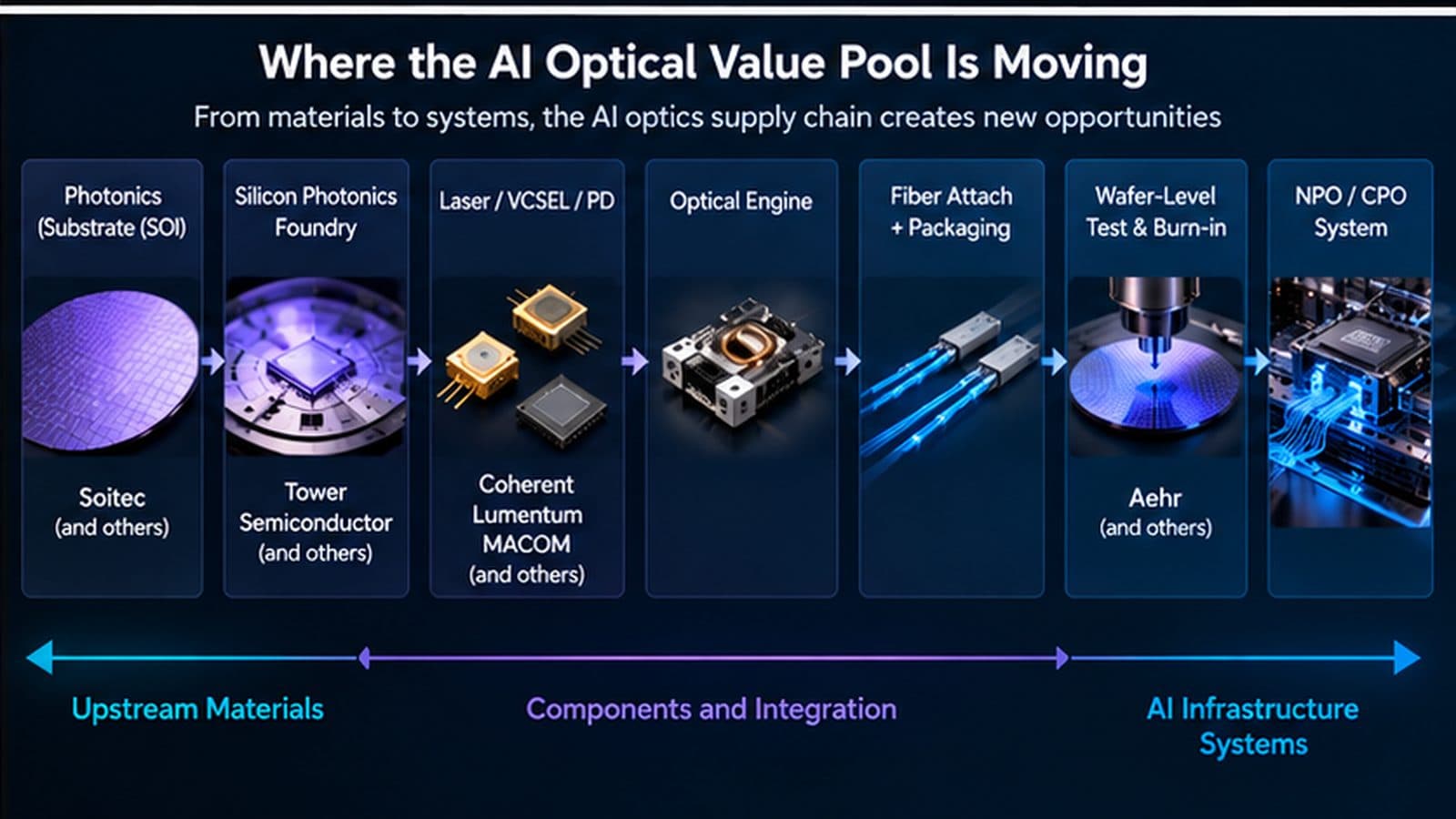
As optical engines move closer to compute and networking ASICs, the value chain becomes more fragmented:
Photonics-SOI substrate → Silicon photonics wafer fabrication → CW lasers, VCSELs, and photodiodes → Drivers and TIAs → Optical engines → Fiber attach and advanced packaging → Wafer-level testing and burn-in → NPO/CPO system integration
This is why the next phase of AI optics cannot be analyzed only through traditional optical transceiver companies.
Several upstream suppliers may offer cleaner exposure to the transition.
Soitec: One of the Cleanest Upstream Silicon Photonics Plays
Soitec is one of the easiest companies to overlook in the AI optical supply chain.
The company supplies Photonics-SOI substrates used in silicon photonics manufacturing.
Whether the final system is a silicon-photonics pluggable transceiver, an NPO optical engine, or a CPO architecture, greater silicon photonics adoption increases demand for the upstream substrate.
On September 2, Soitec raised its Photonics-SOI outlook.
The company now expects second-quarter FY27 Photonics-SOI revenue to be roughly three times the prior-year level. First-half revenue is expected to reach around 2.3 times the comparable period, while full-year FY27 Photonics-SOI revenue is projected to reach approximately 2.5 to 3 times FY26 levels.
FY26 Photonics-SOI revenue had already exceeded $100 million.
Even more important than the growth rate is customer behavior.
Soitec has been negotiating multiyear capacity-reservation agreements with major Photonics-SOI customers, including customer deposits and minimum-volume commitments.
This represents a much stronger signal than an industry CAGR forecast.
Customers are beginning to reserve upstream material capacity before the final optical architecture is fully settled.
From an investment perspective, Soitec does not need to predict whether NPO ultimately beats CPO.
It primarily needs one broader thesis to remain intact:
Silicon photonics penetration in AI interconnects continues to rise.
Tower Semiconductor: Customers Are Already Paying to Reserve Silicon Photonics Capacity
If Soitec represents the material layer, Tower Semiconductor represents the next layer: silicon photonics manufacturing.
In May, Tower announced customer contracts representing approximately $1.3 billion of silicon photonics revenue for 2027.
Customers have also provided approximately $290 million in capacity-reservation prepayments, while the company's contracted wafer commitments for 2028 are even larger.
This is one of the strongest pieces of supply-demand evidence in the AI optical chain.
Technology companies frequently describe AI optics demand as strong.
The more meaningful signal appears when customers are willing to pay in advance to secure manufacturing capacity.
Tower has moved beyond product-roadmap optimism into:
capacity reservation.
Its foundry position also provides substantial architectural neutrality.
Silicon photonics capacity can serve pluggable transceivers, NPO optical engines, and CPO systems.
Relative to companies that must predict which final module architecture wins, Tower carries less architecture-selection risk.
Aehr Test Systems: Silicon Photonics Creates a New Testing Bottleneck
Moving optics closer to expensive compute silicon creates another question that receives much less attention:
When do manufacturers know that a photonic die is actually good?
If a defective photonic die is discovered only after it has entered an expensive advanced package, the loss may extend beyond the optical chip itself.
The manufacturer may also lose the optical engine, package, fiber attachment, and potentially other high-value components.
As silicon photonics moves toward high-volume manufacturing, known-good-die screening and wafer-level reliability testing become more important.
Aehr Test Systems has received a series of silicon photonics production orders this year.
Its FOX-XP platform can perform wafer-level burn-in across as many as nine 300mm wafers simultaneously. Recent systems support up to 3,500 watts per wafer and automated wafer handling for volume manufacturing.
Aehr has also disclosed a new customer that it describes as a leading global networking company and a major supplier of data-center optical transceivers. That customer has already progressed from qualification into production ramp.
Aehr remains a smaller company, and silicon photonics is not yet its entire revenue base.
But it exposes an important second-order bottleneck:
The more expensive optical integration becomes, the more valuable it is to identify bad dies before packaging.
If NPO and CPO enter true high-volume manufacturing, wafer-level test and burn-in could become a much more important part of the AI optical equipment stack.
Coherent and Lumentum: Why Optical Component Platforms May Be Safer Than a Single Module Architecture
Coherent and Lumentum occupy the middle of the optical value chain.
Their key advantage is that they do not rely on one final transceiver architecture.
Coherent has capabilities across InP lasers, CW lasers, VCSELs, photodiodes, silicon photonics, fiber attach, and integrated optical engines.
At OFC, the company demonstrated multiple CPO and NPO-related technologies, including silicon photonics, VCSEL-based optical engines, and InP-based solutions. Its upcoming PhotonLink platform is designed to support NPO, CPO, and other integrated-optics architectures.
This gives Coherent a high degree of technology-route neutrality.
If short-reach AI scale-up networks favor VCSELs, Coherent has exposure.
If the market shifts toward silicon photonics and CW lasers, it has exposure there as well.
If external lasers become increasingly important in CPO systems, that remains inside its product portfolio.
Lumentum is more concentrated around the laser layer.
Its recent results already show increasing demand for ultra-high-power CPO lasers, first orders for external-laser-source modules, and multiple NPO engagements.
As modulation functions increasingly move into silicon photonics, the laser can become a more independent and strategically important part of the optical system.
For both COHR and LITE, the rise of NPO and CPO therefore should not be viewed simply as a threat to traditional optical-module demand.
They are competing for something larger:
the incremental optical bill of materials moving inside the AI rack.
MACOM: Another Architecture-Neutral Supplier Worth Watching
MACOM deserves attention because its strategy resembles a supplier of enabling components rather than a bet on a single optical architecture.
The company offers CW lasers used in high-speed silicon photonics applications and has continued developing high-speed drivers and TIAs for next-generation optical links.
Its latest 448G PAM4 modulator drivers can support multiple modulation platforms, including silicon photonics, EML, and TFLN.
That matters because MACOM does not need to know which modulation technology becomes the sole winner.
If lane speeds continue rising and the optical bill of materials continues expanding, demand for lasers, drivers, TIAs, and other high-speed analog components can grow across multiple architecture paths.
This gives MTSI a different type of exposure from a pure optical module manufacturer.
AAOI Shows Why the Existing Pluggable Cycle Is Not Over
The rise of NPO and CPO can easily create another incorrect conclusion:
If optics is moving closer to the ASIC, is the traditional pluggable optical transceiver cycle already nearing its peak?
Current operating data says no.
AAOI reported second-quarter revenue of $191.9 million, up approximately 86% year over year. 800G shipments more than doubled sequentially, and the company expects demand for 800G and 1.6T products to exceed its manufacturing capacity through at least mid-2027.
It plans to increase combined 800G and 1.6T manufacturing capacity to roughly 650,000 units per month by year-end.
In March, the company also received a hyperscaler order worth more than $200 million for 1.6T data-center transceivers, with shipments expected across the third and fourth quarters of 2026.
This means two optical cycles are now developing at the same time.
Scale-Out: 800G → 1.6T continues to expand rapidly.
At the same time:
Scale-Up: Copper → NPO/CPO begins creating a new optical market.
AAOI is also preparing for the second cycle.
At OFC, the company demonstrated a 25 dBm, 400 mW ELSFP designed for silicon photonics, NPO, and CPO architectures, alongside next-generation onboard optical solutions.
For now, however, AAOI's operating results remain much more dependent on traditional 800G and 1.6T transceivers. (For a deeper read on AAOI's broader orders and capacity trajectory, see AAOI: The AI Optical Bottleneck Is Real. But Can AXT Capture the Value?.)
That gives AAOI a different investment profile from Soitec or Tower Semiconductor.
AAOI offers stronger near-term revenue realization, but also greater long-term architecture-transition risk.
Which Stocks Are the Cleanest NPO and CPO Beneficiaries?
The answer depends on whether the objective is near-term earnings leverage or low exposure to architecture risk.
| Company | Position in the Supply Chain | Current Evidence | NPO / CPO Architecture Risk | |---|---|---|---| | Soitec | Photonics-SOI substrate | FY27 Photonics-SOI revenue expected at 2.5–3× FY26 levels; multiyear capacity agreements | Very Low | | Tower Semiconductor | Silicon photonics foundry | $1.3B of 2027 contracts + $290M capacity prepayments | Very Low | | Aehr Test Systems | Wafer-level test and burn-in | Multiple SiPh production orders moving into HVM | Low, but small-company risk | | Coherent | Lasers, VCSELs, PDs, SiPh, optical engines | Broad NPO/CPO exposure and copper-to-optical transition | Low | | Lumentum | CW/UHP lasers and ELS | CPO laser demand, initial ELS orders, NPO engagements | Low to Medium | | MACOM | Lasers, drivers, TIAs | Supports SiPh, EML, and TFLN architectures | Low to Medium | | AAOI | 800G/1.6T transceivers + ELS | Strong current orders and capacity expansion | Medium |
The table highlights an important distinction.
The stock with the highest near-term upside is not necessarily the company with the cleanest long-term position in the optical architecture transition.
AAOI has unusually strong current demand visibility.
Soitec, Tower, and several upstream component suppliers may carry less risk from whether NPO, CPO, or pluggable optics ultimately captures more of the system.
(For the broader network architecture shift that is driving this transition, including how Broadcom and Nvidia are positioning, see Broadcom's $115B AI Forecast Changes the Nvidia, HBM and Networking Trade. For a deeper look at the silicon photonics substrate layer, see Sivers Semiconductors (SIVE): When Does an AI Photonics Story Become a Business? and AXTI: The AI Optical Bottleneck Is Real. But Can AXT Capture the Value?.)
The Next AI Optical Bottleneck May Move Upstream
As optical systems move from a single front-panel transceiver toward dozens or potentially hundreds of optical channels positioned close to ASICs, a new set of manufacturing constraints emerges.
These include:
- wafer-level photonic testing;
- known-good-die screening;
- fiber-array alignment;
- fiber attach;
- advanced optical packaging;
- high-power external-laser reliability;
- automated manufacturing throughput.
Coherent's own CPO supply-chain materials now include fiber attach units, microlens arrays, polarization-maintaining fiber, external laser sources, InP CW lasers, isolators, and thermal-control components.
This suggests that the industry's next bottleneck may not remain in complete transceiver assembly.
The bottleneck could move through the supply chain:
Transceiver assembly → Silicon photonics wafer capacity → CW and InP lasers → Fiber attach → Wafer-level test
This is why the next stage of AI optical investing may expand far beyond the optical-module stocks that currently receive most of the market's attention.
Will NPO Replace CPO?
There is not enough evidence to support that conclusion.
NPO solves several practical engineering and supply-chain problems, but CPO still offers advantages in electrical-path length, bandwidth density, and potentially the lowest power per bit.
In the most demanding switching and AI networking systems, those advantages remain valuable.
A more likely outcome is a layered optical market.
Scale-Up
NPO and CPO compete with each other while gradually replacing portions of copper interconnect.
Scale-Out
800G, 1.6T, and eventually 3.2T pluggable optics continue to grow, while CPO may penetrate some high-radix switching platforms.
Scale-Across
Longer-reach 1.6T, 3.2T, and coherent optical links continue expanding between buildings, campuses, and distributed AI infrastructure.
Investors therefore face meaningful risk if they try to identify a single winner too early.
The more defensible trend is broader:
Optics is moving closer to compute.
Optical connectivity is gradually shifting from the edge of the AI network into the compute system itself.
Investment Conclusion: AI Optics Is Entering a Second Growth Phase
Demand for 800G and 1.6T pluggable transceivers remains strong. AAOI's order book and capacity expansion show that the existing optical cycle is still accelerating.
But the source of the next growth phase is beginning to change.
As GPU and XPU scale-up networks become larger, the distance, power, and signal-integrity limits of copper will force more interconnects toward optical technologies.
NPO and CPO are two different engineering responses to that same physical constraint.
That means the next generation of AI optical winners should not be selected only by asking which company sells the most 1.6T modules.
Soitec and Tower Semiconductor represent upstream silicon photonics material and manufacturing capacity. Their architecture risk is comparatively low, and customers are already locking in supply through multiyear contracts and capacity prepayments.
Aehr, Coherent, Lumentum, and MACOM represent emerging manufacturing and component bottlenecks, ranging from wafer-level test to CW lasers, VCSELs, drivers, and optical engines.
AAOI represents the clearest near-term realization of the existing cycle: 800G and 1.6T remain supply constrained, while the company is beginning to build products for external-laser and next-generation NPO/CPO architectures.
The most important change in AI optics may therefore not be a new type of optical module.
It is something more fundamental:
AI is beginning to turn connections that used to be copper into light.
If that transition continues, NPO and CPO are not merely competing for the existing optical-transceiver market.
They are opening a new optical market inside AI compute infrastructure.
And the next physical bottleneck may continue moving upstream along the chain:
Photonics-SOI → Silicon Photonics → Lasers → Optical Engines → Fiber Attach → Testing.
Frequently Asked Questions
What is NPO in optical networking?
NPO (Near-Packaged Optics) places the optical engine very close to the switch ASIC or XPU while keeping it physically separate from the compute package. NPO aims to capture much of the signal-integrity and power benefit of co-packaged optics while preserving more modularity, easier serviceability, and a more flexible supply chain than full CPO integration.
What is the difference between NPO and CPO?
CPO (Co-Packaged Optics) integrates the optical engine directly into the ASIC's package, minimizing electrical-path length and maximizing bandwidth density. NPO keeps the optical engine adjacent to, but separate from, the package, accepting a slightly longer electrical path in exchange for easier testing, qualification, servicing, and supply-chain flexibility. The two approaches may coexist in different parts of the AI system rather than one displacing the other.
Will NPO replace CPO?
Not based on current evidence. CPO still offers the shortest electrical path and the highest potential bandwidth density, which is valuable in the most demanding switching and AI networking systems. NPO is more likely to coexist with CPO in different parts of scale-up networks, with the mix depending on power, cost, yield, serviceability and qualification requirements for each system.
Will CPO replace pluggable optical transceivers?
No. Plug-in transceivers remain a mature ecosystem with a strong 800G and 1.6T cycle, demonstrated by Applied Optoelectronics' 86% YoY Q2 revenue growth and roughly $200 million hyperscaler 1.6T order. A more likely outcome is a layered optical market in which pluggable, NPO, and CPO each capture different network tiers.
Why are AI data centers moving from copper to optical interconnects?
As GPU and XPU scale-up domains grow across trays, racks, and larger compute fabrics, copper interconnects face constraints in distance, power consumption, and signal integrity at higher lane speeds. Microsoft's Maia 200, for example, exposes 2.8 TB/s of bidirectional scale-up bandwidth per accelerator and supports domains of up to 6,144 accelerators, which copper cannot efficiently serve at scale.
Which stocks could benefit from NPO and CPO?
The investment opportunity is distributed across the supply chain. Upstream silicon photonics material and foundry exposure (Soitec, Tower Semiconductor) and wafer-level test (Aehr Test Systems) are the most architecture-neutral plays. Middle-of-stack component platforms (Coherent, Lumentum, MACOM) benefit regardless of which final module architecture wins. Front-panel module suppliers (Applied Optoelectronics) capture the most near-term revenue from the existing 800G/1.6T cycle but carry higher long-term architecture-transition risk.
How does silicon photonics benefit from AI optical interconnects?
Silicon photonics is the underlying technology that allows optical engines to be integrated close to the ASIC in both NPO and CPO. Greater penetration of silicon photonics in AI interconnects increases demand for upstream Photonics-SOI substrates, foundry silicon photonics capacity, CW lasers, fiber attach, and wafer-level test. The architecture itself can shift between NPO, CPO, and pluggable, but silicon photonics remains common to all three.
Why could wafer-level testing become an AI optics bottleneck?
As optical engines are integrated closer to expensive compute packages, identifying a defective photonic die after packaging becomes far more costly — the loss can include the optical engine, package, fiber attachment, and other high-value components. Wafer-level burn-in and known-good-die screening therefore become more important as silicon photonics moves into high-volume manufacturing, creating an emerging second-order bottleneck upstream in the AI optical equipment stack.
Sources
| No. | Source | Publisher | Date | Type | What it supports |
|---|---|---|---|---|---|
| 1 | Applied Optoelectronics Q2 results and 800G/1.6T capacity update | Applied Optoelectronics | 2026-08 | Company IR | AAOI Q2 revenue $191.9M (+86% YoY), 800G shipments doubled sequentially, hyperscaler 1.6T order worth $200M+, 800G/1.6T capacity plan ~650,000 units/month by year-end. |
| 2 | Coherent OFC 2026 investor materials and CPO supply-chain roadmap | Coherent | 2026 | Company IR | CPO opportunity >$15B by 2030 (supplier estimate), copper-to-optical scale-up transition, PhotonLink platform supporting NPO/CPO, silicon photonics, VCSELs, InP lasers, fiber attach, external lasers. |
| 3 | Lumentum investor materials and CPO/ELS updates | Lumentum | 2026 | Company IR | Ultra-high-power CPO laser demand, first external-laser-source module orders, multiple NPO customer engagements, architectural neutrality across laser layer. |
| 4 | Soitec Photonics-SOI outlook and capacity reservation | Soitec | 2026-09-02 | Company IR | Q2 FY27 Photonics-SOI revenue ~3x prior year, H1 revenue ~2.3x, FY27 ~2.5–3x FY26 levels, FY26 Photonics-SOI revenue >$100M, multiyear capacity-reservation agreements and customer deposits. |
| 5 | Tower Semiconductor silicon photonics capacity contracts | Tower Semiconductor | 2026-05 | Company IR | $1.3B of 2027 silicon photonics customer contracts, ~$290M capacity-reservation prepayments, larger 2028 contracted wafer commitments, foundry-architecture neutrality across pluggable/NPO/CPO. |
| 6 | Aehr Test Systems silicon photonics production orders | Aehr Test Systems | 2026 | Company IR | FOX-XP wafer-level burn-in platform, 9-wafer simultaneous testing, up to 3,500W per wafer, production ramp at major global networking / data-center optical transceiver supplier, known-good-die screening relevance. |
| 7 | MACOM 448G PAM4 modulator drivers and architecture support | MACOM | 2026 | Company IR | 448G PAM4 modulator drivers supporting silicon photonics, EML, and TFLN; CW laser portfolio; architecture-neutral exposure. |
| 8 | STMicroelectronics AWS silicon photonics commercial agreement | STMicroelectronics | 2026 | Company IR | Multiyear multibillion-dollar silicon photonics commercial agreement with AWS, 300mm silicon photonics capacity expansion, NPO and CPO as architectural targets. |
| 9 | Open Compute Interconnect Multi-Source Agreement (OCI-MSA) | Open Compute Project / OCI-MSA | 2026 | Industry consortium | Open optical PHY ecosystem for AI scale-up networks, multi-source optical interconnects, founding participants Meta, Microsoft, AMD, Broadcom, NVIDIA, OpenAI. |
| 10 | Microsoft Maia 200 scale-up network architecture | Microsoft | 2026 | Company IR | Maia 200 2.8 TB/s bidirectional scale-up bandwidth per accelerator, Ethernet-based scale-up network, support for domains of up to 6,144 accelerators. |
| 11 | ODCC ETH-X Ultra 3.2T NPO project | Open Data Center Committee (ODCC) | 2026 | Industry consortium | 32 lanes at 112G, ~30m reach, $0.20/Gbps system interconnect cost target, 3.2T NPO product shipped to leading industry customer in early 2026, 6.4T NPO standard in progress. |
Operating data and company commentary are taken directly from each supplier's public filings, earnings releases, conference-call transcripts, and OFC 2026 disclosures. TAM estimates referenced from supplier materials are supplier estimates, not VIUS projections. The investment conclusions are derived from these primary sources and represent the operating variables, not price targets or Buy/Sell recommendations.
Related Reading
CPO Isn’t Dead. The Timeline Is.
After the CPO Selloff: The Real Story Is Not the Death of Optical Stocks, but a Repricing of AI Infrastructure’s Transition Layer
Sivers Semiconductors (SIVE): When Does an AI Photonics Story Become a Business?
The market is already pricing a future in co-packaged optics, external laser sources and InP manufacturing. The harder question is whether qualification, capacity, yield and customer orders can turn that future into per-share cash flow.
AXTI: The AI Optical Bottleneck Is Real. But Can AXT Capture the Value?
Public research has accelerated the discovery of AXT’s strategic position in indium phosphide. The investment outcome now depends on whether operating economics can catch up with expectations already embedded in the stock.
Broadcom’s $115B AI Forecast Changes the Nvidia, HBM and Networking Trade
Broadcom’s custom accelerators are moving into gigawatt-scale deployments. The bigger investment question is what happens to the AI infrastructure value pool when compute is no longer built around GPUs alone.
HBM vs DDR5: What’s the Difference—and Why AI Needs Both
HBM supplies extreme bandwidth to AI accelerators, while DDR5 provides larger pools of system memory. Understanding the difference is essential for analyzing AI infrastructure and memory stocks.
Invest better with thoughtful research.
Join readers who receive our best ideas and insights straight to their inbox.
Disclosure
This article is for research and education only. It is not investment advice.
Comments