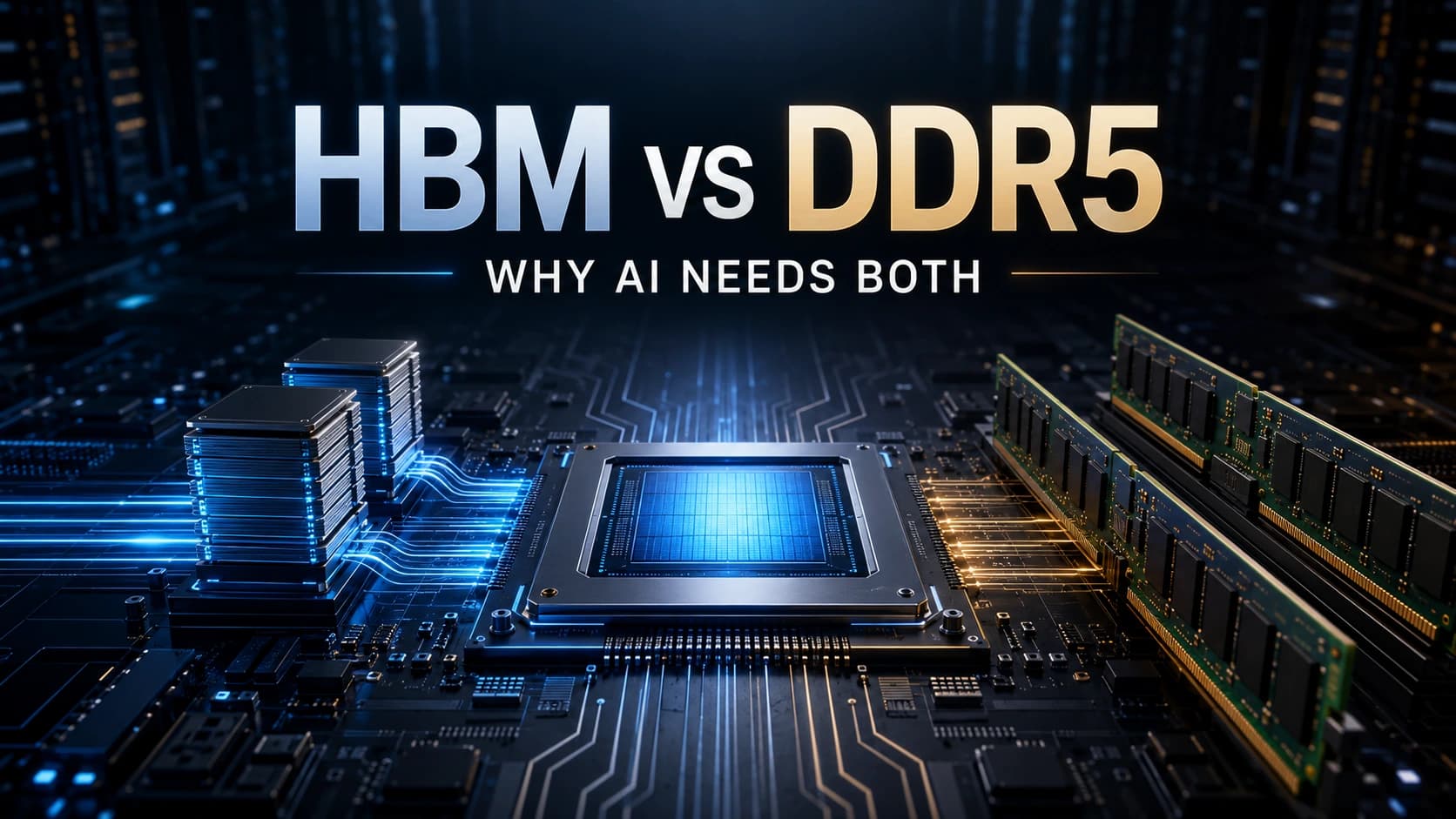
High-bandwidth memory, or HBM, and DDR5 are both forms of DRAM, but they solve different problems. HBM feeds data directly to GPUs and other AI accelerators at extreme speed, while DDR5 provides larger pools of system memory for CPUs and servers.
That difference explains why an HBM shortage does not necessarily mean every segment of the memory market is equally tight. It also explains why a company capable of producing DDR5 is not automatically ready to compete with SK Hynix, Samsung Electronics and Micron Technology in advanced AI memory for Nvidia and other accelerator customers.
Key Takeaways
- HBM and DDR5 are both volatile memory, but they are not interchangeable products.
- HBM sits close to GPUs and AI accelerators, using vertically stacked DRAM and an extremely wide interface to maximize bandwidth.
- DDR5 is conventional system memory used by server CPUs, PCs and other computing devices.
- HBM is harder to manufacture because it requires additional wafers, through-silicon vias, stacking, advanced packaging and customer qualification.
- Micron estimates that HBM3E consumes roughly three times as much wafer supply as DDR5 to produce the same number of bits.
- CXMT’s progress in DDR5 does not make it an immediate competitor to SK Hynix, Samsung and Micron in scaled HBM production.
What Is the Difference Between HBM and DDR5?
High-bandwidth memory is designed to move enormous amounts of data between memory and a processor. It is used primarily alongside GPUs and other high-performance accelerators.
DDR5 is the fifth generation of double data rate memory. It is the main system memory used by modern server CPUs and personal computers.
The simplest way to understand the difference is to think about their jobs. HBM is built to feed an accelerator as quickly as possible. DDR5 is built to give the broader system a large, flexible and relatively economical memory pool.
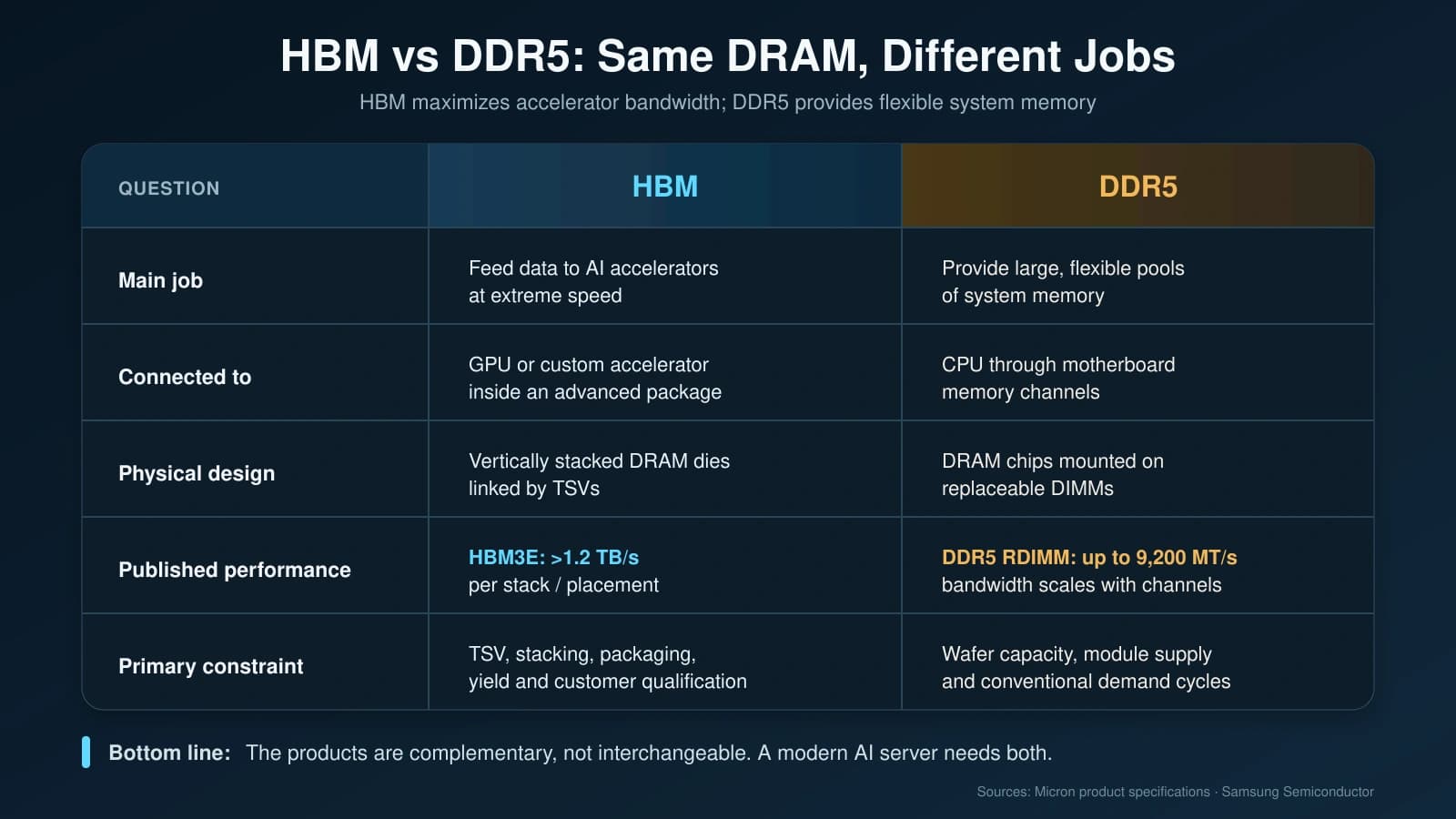
Both products originate from DRAM technology. Their architectures, manufacturing processes, economics and customer qualification requirements, however, are materially different.
What Is HBM?
HBM is a stack of multiple DRAM dies connected vertically using through-silicon vias, or TSVs. These microscopic electrical connections pass through the silicon, allowing data to move between the layers of the stack.
The completed HBM stack is placed beside a GPU or accelerator, usually on a silicon interposer or another advanced packaging platform. This short physical distance and very wide connection allow the processor to access substantially more data per second than it could through conventional system memory.
Samsung describes HBM as combining TSV-based stacking with a wide interface for AI and high-performance computing. Its advanced packaging platforms place the processor and HBM stacks together to create a short, high-bandwidth data path.
Modern HBM is measured in terabytes per second. Micron says one HBM3E stack can deliver more than 1.2 terabytes per second of bandwidth. Multiple stacks are then used around an accelerator.
For example, Nvidia’s H200 combines 141GB of HBM3E with 4.8TB per second of total memory bandwidth. Blackwell Ultra raises those figures to as much as 288GB and 8TB per second.
That bandwidth is essential because a powerful GPU creates little economic value if it spends much of its time waiting for data.
What Is DDR5?
DDR5 is conventional system memory used by CPUs in servers, workstations and PCs. Individual DRAM chips are normally mounted on a dual in-line memory module, or DIMM, which connects to the motherboard.
DDR5 improves speed, capacity and power efficiency over DDR4. Micron’s server-memory portfolio includes DDR5 registered DIMMs with speeds of up to 9,200 megatransfers per second and describes DDR5 as delivering as much as twice the bandwidth of DDR4-3200.
That is a major improvement for general-purpose computing, but DDR5 still uses a much narrower interface than HBM. A server can increase DDR5 performance by installing more memory channels and modules, although it cannot reproduce the same processor-adjacent bandwidth that HBM provides.
DDR5’s advantages are different: it is removable, standardized, widely supported and more economical for building large pools of system memory. A server may have hundreds of gigabytes—or even several terabytes—of DDR5 serving its CPUs.
Why Does AI Need HBM?
AI accelerators perform huge numbers of calculations in parallel. To keep their processing units occupied, they must continuously retrieve model weights, activations and other data from memory.
The limiting factor is therefore not always the accelerator’s theoretical computing power. It can be the speed at which data reaches that compute engine.
This is known as the memory-bandwidth bottleneck. If the processor completes calculations faster than memory can supply the next data set, expensive computing capacity sits underutilized.
HBM addresses that problem with a wide interface, short data path and stacked architecture. Higher HBM capacity also allows larger models, longer contexts and larger inference batches to remain close to the accelerator rather than being moved repeatedly to slower levels of storage.
Nvidia says the H200’s larger and faster HBM3E accelerates generative AI and large language models. Its subsequent Blackwell Ultra architecture increased HBM capacity by 3.6 times and bandwidth by 2.4 times compared with the H100. Those changes demonstrate that new AI accelerators are scaling memory alongside raw computing performance.
Does AI Still Need DDR5?
HBM does not replace system memory. AI servers still require DDR5 for their CPUs, operating systems, data preparation, orchestration and applications that do not run entirely on the GPU.
Before information reaches an accelerator, CPUs may need to retrieve it from storage, transform it, organize it and move it through the system. DDR5 supports those processes.
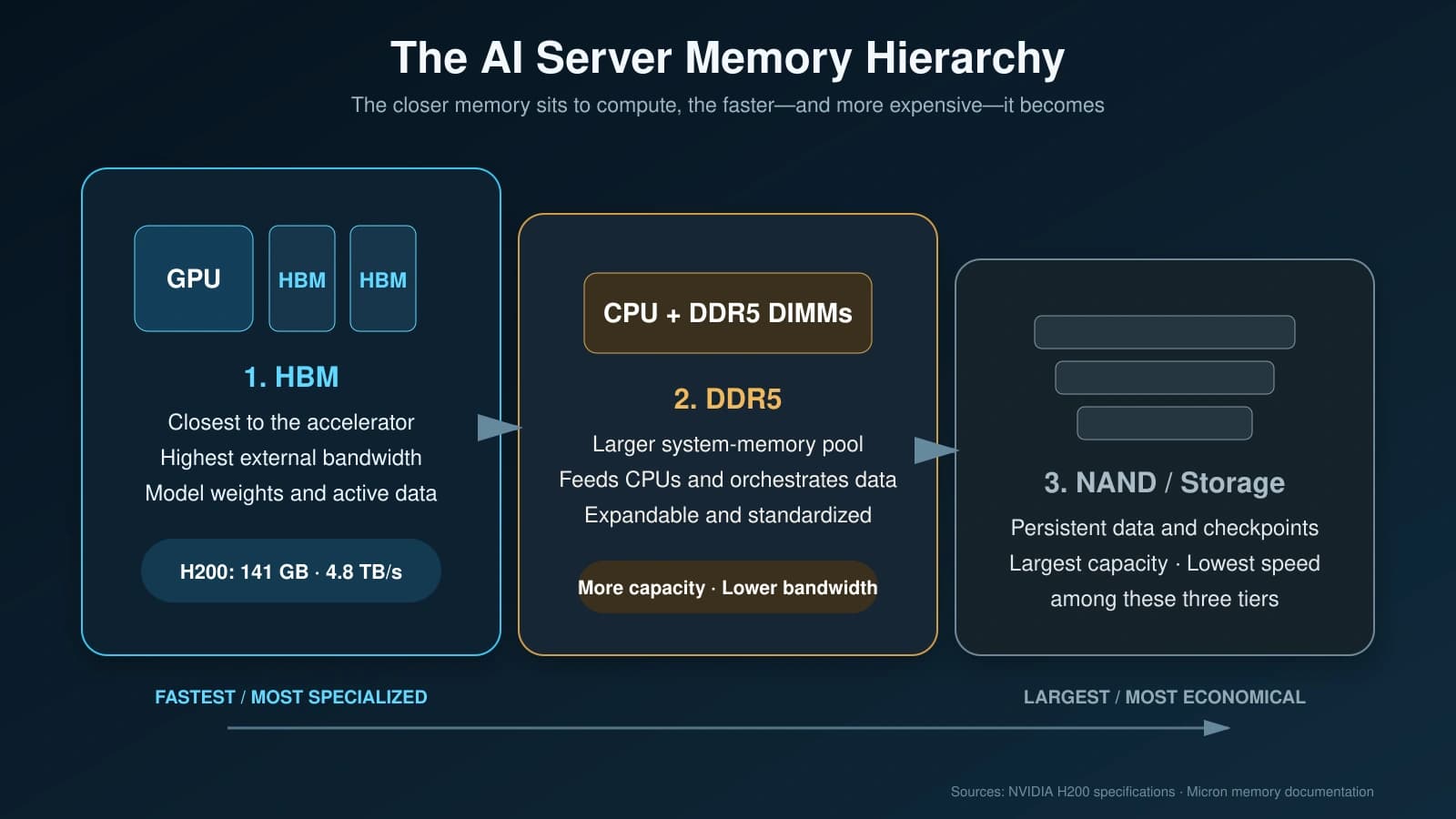
A typical AI server therefore contains a memory hierarchy:
- HBM sits closest to the GPU and provides the highest external-memory bandwidth.
- DDR5 supplies the CPUs and holds a larger pool of active system data.
- NAND flash and other storage technologies provide much greater capacity at slower speeds.
- Networking connects memory and compute resources across servers and racks.
The balance varies by workload. Training large models places exceptional pressure on accelerator bandwidth. Inference can also become limited by HBM capacity and bandwidth, particularly as context lengths, reasoning workloads and concurrent user requests increase.
CPU memory remains necessary in both cases.
Why Is HBM More Difficult to Manufacture?
Producing HBM requires more than manufacturing a faster DRAM chip. Several good memory dies must be stacked, connected, bonded, tested and combined with a base die and advanced package.
Every additional step can affect yield. If one important component in the completed stack fails, the value of the other components may also be lost.
HBM manufacturing includes several constraints:
- Advanced DRAM wafer capacity
- TSV formation through the memory dies
- Die thinning and stacking
- Bonding or molding technology
- Thermal management
- Assembly and testing capacity
- Silicon interposers and other packaging components
- Qualification with GPU and accelerator customers
SK Hynix attributes part of its HBM position to its MR-MUF packaging process, which was designed to support stable mass production, manufacturing yield and heat dissipation.
This complexity also explains why a new DRAM producer cannot become a competitive HBM supplier simply by announcing a product. It must demonstrate performance, power efficiency, thermal reliability, packaging yield and consistent high-volume output. The same capacity, qualification and packaging constraints shape the broader AI semiconductor supply-bottleneck cycle.
Why Does HBM Use More Wafer Capacity Than DDR5?
HBM delivers fewer saleable bits from a given amount of wafer capacity because it requires more silicon and additional manufacturing steps.
In its fiscal Q2 2024 presentation, Micron estimated that HBM3E consumes approximately three times as much wafer supply as DDR5 to produce the same number of memory bits on the same process node. The company expects the trade ratio to become even higher with HBM4.
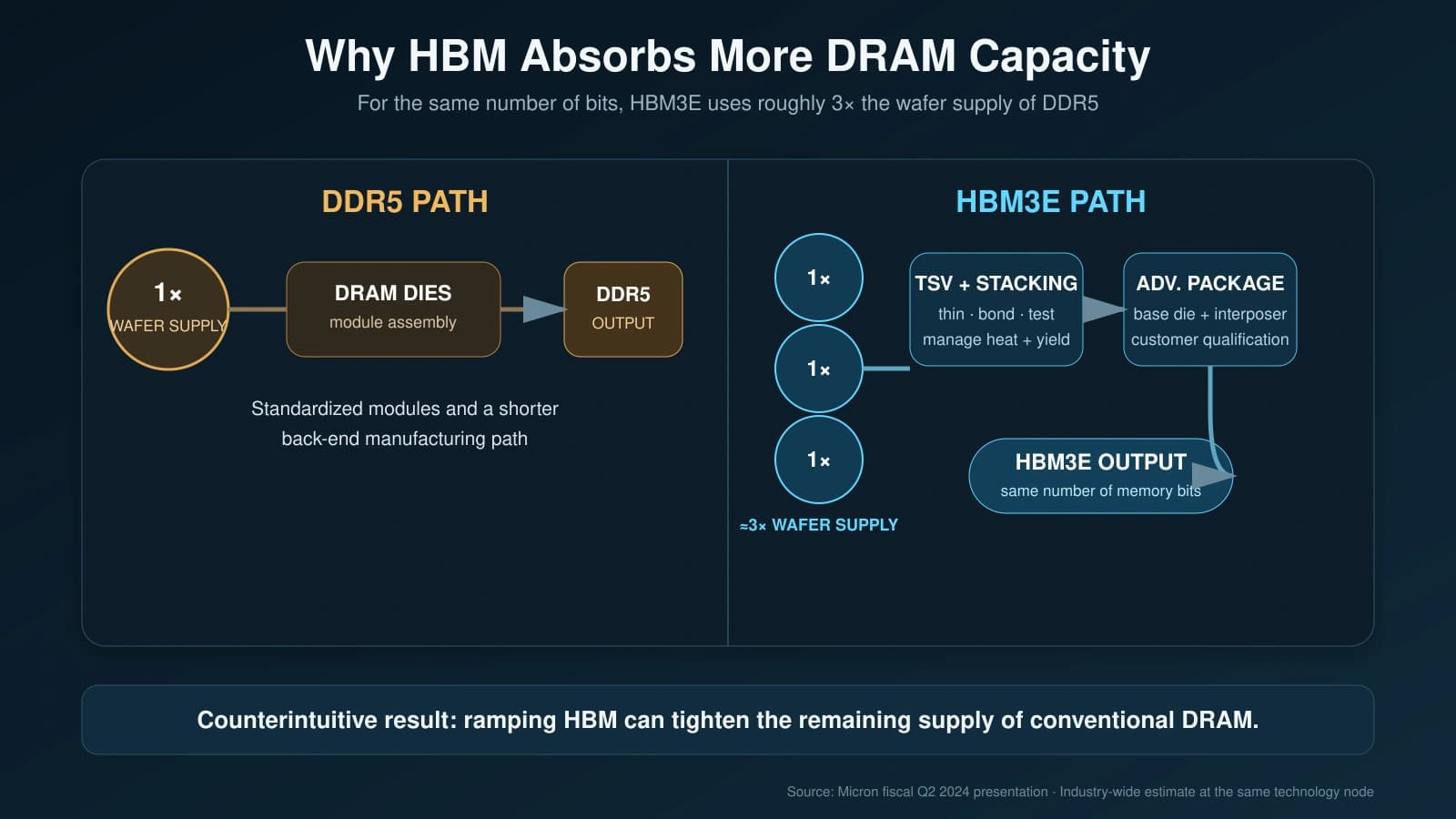
This has an important—and initially counterintuitive—effect on the broader DRAM market. When Samsung, SK Hynix or Micron redirects production toward HBM, the company may reduce the amount of conventional DRAM it can produce from the same wafer base.
As a result, strong HBM demand can tighten DDR5 supply even when DDR5 demand itself is not accelerating at the same rate.
But the relationship is not automatic. Memory companies can add cleanroom space, improve process yields or change their product mix. Meanwhile, weak demand from PCs, smartphones or conventional servers can still pressure some types of DRAM.
Investors should therefore analyze HBM and conventional DRAM separately while also tracking how they compete for the same manufacturing resources.
Why Is HBM More Expensive Than DDR5?
HBM commands higher prices because it offers much greater bandwidth and requires more expensive manufacturing, packaging and qualification.
Its economic value is also connected to the accelerator beside it. If additional HBM allows a costly GPU to process more tokens, support larger models or serve more users, customers may accept a much higher memory price.
DDR5 operates in a more standardized market. Buyers can often qualify similar modules from several suppliers, and the product is easier to replace or expand. That makes conventional DRAM more exposed to commodity pricing cycles.
HBM is not immune to competition, but orders are negotiated around specific products, accelerator platforms and delivery schedules. Customer qualification takes longer, and usable supply depends on both front-end wafer production and back-end packaging capacity.
These differences can produce higher margins and better revenue visibility for successful HBM suppliers.
Who Makes HBM and DDR5?
Samsung Electronics, SK Hynix and Micron Technology manufacture both HBM and DDR5. However, their competitive positions are not identical across the two markets.
SK Hynix established an early lead in advanced HBM and became a major supplier for AI accelerators. Samsung has enormous DRAM scale and is investing aggressively in HBM technology and advanced packaging. Micron has expanded from HBM3E into volume shipments of HBM4 designed for Nvidia’s Vera Rubin platform.
Other companies may compete in conventional DDR before they become credible HBM suppliers.
CXMT, for example, has entered mass production of DDR5 and LPDDR5X. That progress makes it increasingly relevant to the conventional DRAM market, particularly in China. But it has not disclosed commercial HBM production comparable in scale with the three established suppliers.
This is why CXMT capacity can pressure DDR or LPDDR expectations without creating an immediate surplus of AI-grade HBM.
Can DDR5 Replace HBM?
DDR5 cannot efficiently replace HBM in leading AI accelerators. Its narrower interface and greater physical distance from the processor cannot supply the same bandwidth.
HBM also cannot replace DDR5 across the entire server. Its cost, packaging requirements and fixed integration with accelerators make it unsuitable as a general substitute for expandable system memory.
The products are complementary. HBM optimizes bandwidth close to the accelerator, while DDR5 provides broader system capacity and flexibility.
New memory technologies and architectures may change the boundaries over time. Low-power memory, custom accelerator memory and coherent connections between processors can alter how systems allocate data. But the fundamental hierarchy—fast, expensive memory close to compute and larger, cheaper memory farther away—is likely to remain.
What Does HBM vs DDR5 Mean for Memory Investors?
The most important conclusion is that “DRAM” is no longer a sufficiently precise investment category.
A company’s product mix matters. Exposure to HBM can produce different growth, pricing and margin outcomes from exposure to PC or mobile DRAM. Packaging capacity and customer qualification can matter as much as total wafer capacity.
Investors should track five variables:
- HBM capacity committed to specific accelerator customers
- The conversion of wafer output from DDR5 to HBM
- Advanced packaging and testing capacity
- Conventional DRAM demand from servers, PCs and smartphones
- New suppliers entering DDR before they can compete in HBM
This distinction also helps explain why apparently conflicting conditions can exist simultaneously. HBM may remain scarce because of AI demand and manufacturing complexity, while parts of the conventional DRAM market face weaker demand or growing Chinese capacity. The SK Hynix and Micron memory-cycle analysis examines how those product-mix and capacity decisions could affect pricing power later in the decade.
Conversely, rapid HBM production can absorb enough wafers to support DDR5 pricing even when conventional demand is only moderate.
The Bottom Line
HBM and DDR5 are built from the same basic class of memory, but they are different products with different customers, supply constraints and economics.
HBM is stacked beside an accelerator to deliver extreme bandwidth. DDR5 sits in server and PC memory modules to provide large, flexible pools of system memory. AI infrastructure needs both, but HBM is currently the more specialized and manufacturing-intensive product.
That is why rising DDR5 capacity does not automatically end an HBM shortage—and why a company that can produce DDR5 is not necessarily ready to challenge the leaders in AI memory.
For investors, the right question is no longer simply whether DRAM supply is rising. It is which kind of DRAM is being added, where it will be used and how quickly it can pass customer qualification.
Frequently Asked Questions
Is HBM faster than DDR5?
Yes. HBM provides much greater bandwidth because it uses stacked DRAM dies, a very wide interface and advanced packaging that places it close to the processor. DDR5 provides lower bandwidth but offers greater flexibility and lower cost for system memory.
Is HBM a type of DRAM?
Yes. HBM is built from DRAM dies. Its distinguishing features are its stacked architecture, wide interface and integration with GPUs or other accelerators.
Does AI use DDR5?
Yes. AI servers use DDR5 as system memory for CPUs, operating systems, data preparation and other workloads. HBM primarily supplies GPUs and AI accelerators.
Can HBM replace DDR5?
Not economically across the whole server. HBM is optimized for accelerator bandwidth, while DDR5 is designed for expandable system memory. Modern AI systems generally require both.
Why is HBM so expensive?
HBM requires additional wafers, TSV connections, die stacking, advanced packaging, thermal management and extensive customer qualification. It also delivers high economic value by improving the utilization of expensive AI accelerators.
Which companies manufacture HBM?
The principal scaled HBM suppliers are SK Hynix, Samsung Electronics and Micron Technology.
Does CXMT manufacture HBM?
CXMT is developing advanced DRAM technology, but it has not disclosed commercial HBM production comparable in scale with SK Hynix, Samsung or Micron. Its current competitive position is stronger in DDR and LPDDR.
Does more HBM production reduce DDR5 supply?
It can. Micron estimates that HBM3E consumes approximately three times the wafer supply required to produce the same number of DDR5 bits. Shifting production toward HBM can therefore constrain conventional DRAM output.
Sources
| No. | Source | Publisher | Date | Type | What it supports |
|---|---|---|---|---|---|
| 1 | HBM3E high-bandwidth memory | Micron Technology | Current | Company information | HBM3E stack bandwidth and product characteristics. |
| 2 | DDR5 SDRAM | Micron Technology | Current | Company information | DDR5 performance, system-memory role and product specifications. |
| 3 | NVIDIA H200 Tensor Core GPU | Nvidia | Current | Company information | H200 HBM3E capacity and memory-bandwidth specifications. |
| 4 | Inside NVIDIA Blackwell Ultra | Nvidia | Current | Company information | Blackwell Ultra HBM capacity and bandwidth comparisons. |
| 5 | High Bandwidth Memory | Samsung Electronics | Current | Company information | HBM architecture, TSV stacking and AI-computing role. |
| 6 | Advanced heterogeneous integration | Samsung Electronics | Current | Company information | Advanced packaging and processor-to-HBM integration. |
| 7 | SK Hynix packaging executive wins the Dawon Kahng Award | SK Hynix | Current | Company information | MR-MUF packaging, manufacturing yield and thermal-management discussion. |
| 8 | Fiscal Q2 2024 earnings presentation | Micron Technology | March 2024 | Company IR | Micron’s approximately three-to-one HBM3E-to-DDR5 wafer trade ratio. |
| 9 | Micron begins high-volume production of HBM4 designed for Nvidia Vera Rubin | Micron Technology | 2026 | Company IR | Micron HBM4 volume-production status and Nvidia Vera Rubin participation. |
Primary company materials support the product specifications, architecture, packaging, manufacturing and wafer-capacity details in this guide.
Related Reading

CXMT Was the Headline. Korea’s Deleveraging Drove the Selloff
Why semiconductor stocks fell after strong earnings: CXMT changed the memory supply narrative, while Korea’s leveraged unwind amplified the selloff.
Invest better with thoughtful research.
Join readers who receive our best ideas and insights straight to their inbox.
Disclosure
This article is for research and education only. It is not investment advice.
Comments