When NVIDIA CEO Jensen Huang used his first post on X to support the “Open Weights and American AI Leadership” letter, the important signal was not that NVIDIA wanted to enter model competition. It was that the largest supplier of AI computing infrastructure sees open-weight AI models as a way to expand the market built on top of its hardware and software.
The AI race has largely been framed as a contest over model capability: which company can train the most intelligent system, hold the benchmark lead and charge a premium for access. That framing remains relevant, but it is incomplete. As capable models become more widely available, the AI business model may increasingly depend on who controls the scarce infrastructure, proprietary data, distribution and applications surrounding those models.
The investment question is therefore not whether open models will defeat closed models. Both can coexist and serve different customers. The more useful question is where economic value accumulates if access to competent AI becomes less scarce while the resources required to deploy it remain constrained.
Key Takeaways
- Jensen Huang’s support for open-weight AI reflects NVIDIA’s infrastructure strategy rather than a shift into model competition.
- OpenAI, Meta, Microsoft, and cloud providers support different versions of open AI because their business incentives differ.
- If model capabilities become more standardized, AI value may move toward computing infrastructure, proprietary data, and applications.
- Investors should focus on which AI bottlenecks remain scarce as models become more accessible.
Why NVIDIA’s Open Model Strategy Is About Expanding the AI Computing Market
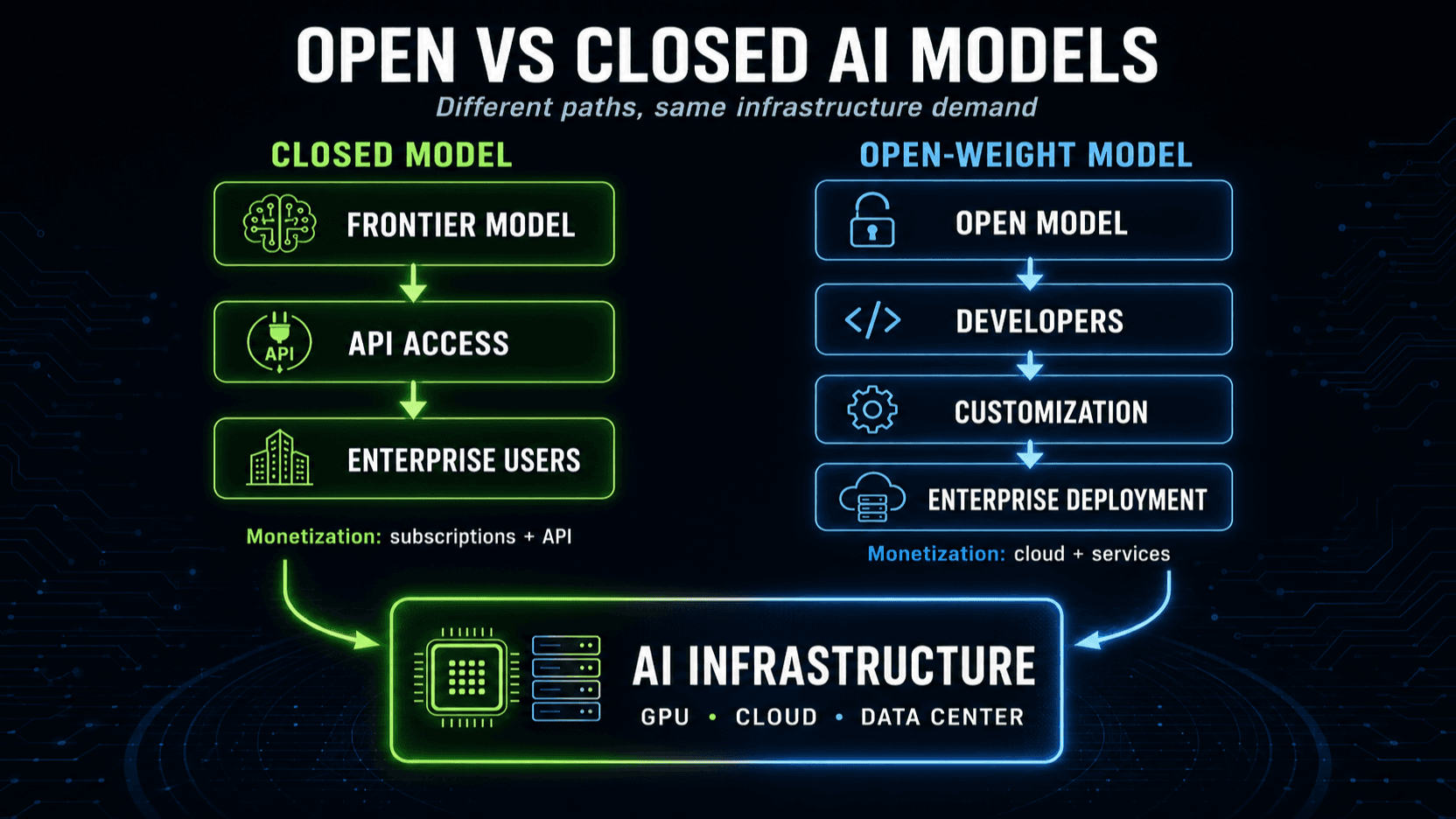
NVIDIA does not primarily monetize intelligence through a consumer subscription or a model API. It sells the computing platform required to train, customize and operate AI systems: accelerators, networking, complete systems and a software ecosystem centered on CUDA. The company’s financial reports make the result visible in its data-center business, while its product strategy increasingly spans the full AI factory rather than a single GPU.
That distinction explains why NVIDIA open AI models are strategically attractive. A market dominated by a few closed providers can still consume enormous amounts of NVIDIA infrastructure, but much of the training and inference activity remains concentrated inside a small number of hyperscalers and frontier labs. An open-weight ecosystem can distribute deployment across enterprises, regional clouds, sovereign AI programs and on-premises data centers.
Every organization that downloads a model does not automatically buy an NVIDIA system. Some deployments will use competing accelerators, CPUs or custom silicon, and efficient smaller models can reduce compute per task. Yet broader access can still increase total demand if lower model costs unlock enough new workloads, users and industry-specific deployments.
This is the core of the strategy. NVIDIA does not need every model to be proprietary or every model developer to earn exceptional margins. It benefits when more organizations build AI systems and when the industry’s bottlenecks shift toward compute, memory, networking, power and packaging.
NVIDIA’s Open AI Ecosystem Strategy
The Nemotron Coalition makes this infrastructure logic more explicit. NVIDIA describes the coalition as a collaboration among model builders and AI labs that will combine research, data and compute to advance open frontier models. The first coalition model is intended to underpin the Nemotron 4 family and is being trained on NVIDIA DGX Cloud.
The strategic objective is larger than one model family. NVIDIA wants developers to build and specialize models using a stack that includes its compute, networking, libraries, inference software and enterprise deployment tools. If open models increase choice, NVIDIA can remain the common infrastructure layer beneath competing ecosystems.
This position resembles earlier platform strategies, but the analogy should not be taken too literally. Linux expanded the cloud market without making servers free, and standardized PC software helped grow demand for processors. In AI, open weights could similarly lower the cost of experimentation while preserving scarcity in the physical systems needed to run production workloads.
The opportunity also reaches beyond accelerators. Larger inference fleets require high-bandwidth memory, storage and fast interconnects, which is why HBM economics and optical networking timelines matter to the open-model thesis. More accessible intelligence can expand demand for the hardware that moves and feeds data, even if the model layer becomes more competitive.
OpenAI’s Open Models Support a Two-Tier Business Model
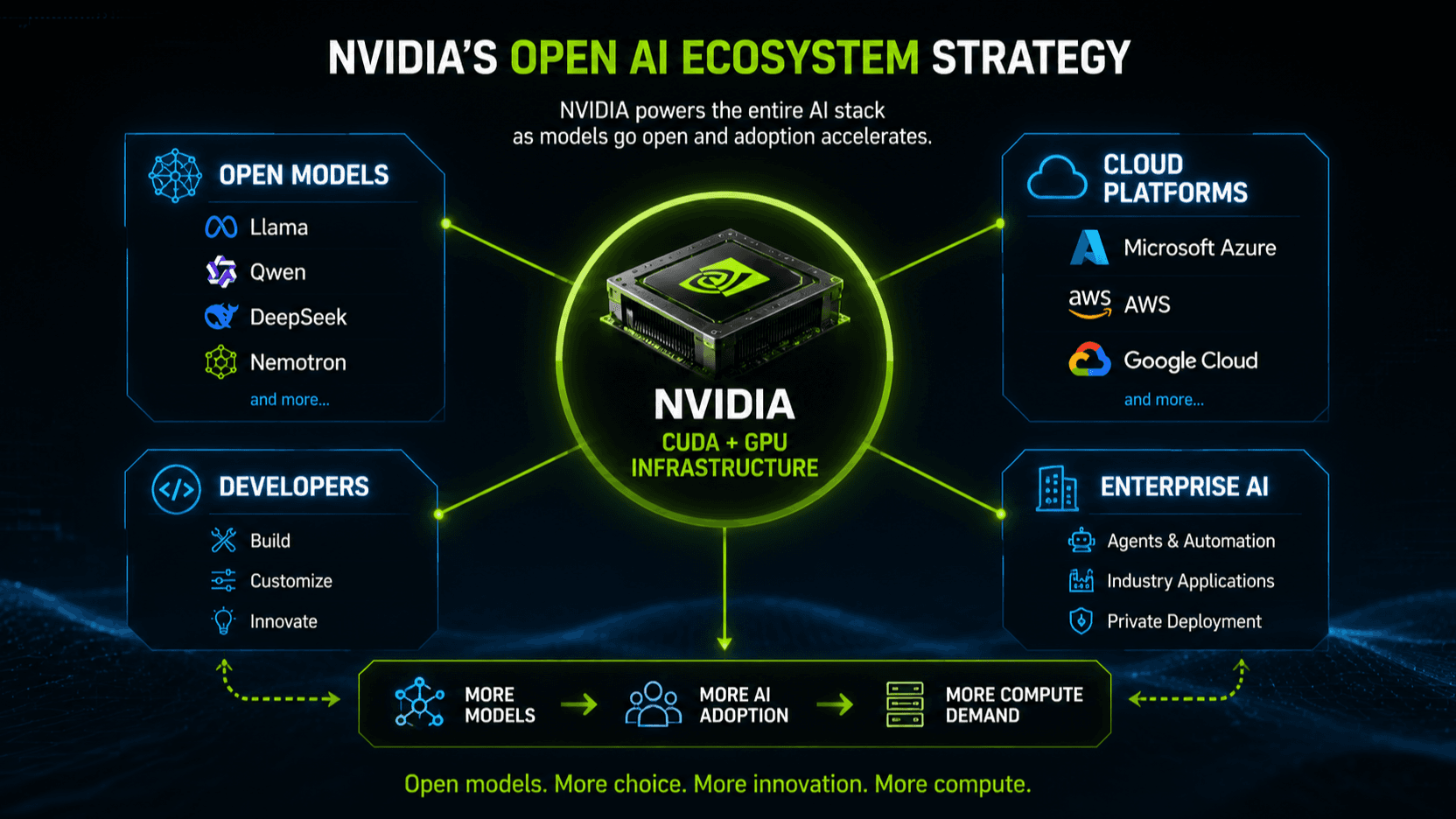
OpenAI has different incentives because model access is itself a major product. ChatGPT subscriptions and hosted APIs monetize performance, reliability and convenience, while the company’s gpt-oss models give developers an open-weight option that can run on infrastructure they control. OpenAI explicitly positions gpt-oss as complementary to its hosted models, not as a replacement for them.
That supports a two-tier AI business model. Frontier hosted systems can serve customers willing to pay for leading capability and a managed service. OpenAI open models can reach organizations that prioritize local deployment, customization, data residency or integration with their own infrastructure.
The strategic risk is price compression. If open-weight AI models become good enough for a rising share of enterprise tasks, customers may reserve premium APIs for the hardest workloads and route routine work to cheaper systems. The counterargument is that frontier capability, safety operations, uptime and integrated tools can remain scarce enough to justify premium pricing.
OpenAI therefore does not need to choose between open and closed. It needs to segment the market without allowing the open tier to erase the economic value of its premium tier.
Meta Llama and the Logic of Ecosystem Expansion
Meta’s incentive structure is different again. The company’s core economics are driven by advertising and engagement rather than model licensing, so Meta Llama can create value by attracting developers, establishing technical conventions and accelerating AI adoption across products and applications.
The comparison between Llama and closed models is therefore not only about benchmark performance. It is about what each provider wants to monetize. A closed-model company may seek direct subscription and API revenue, while Meta can benefit if a large Llama ecosystem improves its strategic influence, recruiting position and ability to shape the tools developers use.
Openness can also reduce dependence on a rival platform. If one closed model provider controlled the dominant interface for AI applications, other technology companies could face the same distribution risk that operating systems and app stores created in earlier cycles. Supporting open weights is one way to keep the model layer plural.
Why Microsoft Azure, Amazon Bedrock and Google Cloud Prefer Model Choice
Microsoft has invested deeply in OpenAI, but Microsoft Azure also offers models from multiple providers through Foundry. Its catalog includes OpenAI systems as well as model families from Meta, DeepSeek and others. This is not a contradiction; it reflects the economics of a cloud platform.
Azure can earn infrastructure and platform revenue regardless of which model a customer selects. Amazon Bedrock follows a similar multi-provider approach, allowing enterprises to compare and deploy foundation models while Amazon Web Services monetizes compute, storage, security, orchestration and managed operations. The provider does not need one model to win if it becomes the environment where many models run.
Google Cloud has comparable incentives through Vertex AI Model Garden, even though Google also develops proprietary Gemini models and open-weight Gemma models. Each cloud wants differentiated first-party intelligence, but each also benefits from customer choice because model competition can increase overall usage of the cloud control plane.
This is why support for open AI does not have one meaning. For Microsoft, Amazon and Google Cloud, openness can expand infrastructure consumption and reduce the risk that model value bypasses the cloud layer. Their ideal outcome is not necessarily a fully commoditized model market; it is a broad, active market in which deployment, governance and data services remain valuable.
Alibaba Qwen and DeepSeek Show the Global Adoption Strategy
Alibaba Qwen and DeepSeek illustrate how open weights can accelerate adoption beyond the U.S. frontier labs. Qwen documentation spans multiple open-weight model sizes and modalities, giving developers options for customization and deployment. Alibaba can benefit not only from the model itself but also from cloud consumption, enterprise integration and industry solutions built around the Qwen ecosystem.
DeepSeek has used open releases to gain global developer attention and lower barriers to experimentation. Its strategy shows why a challenger may value distribution and ecosystem share more than immediate control over every inference request. Open access can make a model a default building block faster than a closed API alone.
This does not mean Chinese providers are uniformly open or that geopolitics can be ignored. Cloud access, export controls, data rules and enterprise security requirements can all shape where models are deployed. The narrower economic point is that companies without the dominant closed platform have a stronger incentive to use openness as a distribution strategy.
The Biggest Investment Question: Will AI Models Become Commoditized?
Commoditization does not mean every model becomes identical or worthless. It means customers perceive less economic difference among models for a growing set of tasks, making it harder for providers to charge a large premium based on capability alone. The relevant threshold is “good enough” performance inside a real workflow, not parity on every benchmark.
Several forces could push in that direction. Open releases allow developers to fine-tune and specialize models, distillation can transfer capabilities into smaller systems, and cloud catalogs make model switching easier. Enterprises can also use routing layers that send each task to a different model based on cost, latency, privacy or quality.
However, model commoditization is not inevitable. The frontier may continue advancing fast enough to preserve meaningful performance gaps. Reliability, multimodal reasoning, agentic tool use, security and distribution can produce durable differentiation even when base model intelligence becomes widely available.
The investment conclusion should therefore be conditional. If capabilities standardize faster than demand expands, model pricing and margins may compress. If lower prices unlock much larger usage, the total AI market can grow even as value migrates away from the model layer.
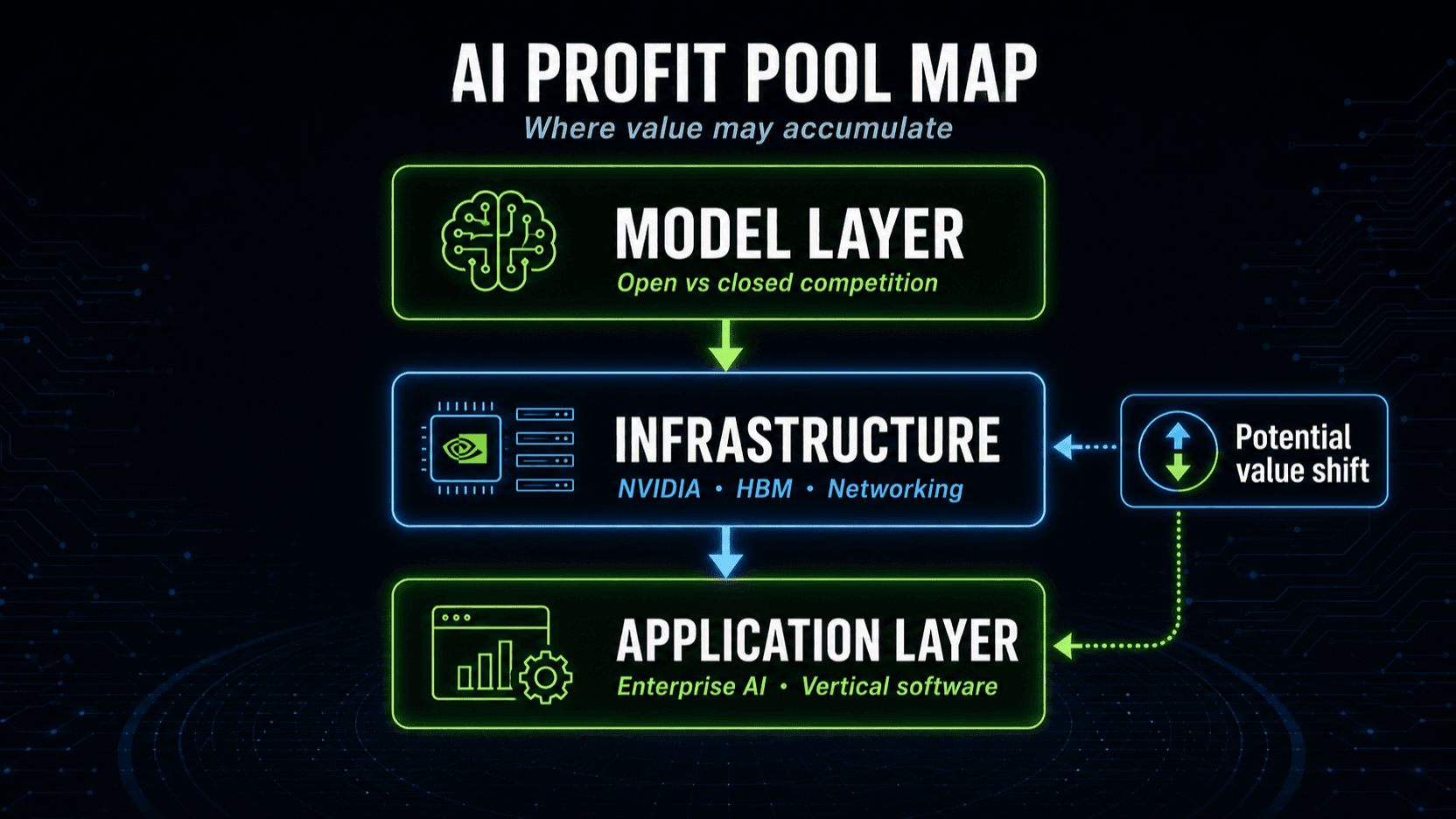
Where AI Value Could Move Beyond Models
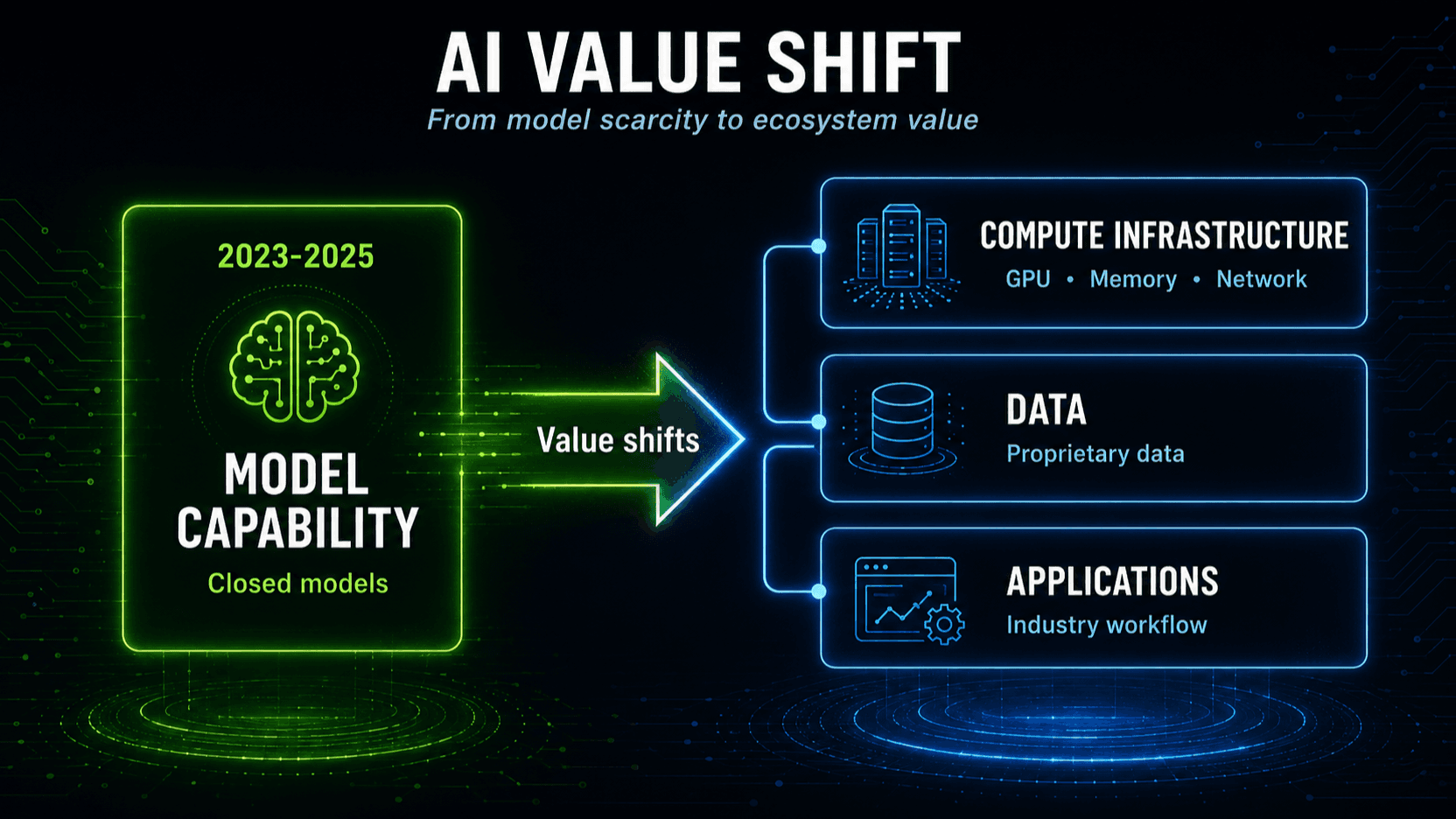
The first destination is computing infrastructure. Training and inference still require accelerators, HBM, networking, storage, power and cooling. The exact winners can change as architectures evolve, but the physical system remains necessary. Investors should use the AI Bottleneck Tracker to distinguish layers with temporary shortages from constraints that can support durable pricing power.
The second destination is proprietary data. When multiple models can perform a task, the differentiator may become the exclusive information used to ground, train or evaluate the system. Financial histories, industrial telemetry, customer relationships and domain-specific feedback can be harder to reproduce than a generic model interface.
The third destination is applications and workflows. Customers ultimately pay for better decisions, lower costs, faster production and reduced risk. Software that is deeply integrated into an industry process can capture value even when it uses interchangeable models underneath, especially if it owns distribution, trust and workflow data.
This value shift would not bypass hardware innovation. It would increase the importance of future AI system bottlenecks, including the data-movement problem described in NVIDIA’s next bottleneck. The scarce layer may move over time, which is why AI infrastructure investment requires continuous supply-chain analysis rather than a static bet on GPUs alone.
What Investors Should Watch
Investors should first watch the share of production workloads that enterprises are willing to route to open models. Downloads and developer attention matter, but sustained inference, renewal behavior and enterprise deployment provide better evidence that model accessibility is changing real spending.
They should also track whether inference efficiency reduces total infrastructure demand or triggers enough new usage to offset the savings. Falling cost per query can pressure hardware intensity at the workload level while expanding the number of workloads at the market level. NVIDIA’s thesis depends on the second effect remaining powerful.
Finally, investors should identify where switching costs are actually forming. A model API can be replaceable while the surrounding data pipelines, security controls, developer tools and operational workflows remain sticky. The companies that own those scarce complements may capture more durable economics than the company that briefly holds the highest benchmark score.
Conclusion: NVIDIA Is Betting on the Market Around the Model
Jensen Huang’s support for open-weight AI does not imply that model capability is becoming irrelevant. It reflects NVIDIA’s position in the value chain. The company can benefit when closed frontier systems require massive clusters and when open models spread into enterprise, sovereign and on-premises deployments.
The strongest version of the thesis is not that open models destroy closed models. It is that a plural model ecosystem expands adoption while moving bargaining power toward whatever remains scarce. That could be compute infrastructure today, proprietary data in one industry and embedded application workflows in another.
For investors, the central question is no longer simply which company has the best model. It is which bottleneck remains difficult to replace after capable intelligence becomes broadly accessible. NVIDIA is betting that the answer will continue to include the infrastructure beneath the entire AI ecosystem.
Sources
- Open Weights Ledger — Open Weights and American AI Leadership — July 24, 2026
- NVIDIA — NVIDIA Launches Nemotron Coalition of Leading Global AI Labs to Advance Open Frontier Models — March 16, 2026
- NVIDIA Investor Relations — NVIDIA Fiscal 2026 Form 10-K — February 25, 2026
- OpenAI — Introducing gpt-oss — August 5, 2025
- Meta — Llama Documentation — Current documentation
- Microsoft Learn — Foundry Models sold by Azure — Current documentation
- Amazon Web Services — Model availability and compatibility in Amazon Bedrock — Current documentation
- Alibaba Qwen — Qwen Documentation — Current documentation
The company and platform documents below support the factual descriptions. The conclusions about commoditization and value migration are VIUS Investing analysis, not company guidance.
Related Reading
NVIDIA’s Next Bottleneck Isn’t GPUs. It’s Data Movement.
Why AI factories are moving from copper to optical connectivity — and which suppliers deserve deeper research

AI Semiconductors Are No Longer Just About Compute. They Are About System Bottlenecks.
AI semiconductors are no longer just about raw compute. The real question is which system bottlenecks customers must solve next.

Micron Is Trying to Escape the Memory Cycle. The Real Test Begins After 2027.
Micron’s AI memory boom is no longer just about one strong quarter. The real question is whether Strategic Customer Agreements, HBM demand, and record capex can turn a memory cycle into a more predictable AI infrastructure business.
HBM vs DDR5: What’s the Difference—and Why AI Needs Both
HBM supplies extreme bandwidth to AI accelerators, while DDR5 provides larger pools of system memory. Understanding the difference is essential for analyzing AI infrastructure and memory stocks.

CPO Isn’t Dead. The Timeline Is.
After the CPO Selloff: The Real Story Is Not the Death of Optical Stocks, but a Repricing of AI Infrastructure’s Transition Layer

AXTI: The AI Optical Bottleneck Is Real. But Can AXT Capture the Value?
Public research has accelerated the discovery of AXT’s strategic position in indium phosphide. The investment outcome now depends on whether operating economics can catch up with expectations already embedded in the stock.
Invest better with thoughtful research.
Join readers who receive our best ideas and insights straight to their inbox.
Disclosure
This article is for research and education only. It is not investment advice.
Comments