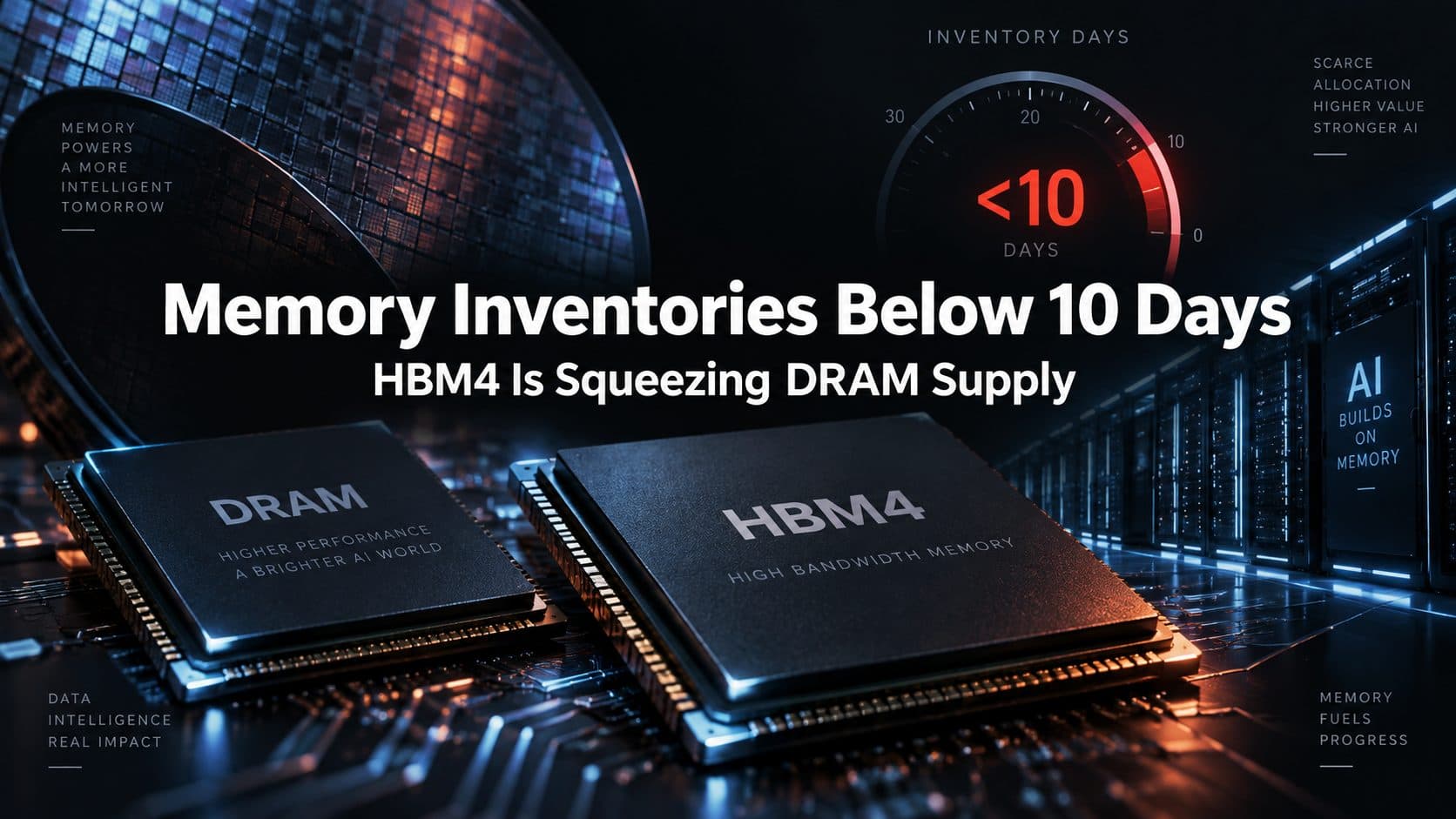
Samsung Electronics and SK hynix memory inventories have fallen below 10 days of supply, according to a September 2026 estimate from KB Securities. The figure is not a company-reported accounting inventory metric, but it points to an unusually thin sellable supply buffer across two of the world's largest memory manufacturers.
The more important signal is what comes next. HBM4 is consuming a growing share of advanced DRAM wafer capacity, server DDR5 is competing for the same capacity, and more future memory supply is being allocated through long-term customer agreements before it reaches the open market. For how HBM and conventional DDR5 differ mechanically, see HBM vs DDR5: What's the Difference—and Why AI Needs Both.
For Micron, SK hynix and Samsung, the next memory-cycle signal is therefore no longer just HBM demand. It is the amount of uncommitted DRAM bit supply still available to customers. The broader HBM demand backdrop is examined in Is HBM Demand Really This Strong? Testing the AI Memory Boom Against Orders, Utilization, and 2027 Supply.
Sandisk is different because NAND does not share HBM's DRAM wafer constraint. But the commercial shift is similar: a growing share of future NAND bits is also being committed through multi-year agreements.
The five variables worth tracking now are supplier inventory, capacity allocation, contract pricing, bit supply and customer inventory. Together, they tell us considerably more about the next phase of the memory cycle than another HBM demand forecast.
Key Memory Supply Signals
| Signal | Latest Evidence | Why It Matters |
|---|---|---|
| Samsung / SK hynix inventory | Below 10 days of supply by KB Securities estimate | The supplier-side buffer has become extremely thin |
| HBM share of DRAM wafer input | ~22% in 2026 → ~30% in 2027 | Less advanced capacity remains available for conventional DRAM |
| HBM share of DRAM bit supply | ~9% in 2026 → ~13% in 2027 | HBM consumes disproportionate wafer capacity per delivered bit |
| Mobile DRAM customer inventory | ~12–14 weeks | Some downstream customers are already well stocked |
| Sandisk contracted NAND supply | ~50% of FY27 bits / ~two-thirds of FY28 bits | More NAND supply is being allocated before production |
| CXMT global DRAM revenue share | 9.5% in 2Q26 vs. 7.6% in 1Q26 | Alternative conventional DRAM supply is becoming more relevant |
Why Are Memory Inventories Falling Below 10 Days?
Inventory is the memory industry's first shock absorber.
When demand accelerates while suppliers still hold substantial finished inventory, customers can be supplied without an immediate change in wafer allocation. Once that buffer becomes extremely thin, however, incremental demand increasingly has to be satisfied by future production.
KB Securities estimates that Samsung and SK hynix memory inventories fell below 10 days during the third quarter. Separately, TrendForce reported on September 7 that DRAM supplier inventories remained at historic lows, while additional supply was being allocated mainly toward server applications.
That distinction matters. The KB figure should not be compared directly with Micron's reported accounting inventory days because they measure different things. The useful signal is not the absolute comparison between companies, but the evidence that immediately sellable supplier inventory has become unusually scarce.
The market is therefore moving beyond a simple inventory drawdown.
The relevant question is increasingly not how many bits the industry will produce, but how many of those bits remain available to a customer that has not already secured an allocation.
How Is HBM4 Squeezing Conventional DRAM Supply?
HBM4 affects conventional DRAM because both compete for advanced DRAM manufacturing capacity.
The common explanation has been that manufacturers simply prefer HBM because HBM generates higher margins. That explanation is now incomplete.
TrendForce has found that strong conventional DRAM pricing pushed the wafer economics of DDR5 64GB RDIMMs to levels competitive with HBM during 2026. In other words, server DDR5 itself has become extremely valuable.
Memory manufacturers therefore face an increasingly expensive capacity trade-off. They need HBM4 production to satisfy AI accelerator programs and strategic customers, while high-capacity server DDR5 is simultaneously generating attractive economics from the same constrained manufacturing base.
The physical mismatch is visible in the industry's wafer allocation.
TrendForce estimates that HBM will account for approximately 22% of total DRAM wafer input in 2026, rising toward 30% in 2027. Yet HBM is expected to represent only around 9% of total DRAM bit supply in 2026 and 13% in 2027.
That gap is one of the most important numbers in the current memory cycle.
If nearly 30% of DRAM wafer input eventually produces only around 13% of industry bits, higher HBM penetration mechanically limits how quickly conventional DRAM bit supply can expand.
More wafer starts therefore do not translate one-for-one into more DDR5 available to other customers.
HBM4 intensifies that effect further. KB Securities estimates that HBM4 requires roughly three times the wafer capacity of conventional DRAM. As HBM4 production ramps, the opportunity cost of allocating another wafer toward AI memory rises.
Samsung is already describing this constraint in operational terms. In its second-quarter results, the company said its memory business was responding to AI demand despite limited capacity, with a primary focus on server products. Samsung also expanded HBM4 sales and expects server DRAM, enterprise SSD and HBM demand to keep the market undersupplied during the second half of 2026.
So the HBM4 crowd-out effect is no longer just a 2027 forecast. It is already showing up in current production allocation.
Memory Is Moving From an Inventory Cycle to an Allocation Cycle
Low inventory becomes much more important when future production is already committed.
SK hynix said in July that it had finalized long-term agreements with roughly 10 key customers and was continuing multi-year contract discussions with other major clients. HBM4 entered mass shipments during the second quarter, with production scheduled to expand during the second half.
Micron is moving in the same direction. Its fiscal third-quarter results highlighted new Strategic Customer Agreements, while HBM4 has entered high-volume shipments for its lead customer's platform and qualification samples have been delivered to additional customers.
This changes the mechanics of a traditional memory cycle.
Historically, manufacturers could increase production, accumulate inventory and then sell those bits through quarterly contracts or the spot market. Increasingly, some future capacity now has a customer attached to it before the product becomes finished inventory.
That makes uncommitted bit supply a more useful scarcity indicator.
Suppose industry bit supply grows 15%. If most incremental high-performance DRAM is already committed to HBM programs, high-capacity RDIMM customers or strategic cloud agreements, the amount of incremental supply available for other buyers may be far smaller than the headline growth number suggests.
This is why the market can simultaneously report higher production and continued scarcity.
Why Can DRAM Contract Prices Slow During a Shortage?
Price growth is also becoming a less reliable proxy for physical supply.
TrendForce expects conventional DRAM contract-price growth to moderate to roughly 13%–18% quarter over quarter in 3Q26. After the extraordinary increases earlier in the year, that deceleration could easily be interpreted as the beginning of the end of the shortage.
Long-term agreements complicate that conclusion.
Several U.S. cloud service providers have entered multi-year LTAs with memory suppliers. TrendForce notes that these agreements restrict suppliers' ability to continue raising prices aggressively for those customers even while the broader server DRAM market remains undersupplied.
Therefore:
Slower contract-price growth does not necessarily mean more memory has become available.
The price slowdown could instead reflect contractual pricing mechanisms.
This matters for identifying a cycle peak. If more supply is sold under long-term agreements, contract-price momentum can weaken before physical scarcity does.
The better question is whether uncommitted supply outside those contracts is actually becoming easier to obtain.
Customer Inventory Is Becoming the Next Leading Indicator
The most interesting contradiction in the current market is the divergence between supplier inventory and customer inventory.
Supplier inventories are extremely low. Customer inventories are not.
TrendForce estimated average mobile DRAM buyer inventory at roughly 12–14 weeks by August. Procurement urgency weakened as inventories increased, contributing to a moderation in mobile DRAM price increases.
The server market is more complicated.
U.S. CSPs accumulated some DRAM inventory during the second quarter because CPU shortages delayed server assembly. Yet customers continued securing future memory supply because CPU availability is expected to improve and server deployments could accelerate again.
That leaves two conditions existing simultaneously:
Supplier inventory can be extremely low while some customers are already well stocked.
This is an important phase change.
During the strongest part of a shortage, supplier inventory is falling while customer inventory is also low. Customers urgently compete for additional supply, creating the strongest pricing environment.
Later, suppliers can remain constrained while customers begin accumulating buffers. Physical scarcity persists, but demand elasticity becomes more visible.
We are already seeing signs of that behavior.
High memory costs have led some server customers to evaluate lower-capacity RDIMM configurations. TrendForce also reported in August that NVIDIA and some CSPs were evaluating lower HBM configurations for next-generation AI accelerators and ASICs as DRAM supply constraints persisted.
This does not mean AI memory demand has collapsed. It means customers are beginning to optimize around the price of scarcity.
That is why customer inventory now deserves almost as much attention as supplier inventory.
Micron, SK hynix and Samsung: Follow Allocation, Not Just HBM Shipments
The three major advanced DRAM suppliers share the same physical constraint, but their allocation structures differ.
SK hynix has already moved HBM4 into mass shipments and finalized LTAs with roughly 10 major customers. A growing portion of future production is therefore connected to strategic customer commitments before those bits reach the broader market.
Samsung Electronics is expanding HBM4 while prioritizing server products within limited capacity. Higher HBM production does not automatically create relief for conventional DRAM if HBM continues absorbing a larger portion of wafer input.
Micron Technology (NASDAQ: MU) is shipping HBM4 in volume and expanding multi-year Strategic Customer Agreements. Its next-generation DDR5 RDIMMs, SOCAMM products and HBM are all competing for advanced manufacturing resources. For Micron's positioning in the broader memory cycle, see Micron AI Memory Cycle 2027.
For all three suppliers, HBM revenue growth remains important. But the more useful operating question is becoming:
How much advanced DRAM capacity remains uncommitted after HBM, server memory and strategic customer allocations are satisfied?
That is the pool of supply most exposed to scarcity pricing.
Why Sandisk's NAND Supply Cycle Is Different
Sandisk (NASDAQ: SNDK) belongs in the same discussion for a different reason.
HBM4 does not directly consume NAND wafer capacity. NAND also has different process migration dynamics and generally greater long-term bit-growth elasticity than advanced DRAM.
But Sandisk is undergoing a similar commercial transition toward pre-allocated supply.
At its August Investor Day, Sandisk said it had signed New Business Model agreements with eight customers representing approximately 50% of FY2027 bits and approximately two-thirds of FY2028 bits.
Those agreements are designed to create more predictable revenue and cash-flow economics around future NAND supply.
The timing is favorable.
Sandisk's fiscal fourth-quarter 2026 revenue reached $8.97 billion, up 51% sequentially. Approximately two-thirds of that sequential increase came from higher pricing and one-third from higher volume. Datacenter revenue more than doubled sequentially.
For SNDK, the most interesting question is therefore not simply whether NAND prices can continue rising.
It is whether Sandisk can use the current period of scarcity to move a traditionally cyclical business toward a larger share of contracted economics before NAND supply becomes more flexible again.
That distinction matters because the DRAM and NAND supply outlooks begin to diverge in 2027.
TrendForce expects DRAM to remain structurally tight while NAND could move into a looser supply environment during 2H27, as new capacity and process migration add bits while consumer demand remains relatively weak.
SNDK's contracted bit coverage may therefore become more important than the next quarterly NAND price increase.
Could CXMT Ease the Conventional DRAM Shortage?
There is also a supply response developing outside the traditional Big Three.
TrendForce estimates that CXMT's global DRAM revenue share increased from 7.6% in 1Q26 to 9.5% in 2Q26, placing it fourth behind Samsung, SK hynix and Micron. For the broader competitive context, see CXMT and the Global DRAM Market Competition.
On September 8, CXMT also announced mass production of LPDDR6 at up to 12,800 Mbps, with the product making its commercial debut in a new smartphone.
CXMT is not an immediate solution to global HBM4 scarcity. Nor can it quickly replace the most advanced server memory supplied by the three market leaders.
Its impact is more likely to appear in conventional DRAM.
If Samsung, SK hynix and Micron continue redirecting advanced manufacturing resources toward HBM and high-value server products, CXMT has an opportunity to occupy more of the mobile, PC and selected server DRAM markets they leave behind.
That creates another reason to avoid treating the "memory shortage" as one uniform market.
HBM4 can remain extremely tight while parts of conventional DRAM gradually gain alternative supply. NAND can normalize on a different timetable again.
The memory cycle is becoming increasingly segmented.
When Could New DRAM Capacity Actually Relieve the Shortage?
New fabs will eventually change this equation, but announcements are not the same as sellable bits.
Samsung, SK hynix and Micron are all expanding capacity. A new DRAM fab, however, has to move through cleanroom construction, equipment installation, wafer starts, yield improvement and customer qualification before it can contribute meaningful commercial supply.
TrendForce expects several new DRAM facilities to begin coming online during 2027, but construction schedules and manufacturing lead times are likely to delay meaningful production ramps until the second half of 2027.
More substantial output contributions are not expected until 2028.
That creates an important timing gap.
The equity market can react to a new fab announcement years before that fab produces enough qualified bits to loosen supply.
For the current memory shortage, qualified commercial output matters more than announced capacity. For the broader context on how announced capacity interacts with the AI supply cycle, see AI Cycle Capex Supply Bottlenecks and the Semiconductor Trade.
What Would Signal the End of the 2026–2027 Memory Shortage?
A real memory-cycle reversal would probably require several operating signals to change together.
Supplier inventories would begin rebuilding rather than remaining near historical lows. CSP customers would stop adding defensive inventory and begin drawing down existing buffers. Uncommitted DRAM bit supply would increase, while scarcity premiums outside long-term agreements would narrow.
At the same time, the industry's new fabs would need to move beyond construction and equipment installation into meaningful qualified commercial output.
No single signal is enough.
Slower HBM growth does not automatically end the shortage. Slower contract-price increases do not automatically mean more memory is available. Higher customer inventory is not necessarily bearish if suppliers still have almost no flexible supply.
The stronger warning would be the combination of:
supplier inventory rising + customer inventory rising + uncommitted supply increasing + new-fab qualified output accelerating.
That would indicate the industry's supply buffer is genuinely rebuilding.
We are not seeing that combination yet.
The Bottom Line
Memory inventories falling below 10 days matter because the industry appears to be running out of the inventory buffer that normally absorbs unexpected changes in demand.
At the same time, HBM4 is consuming an increasingly large share of DRAM wafer capacity, high-value server DDR5 is competing for the same manufacturing resources, and more future supply is being committed through long-term customer agreements.
That makes the amount of uncommitted bit supply increasingly important.
There are already signs that customers are responding to high memory prices. Mobile buyers have built larger inventories, server customers are adjusting memory configurations, and some AI platforms are evaluating lower memory content.
But customer price sensitivity is not the same thing as supply normalization.
For the shortage to genuinely reverse, supplier inventory must rebuild, customer buffers must stop expanding, flexible bit supply must return, and new fabs must begin producing qualified commercial output at scale.
Until then, the next memory-cycle question is no longer simply:
How much will HBM demand grow?
It is:
How much memory supply is still available to buy?
Sources
- KB Securities estimate reported by Seoul Economic Daily, September 7, 2026 — Samsung and SK hynix memory inventories below 10 days; HBM4 wafer-capacity requirements.
- TrendForce, September 7, 2026 — 2Q26 DRAM industry revenue, supplier inventory and 3Q26 contract-price outlook.
- TrendForce, June 2, 2026 — HBM wafer-input share versus HBM bit-supply share and conventional DRAM capacity crowd-out.
- TrendForce, July 9, 2026 — Server DRAM LTAs, contract pricing and CSP inventory buildup.
- TrendForce, August 2026 — Mobile DRAM buyer inventory and contract-price conditions.
- SK hynix 2Q26 Financial Results — HBM4 mass shipments and long-term customer agreements.
- Micron Fiscal Q3 2026 Results — HBM4 high-volume shipments and Strategic Customer Agreements.
- Samsung Electronics 2Q26 Results — HBM4 ramp, limited capacity and server-memory prioritization.
- Sandisk FY2026 Q4 Results and 2026 Investor Day — revenue mix and NBM contracted-bit coverage.
- TrendForce, July 30, 2026 — 2027 DRAM/NAND supply divergence and timing of new DRAM capacity.
- TrendForce, September 8, 2026 — CXMT LPDDR6 mass production and global DRAM market share.
Related Reading
HBM vs DDR5: What’s the Difference—and Why AI Needs Both
HBM supplies extreme bandwidth to AI accelerators, while DDR5 provides larger pools of system memory. Understanding the difference is essential for analyzing AI infrastructure and memory stocks.
Is HBM Demand Really This Strong? Testing the AI Memory Boom Against Orders, Utilization, and 2027 Supply
AI server orders, cloud utilization, and HBM contracts all point to real demand. The harder question for 2027 is whether high prices and new qualified supply begin to change the cycle.
Micron Is Trying to Escape the Memory Cycle. The Real Test Begins After 2027.
Micron’s AI memory boom is no longer just about one strong quarter. The real question is whether Strategic Customer Agreements, HBM demand, and record capex can turn a memory cycle into a more predictable AI infrastructure business.
How CXMT Is Reshaping the Global DRAM Market
CXMT has proven it can manufacture mainstream DRAM at scale and enter China’s server supply chain. What remains unproven is whether it can match Samsung, Micron and SK hynix on yield, cost per bit and profitability through a full memory cycle.

How to Read the AI Cycle: CapEx, Supply Bottlenecks, and the Semiconductor Trade
AI infrastructure spending is still expanding, but the semiconductor equity trade is becoming more fragile. The next phase depends on CapEx, supply bottlenecks, usage, pricing, and earnings revisions.
Invest better with thoughtful research.
Join readers who receive our best ideas and insights straight to their inbox.
Disclosure
This article is for research and education only. It is not investment advice. Memory inventory days, HBM wafer-share figures, contract pricing outlooks and CXMT market-share figures reference third-party industry estimates (KB Securities, TrendForce) and are not company-reported accounting metrics; investors should consult primary filings before making any investment decision.
Comments