Key Takeaways
- AI server orders, cloud utilization, and HBM contracts all point to real demand. Dell is recognizing large AI server revenue, Microsoft says new Azure capacity is monetized quickly, and Nvidia says its cloud compute remains heavily utilized and its growth outlook is still supply-constrained.
- Memory vendors are moving from forecasts into contracts and realized revenue. SK Hynix has long-term agreements with around 10 major customers, Micron has already recognized more than $1 billion of HBM4 revenue, and Samsung's server share of mix and HBM4 sales continue to expand.
- Advanced packaging independently confirms the bottleneck is physical: TSMC says packaging capacity is tight enough to limit customer growth, which is consistent with Dell calling memory the primary constraint.
- HBM prices are now high enough to change customer behavior. Nvidia is evaluating lower HBM configurations for Rubin Ultra, and TrendForce still expects 2027 HBM bit shipments to grow 50%–60% year over year even with that new elasticity.
- South Korea is creating a new fiscal feedback loop: AI infrastructure demand → HBM and memory profits → higher tax revenue → greater fiscal capacity → AI / data center / semiconductor investment. KEPCO is also trying to pull memory suppliers into grid financing.
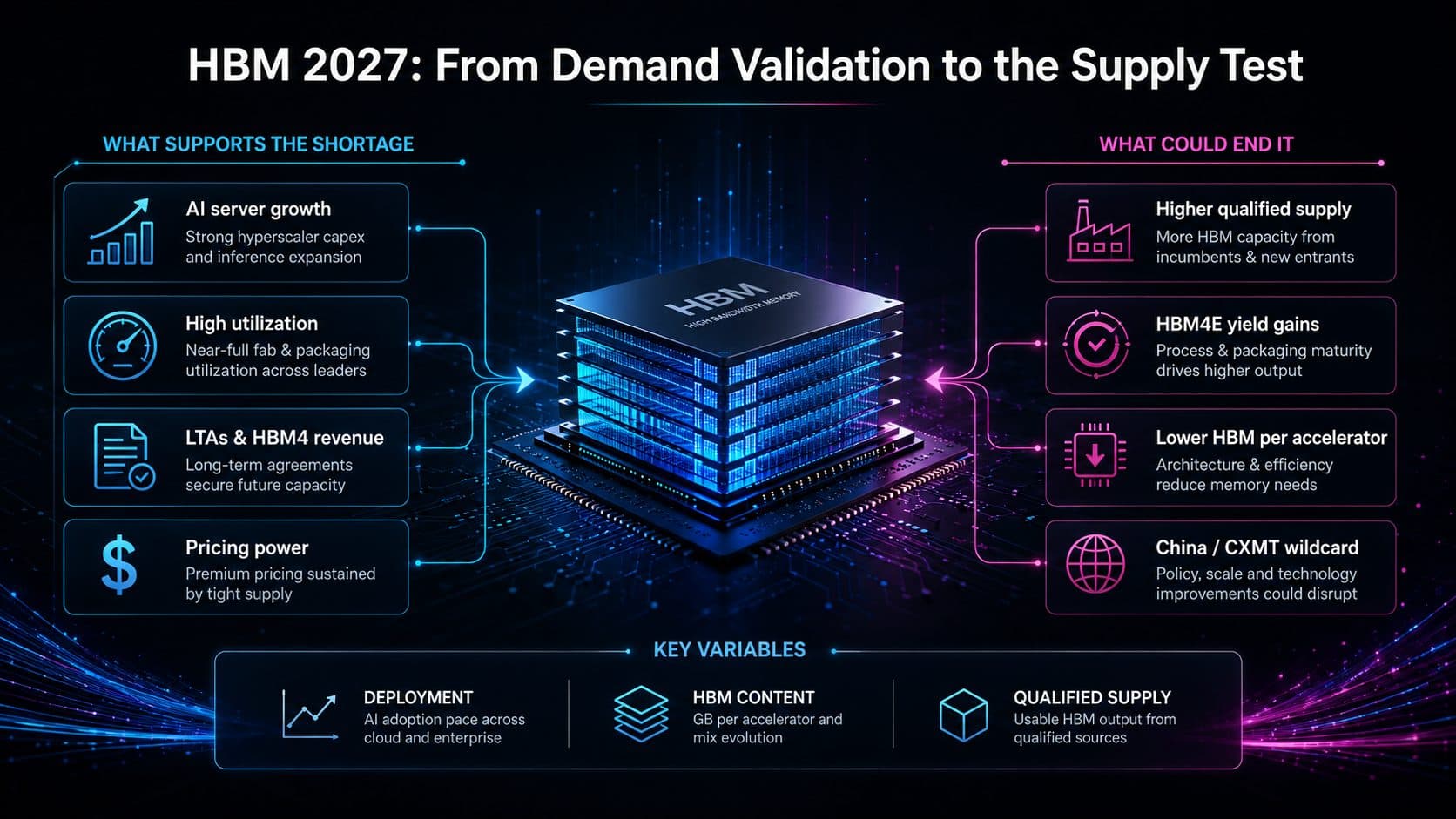
- The 2027 risk is shifting from weak demand to stronger usable supply. HBM4E qualification, sellable qualified supply, and content per accelerator are now the three operating variables that will decide whether the cycle moves from shortage to balance.
AI server orders, cloud utilization, and HBM contracts all point to real demand. The harder question for 2027 is whether high prices and new qualified supply begin to change the cycle.
As of September 2026, the evidence increasingly supports one conclusion: the current HBM shortage is being driven primarily by real AI infrastructure deployment, not just by memory suppliers projecting aggressive future demand. Dell is converting large AI server orders into revenue, Microsoft says newly available Azure capacity is monetized quickly, Nvidia says its cloud compute remains heavily utilized and its growth outlook is still supply-constrained, while Dell and TSMC continue to identify memory and advanced packaging as physical bottlenecks in the AI supply chain.
That does not mean today's HBM demand can be extrapolated linearly into 2027 and 2028. TrendForce reported in August that Nvidia is evaluating lower-HBM configurations for Rubin Ultra, while some cloud service providers are considering lower HBM capacity for next-generation custom AI ASICs. A real shortage can eventually create its own counterforce: the more expensive and scarce HBM becomes, the stronger the incentive to reduce memory content per accelerator or redesign systems around the bottleneck.
The more useful question is therefore no longer simply whether HBM demand is strong. It is how much of today's demand has already converted into deployed, monetized compute; how much is merely precautionary capacity reservation; and how quickly new qualified HBM supply can catch up without damaging pricing.
The strongest evidence starts downstream: Dell is actually shipping AI servers
Dell's latest quarter moves the AI server story from forecast to realized revenue. In fiscal Q2 2027, the company reported a record $60.9 billion of AI server orders, $16.4 billion of AI server revenue, and $95 billion of AI backlog. Dell also said its AI customer count had expanded to more than 6,500, while management raised its full-year fiscal 2027 revenue outlook to $192 billion.
Source: Dell Technologies Q2 FY2027 results
These numbers matter because orders, revenue, and backlog are all moving higher at the same time. Backlog alone can be inflated by customers trying to secure scarce equipment early, but $16.4 billion of recognized AI server revenue means a meaningful portion of demand has already moved beyond planning and into hardware delivery.
Dell's conference-call commentary also gives us one of the clearest independent reads on memory supply. In its fiscal Q1 discussion, management said demand continued to exceed supply and identified memory as the primary constraint, noting that uncertainty around availability was encouraging customers to secure infrastructure further in advance.
Source: Dell Technologies Q1 FY2027 earnings materials
That statement contains both bullish evidence and an important caveat. It confirms that server OEMs are genuinely constrained by memory availability, but it also tells us that scarcity itself can change ordering behavior. Customers that fear future shortages may order earlier, reserve capacity for longer, or secure supply from more than one vendor.
That is why Dell's order growth cannot be treated as a perfect proxy for final consumption. It is strong evidence, but it still needs to be tested against downstream utilization.
The better test: are those AI servers actually being used?
If AI servers are being purchased but remain underutilized, large order books would not prove that infrastructure demand can sustain itself. The more powerful validation comes one step further downstream: does newly installed compute get consumed and monetized quickly?
Microsoft's latest results provide one of the strongest checks. Azure and other cloud services grew 43% year over year, while management said demand continued to exceed available capacity. CFO Amy Hood also said newly available capacity and efficiency-driven supply improvements were monetized quickly during the quarter.
Source: Microsoft FY2026 Q4 earnings
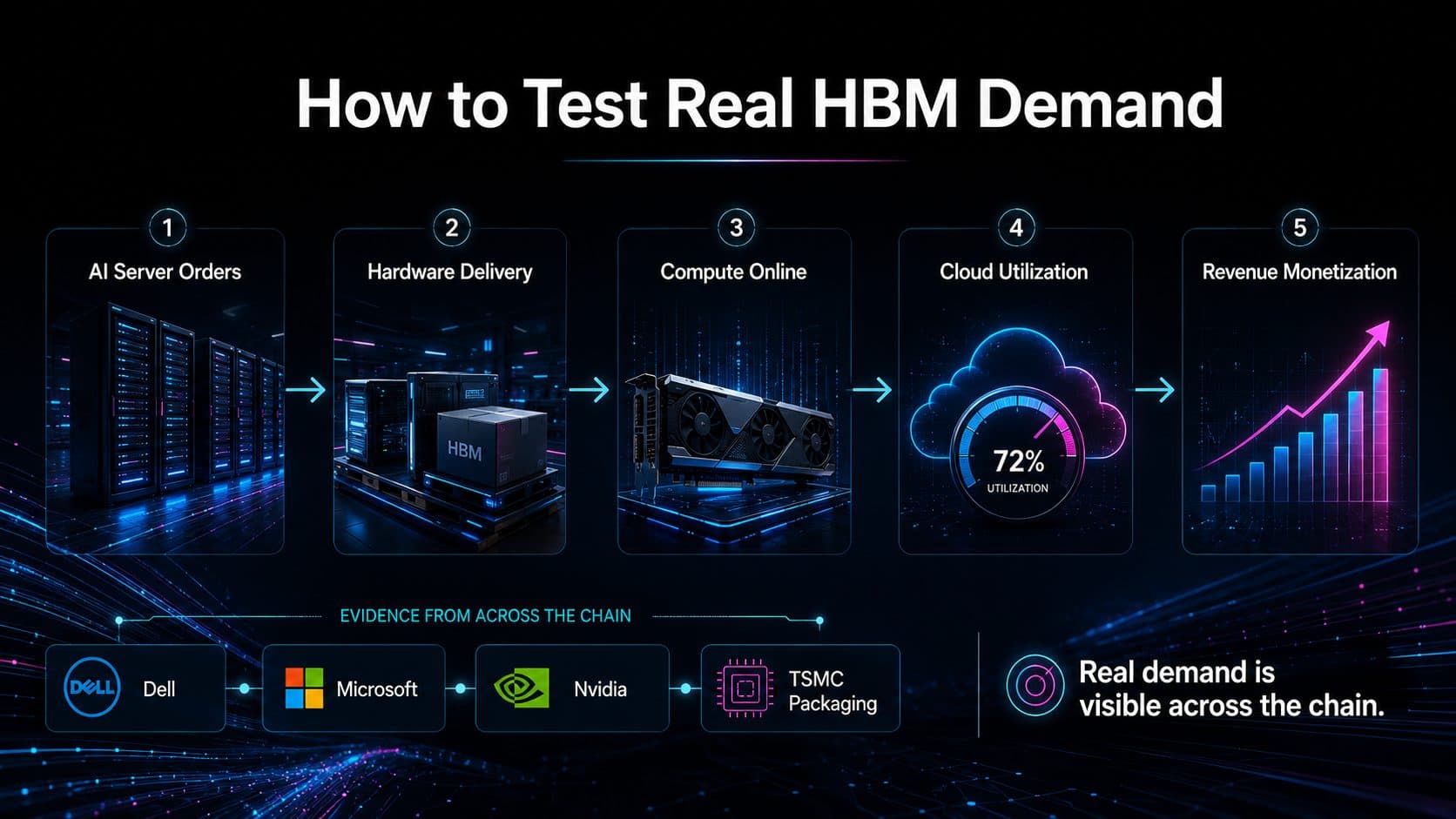
This creates a much stronger chain of evidence:
server orders → hardware delivery → compute capacity online → customer usage → cloud revenue
When the final step is visible, the argument that customers are merely stockpiling accelerators becomes much harder to sustain.
Nvidia adds another utilization check. In its August earnings call, management said Nvidia compute was fully utilized across the clouds it serves and described the company's fiscal 2028 growth outlook as supply-constrained. Nvidia also said customer forecasts imply materially higher demand than the supply it can currently secure.
Source: Nvidia Q2 FY2027 earnings call transcript
Nvidia is not a neutral observer; it is one of the largest beneficiaries of AI infrastructure spending. But its claims become more useful when they align with Microsoft's cloud monetization and Dell's realized server revenue. Together, these signals make it increasingly difficult to explain the current HBM shortage as a purely speculative inventory cycle.
HBM demand is broadening beyond Nvidia GPUs
Another reason HBM demand may remain stronger than a simple Nvidia shipment model implies is the rise of custom AI accelerators. Broadcom's fiscal Q3 2026 results showed $16.7 billion of AI semiconductor revenue, up 221% year over year, with management guiding to further growth in the following quarter. CEO Hock Tan continued to describe custom AI accelerator and networking demand as very strong.
Source: Broadcom Q3 FY2026 results
Broadcom's AI semiconductor revenue cannot be translated directly into HBM demand because it includes networking and because custom ASICs use different memory architectures and capacities. The broader point is that the accelerator market is diversifying. HBM demand increasingly depends on Nvidia GPUs, AMD accelerators, Google TPUs, AWS Trainium, and other custom silicon.
A more useful demand equation is:
AI accelerator units × HBM capacity per accelerator × product generation and stack configuration = HBM bit demand
The first variable is rising as the accelerator market broadens. The second variable may not keep rising indefinitely. Those two forces can move in opposite directions, which is why 2027 HBM demand will be harder to forecast than simply projecting GPU shipments.
The memory vendors are moving from forecasts to contracts and realized revenue
Statements from SK Hynix, Micron, and Samsung are most useful when they contain observable operating evidence rather than generic commentary about strong demand.
SK Hynix said additional supply requests continue to increase and that it has finalized long-term agreements with around 10 major customers, while continuing to discuss additional multi-year arrangements. HBM4 entered mass shipment in the second quarter, and HBM4E samples had already been delivered.
Source: SK Hynix Q2 2026 business results
That does not mean every requested bit of HBM is guaranteed final consumption. LTAs can contain very different volume commitments, cancellation terms, and pricing structures. Still, they are stronger evidence than informal customer forecasts because at least part of future demand is becoming contractually visible.
Micron provides an even harder signal through actual revenue. The company said its HBM4 12-high ramp is progressing about twice as fast as the HBM3E 12-high ramp, and it has already recognized more than $1 billion of HBM4 revenue. Micron has also said that 2026 HBM supply was already covered by pricing and volume agreements, while HBM4E is expected to move into volume production in calendar 2027.
Sources: Micron HBM and earnings materials and Micron prior HBM agreement commentary
Samsung is showing the same direction of travel. Its memory business reported another record quarter, server revenue reached a record share of the mix, HBM4 sales increased, and HBM4E samples were shipped to major customers. Samsung expects server DRAM, enterprise SSD, and HBM demand to remain strong even as PC and smartphone demand moderates.
Source: Samsung Electronics Q2 2026 results
The combined picture is stronger than "three memory companies expect strong demand." We now have long-term agreements, defined pricing and volume commitments, HBM4 production ramps, actual HBM4 revenue, and next-generation customer qualification all moving in the same direction.
The missing information is equally important. Public disclosures generally do not tell us whether most HBM LTAs contain strict minimum purchase requirements, non-cancellable terms, or take-or-pay provisions. Long-term agreements improve demand visibility, but they do not automatically equal irreversible end demand.
Advanced packaging independently confirms that the bottleneck is physical
HBM supply cannot be measured by DRAM wafer starts alone. A usable HBM product depends on DRAM die yield, TSV and stacking, base-die integration, advanced packaging, and final customer qualification. Any one of those stages can prevent nominal capacity from becoming sellable supply.
TSMC CEO C.C. Wei said in the company's second-quarter call that advanced-packaging capacity was tight enough to limit customer growth, and the company is continuing to expand that capacity.
Source: TSMC Q2 2026 earnings call transcript
This creates an important cross-check across three separate parts of the supply chain. Dell says memory is constraining server shipments. Nvidia says the wider AI supply chain remains heavily utilized and constrained. TSMC says advanced packaging is limiting customer growth.
When bottlenecks appear independently at several stages of the same production chain, the probability that the shortage is purely the result of speculative ordering falls.
It also explains why announced CapEx should not be counted immediately as 2027 HBM supply. New fabs, packaging facilities, equipment installation, yield ramps, and customer qualification all take time. A project announced during the current boom may be very important for 2029 while doing almost nothing to close a 2027 shortfall.
HBM prices are now high enough to change customer behavior
This is the strongest counterargument to a simple bullish HBM thesis.
TrendForce reported in August that, because of tight 2027 DRAM supply, rising HBM prices, and uncertainty around HBM4E qualification and yield, Nvidia is no longer evaluating only the original 12-high HBM4E configuration for Rubin Ultra. It is also considering 8-high HBM4E, 12-high HBM4, and 8-high HBM4 alternatives. Some cloud service providers are also evaluating lower HBM capacities for their next-generation custom AI ASICs.
Source: TrendForce: HBM configuration options for Rubin Ultra
This is the first clear sign that HBM is developing meaningful demand elasticity. If the old model was that every new AI accelerator generation would use more HBM, the new model needs an additional constraint: when HBM becomes expensive or difficult enough to source, chip designers will trade off performance, memory capacity, shipment volume, and system cost.
The HBM demand equation therefore cannot focus only on accelerator shipments:
HBM demand = accelerator shipments × HBM content per accelerator
TrendForce still expects 2027 HBM bit shipments to grow roughly 50%–60% year over year and believes supply will remain insufficient relative to demand. At the same time, lower-memory configurations are now being actively evaluated, which means today's pricing power is already creating the mechanism that could slow future content growth.
That is not evidence that HBM demand has already weakened. It is a leading indicator worth watching closely.
Could double ordering still be inflating HBM demand?
Yes. It cannot be fully ruled out.
Dell has already acknowledged that memory uncertainty is encouraging customers to secure infrastructure further in advance. That is rational behavior in a shortage, but it also means the same end customer can appear as demand in several places if it reserves supply from multiple vendors or reports aggressive forecasts across several procurement channels.
This is why different forms of "demand" should not be treated equally.
| Demand evidence | Reliability as proof of final demand | |---|---| | Multi-year customer forecast | Low | | Capacity reservation | Low to medium | | Purchase order | Medium | | Long-term supply agreement | Medium to high | | Agreed pricing and volume | Higher | | Non-cancellable / take-or-pay / prepayment | Very high | | Product delivered and deployed | Stronger | | New compute capacity generates revenue | Strongest realized evidence |
By this standard, the HBM cycle has already moved beyond the weakest forms of evidence. Micron has pricing and volume agreements plus realized HBM4 revenue. SK Hynix has multiple LTAs. Dell is recognizing AI server revenue. Microsoft is showing that new capacity can be monetized quickly.
Double ordering may still exist at the margin, but public evidence does not currently support the stronger claim that the HBM shortage is primarily a double-ordering phenomenon.
Rising memory inventory would not automatically mean demand has weakened
Memory cycles are usually very sensitive to inventory, but the 2026 AI server supply chain is unusually asynchronous. DRAM, GPUs, CPUs, networking gear, optics, racks, and power infrastructure do not arrive at the same time. If one component is delayed, another can build inventory even while final server demand remains strong.
That means higher memory inventory at a cloud provider would need to be interpreted alongside the rest of the system. The key question is not whether inventory is rising, but why it is rising.
If memory inventory increases while server deployments, cloud utilization, and AI revenue all slow, the signal would be negative. If memory arrives early while CPUs, GPUs, racks, or power remain constrained and deployment continues to rise once those bottlenecks clear, the same inventory increase would have a very different meaning.
For HBM, inventory quality is more useful than inventory quantity alone.
The funding behind HBM demand is becoming more complex
Historically, investors could explain most AI infrastructure demand by tracking CapEx from Microsoft, Meta, Amazon, and Google. By 2026, the funding base is becoming broader.
Nvidia has said that its non-hyperscaler data-center business increasingly includes neoclouds, sovereign AI projects, enterprises, and AI-native customers. The company has also acknowledged that some frontier AI labs are growing faster than their own balance sheets or credit capacity can support, increasing the importance of institutional capital, revenue guarantees, and take-or-pay structures.
Source: Nvidia Q2 FY2027 earnings call transcript
This matters because real demand and high-quality demand are not the same thing.
Microsoft funding AI infrastructure from a mature cloud business that quickly converts new capacity into revenue is relatively high-quality demand. AI-native companies and neoclouds can have equally real compute needs, but if their infrastructure depends more heavily on debt, leases, vendor financing, third-party guarantees, or open capital markets, credit conditions and long-term interest rates begin to matter more for HBM demand. (For a deeper framework on how AI funding and credit conditions can transmit into infrastructure cycles, see The AI Bubble and the Credit System: A Risk Guide.)
The next stage of HBM analysis therefore needs to track not only how much AI CapEx is being announced, but also who is funding it and whether that funding model can survive a tighter credit environment.
South Korea is creating a new fiscal feedback loop around AI and memory
South Korea adds another source of capital formation that has received less attention in HBM analysis.
The government has proposed a KRW 821 trillion budget for 2027, up 12.8% year over year. Reuters reported that the semiconductor boom is expected to drive a large increase in tax receipts, with corporate-tax revenue rising sharply and part of the additional fiscal capacity being directed toward future-growth industries and semiconductor infrastructure.
Source: Reuters: South Korea proposes record 2027 budget
The Ministry of Science and ICT has provided a more specific AI allocation. Its proposed 2027 budget rises to KRW 29.6 trillion, while AI-related spending reaches KRW 9.4 trillion, up roughly 84%, covering areas such as AI data centers, next-generation semiconductors, physical AI, GPU infrastructure, and domestic AI models.
Source: South Korea government budget briefing
That creates a feedback loop worth watching:
AI infrastructure demand → HBM and memory profits → higher tax revenue → greater fiscal capacity → AI/data-center/semiconductor investment → more compute deployment
It would be too aggressive to treat every won of Korean AI spending as future HBM revenue. Much of it will go to research, software, data centers, power infrastructure, and other areas. The important point is that AI CapEx is no longer financed only by corporate cash flow; semiconductor profits are beginning to expand the fiscal capacity available for another round of AI investment.
A second loop may emerge through electricity infrastructure. Reuters reported that KEPCO has proposed asking Samsung to prepay roughly KRW 20 trillion of future electricity charges and SK Hynix roughly KRW 5 trillion to help finance grid expansion.
Source: Reuters: KEPCO proposes advance power payments
The proposal is not the same as completed financing, but it shows how quickly the AI bottleneck is migrating from chips into power infrastructure. Capital generated by the semiconductor boom may end up funding the grid required for the next wave of semiconductor and data-center capacity.
The 2027 risk is shifting from weak demand to stronger usable supply
If the evidence above is accepted, it becomes difficult to describe the current HBM cycle as a purely expectation-driven bubble. The more important question is when the supply-demand balance begins to change.
The first source of change is the existing supplier base. As Samsung, SK Hynix, and Micron improve HBM4 yield, expand advanced packaging, and complete more customer qualifications, the same nominal wafer capacity can generate more sellable HBM. Micron has already said its HBM4 12-high ramp is reaching maturity faster than the previous generation, while SK Hynix and Samsung continue to scale HBM4 production.
The second source is China. Reuters reported on August 31 that CXMT had begun small-scale production of advanced HBM, marking a significant technical step. But small-scale output is still far from market-changing supply. Yield, stacking capability, packaging throughput, cost, and customer qualification remain open questions.
Source: Reuters: CXMT begins small-scale advanced HBM production
For now, CXMT is better treated as a 2027–2028 supply variable than evidence that the current HBM shortage is already ending. (For the broader read on how CXMT is reshaping the global DRAM market, see How CXMT Is Reshaping the Global DRAM Market.)
There is also an indirect path. Even if CXMT cannot supply large volumes of high-end HBM in the near term, rapid growth in conventional DRAM capacity could pressure commodity DRAM economics and influence how Samsung, SK Hynix, and Micron allocate wafers and capital between conventional DRAM and HBM.
That is why the China-memory question is more complex than "CXMT enters HBM, therefore HBM prices fall." The real transmission runs through commodity DRAM profitability, wafer allocation, advanced packaging, and customer qualification.
HBM4E could become one of the most important 2027 supply-demand variables
HBM4E matters not only because it offers more bandwidth. It also changes memory capacity per accelerator, manufacturing complexity, yield requirements, and system cost.
Rubin Ultra's final memory configuration is not fully settled. TrendForce says Nvidia is evaluating multiple options, including 12-high and 8-high HBM4E as well as HBM4 alternatives. That means current 2027 HBM demand forecasts still contain an architectural variable.
If HBM4E qualification and mass production progress smoothly, the platform can support higher memory content and bandwidth. If supply or yield remains constrained, Nvidia may reduce stack height or use different memory configurations to maximize accelerator shipments.
This creates an unusual tension inside the 2027 HBM market:
the tighter HBM supply becomes, the stronger supplier pricing power gets; but the more expensive HBM becomes, the stronger the incentive for customers to reduce HBM content per accelerator.
HBM4E qualification, the 12-high versus 8-high mix, HBM capacity per accelerator, and actual accelerator shipment volumes should therefore be treated as a single operating system rather than separate data points.
What would make this HBM thesis wrong?
My current view is that HBM represents a real structural shortage with some precautionary ordering and some financing-driven demand layered on top. That view should change if several operating variables reverse at the same time.
If Dell's AI backlog begins to fall while revenue conversion slows, Microsoft stops monetizing new capacity quickly, Nvidia reports lower cloud utilization, and HBM ASPs begin to decline sequentially, the demand side would finally show a coordinated weakening signal.
The cycle could also turn from the supply side even if AI demand remains strong. If Samsung, SK Hynix, and Micron improve HBM4/HBM4E yields rapidly, advanced-packaging bottlenecks ease, and customers broadly adopt lower-memory accelerator configurations, HBM could move from shortage to balance while total AI compute still grows quickly.
Those two outcomes should not be confused. A semiconductor downcycle in HBM would not necessarily mean the secular AI infrastructure story had failed.
HBM is moving from demand validation to the supply test
The earliest phase of the AI memory cycle required investors to decide whether generative AI would create durable compute demand. By September 2026, the evidence has moved much further into the operating system. Dell is recognizing large AI server revenue and backlog, Microsoft says newly available capacity is monetized quickly, Nvidia remains supply-constrained and heavily utilized, Broadcom's custom AI accelerator business is expanding rapidly, and all three major HBM suppliers are moving from forecasts into contracts, HBM4 shipments, and realized revenue.
That makes a sudden collapse in underlying HBM demand difficult to reconcile with the current evidence.
The more credible risk is subtler: real demand keeps growing, but high HBM prices begin to reduce memory content per accelerator just as Samsung, SK Hynix, and Micron improve yield and packaging capacity. If those forces meet in 2027 or 2028, HBM could move from severe shortage toward balance even while the broader AI compute market continues to expand.
That is why the next stage of HBM analysis should focus less on another headline CapEx number and more on three operating variables:
actual AI accelerator deployment, HBM content per accelerator, and qualified sellable HBM supply.
In 2024 and 2025, the market was still validating AI demand. In 2026, HBM moved into demand realization and earnings realization. In 2027, the central question increasingly becomes the supply test.
AI can remain a secular growth market while HBM still moves through a semiconductor cycle of its own. (For the broader read on the memory trade's next move, see HBM Demand Is Still Strong. What Could Restart the Memory Trade?.)
FAQ
Is there really an HBM shortage in 2026 and 2027?
Current evidence supports a genuine supply constraint. Dell identifies memory as a server bottleneck, Nvidia describes growth as supply-constrained, TSMC says advanced packaging is limiting customer growth, and HBM suppliers continue to ramp output into committed demand.
How fast could HBM demand grow in 2027?
TrendForce currently expects HBM bit shipments to grow roughly 50%–60% year over year in 2027. The final number will depend heavily on accelerator shipments, HBM4/HBM4E configuration, customer qualification, and how quickly new usable supply comes online.
Why does HBM4E matter?
HBM4E affects bandwidth, memory capacity per accelerator, stack configuration, yield, and system cost. Nvidia's evaluation of multiple Rubin Ultra memory configurations makes HBM4E one of the most important swing factors for both 2027 demand and supply.
Could high HBM prices reduce demand?
Yes. Nvidia and some cloud providers are already evaluating lower HBM configurations for future accelerators. AI accelerator shipments can keep rising while HBM content per accelerator grows more slowly than previously expected.
Could CXMT end the HBM shortage?
There is not enough evidence yet. CXMT has reportedly begun small-scale advanced HBM production, but high-volume yield, qualification, packaging throughput, and customer adoption are still unclear. It is better viewed as a potential 2027–2028 supply variable than as current large-scale HBM supply.
Sources
| No. | Source | Publisher | Date | Type | What it supports |
|---|---|---|---|---|---|
| 1 | Dell Technologies Q2 FY2027 results | Dell Technologies | 2026-09 | Company IR | $60.9B AI server orders, $16.4B AI server revenue, $95B AI backlog, 6,500+ AI customers, raised FY2027 revenue outlook to $192B. |
| 2 | Dell Technologies Q1 FY2027 earnings materials | Dell Technologies Investor Relations | 2026 | Company IR | Memory identified as primary constraint, customer behavior under scarcity, advance ordering. |
| 3 | Microsoft FY2026 Q4 earnings | Microsoft Investor Relations | 2026-07-29 | Company IR | Azure and other cloud services 43% YoY growth, demand exceeds available capacity, new capacity and efficiency-driven supply monetized quickly (CFO Amy Hood). |
| 4 | Nvidia Q2 FY2027 earnings call transcript | Nvidia Investor Relations | 2026-08-26 | Company IR | Nvidia compute fully utilized, FY2028 outlook supply-constrained, non-hyperscaler data-center mix, frontier-AI capital structure, customer forecasts above secured supply. |
| 5 | Broadcom Q3 FY2026 results | Broadcom Investor Relations | 2026 | Company IR | $16.7B AI semiconductor revenue, up 221% YoY, custom AI accelerator and networking demand commentary from CEO Hock Tan. |
| 6 | SK Hynix Q2 2026 business results | SK Hynix | 2026 | Company IR | Long-term agreements with ~10 major customers, HBM4 mass shipment, HBM4E sample delivery. |
| 7 | Micron HBM and earnings materials | Micron Investor Relations | 2026 | Company IR | HBM4 12-high ramp, $1B+ HBM4 revenue recognized, 2026 HBM supply covered by pricing and volume agreements, HBM4E volume in calendar 2027. |
| 8 | Micron prior HBM agreement commentary | Micron Investor Relations | 2026 | Company IR | Prior period HBM pricing and volume agreement context. |
| 9 | Samsung Electronics Q2 2026 results | Samsung Newsroom | 2026 | Company IR | Memory business record quarter, server share of mix, HBM4 sales increase, HBM4E sample shipment, server DRAM, enterprise SSD and HBM outlook. |
| 10 | TSMC Q2 2026 earnings call transcript | The Motley Fool / TSMC | 2026-07-16 | Company IR | Advanced packaging capacity tight enough to limit customer growth (TSMC CEO C.C. Wei). |
| 11 | TrendForce: HBM configuration options for Rubin Ultra | TrendForce | 2026-08-04 | Research | Nvidia evaluating 8-high HBM4E, 12-high HBM4, 8-high HBM4 for Rubin Ultra; CSPs evaluating lower HBM for custom AI ASICs. |
| 12 | South Korea proposes record 2027 budget | Reuters | 2026-09-01 | Reputable financial media | KRW 821T 2027 budget (+12.8% YoY), semiconductor tax receipts, fiscal capacity for AI / data center investment. |
| 13 | South Korea government 2027 budget briefing (MSIT) | Government of the Republic of Korea | 2026 | Government | MSIT proposed 2027 budget KRW 29.6T, AI-related spending KRW 9.4T (+~84%). |
| 14 | KEPCO proposes advance power payments from Samsung and SK Hynix | Reuters | 2026-09-03 | Reputable financial media | KEPCO proposal: Samsung ~KRW 20T advance electricity charges, SK Hynix ~KRW 5T for grid expansion. |
| 15 | CXMT begins small-scale advanced HBM production | Reuters | 2026-08-31 | Reputable financial media | CXMT small-scale advanced HBM production as 2027–2028 supply variable. |
This article is built from public company filings, earnings calls, and primary reporting. Dell, Microsoft, Nvidia, Broadcom, SK Hynix, Samsung, Micron, and TSMC figures are taken directly from their own investor materials. TrendForce, Reuters, and the South Korean government briefing are used for HBM configuration, Korea fiscal context, and CXMT supply signals. Forward-looking statements about HBM4E, HBM pricing, AI funding, and 2027 supply are subject to each company's own risk factors and disclosures.
Related Reading
HBM Demand Is Still Strong. What Could Restart the Memory Trade?
Memory stocks have bounced from the selloff and settled into a range. The next move may depend less on another headline that AI demand is strong, and more on whether the market can push its earnings assumptions several years further out.
HBM vs DDR5: What’s the Difference—and Why AI Needs Both
HBM supplies extreme bandwidth to AI accelerators, while DDR5 provides larger pools of system memory. Understanding the difference is essential for analyzing AI infrastructure and memory stocks.
How CXMT Is Reshaping the Global DRAM Market
CXMT has proven it can manufacture mainstream DRAM at scale and enter China’s server supply chain. What remains unproven is whether it can match Samsung, Micron and SK hynix on yield, cost per bit and profitability through a full memory cycle.
Can AI CapEx Pay Off? Start With Token Cost, Then Watch the Payback Period.
Nvidia is showing that the unit cost of AI production is falling. Investors are asking whether cheaper tokens can turn into visible profits and free cash flow fast enough.

Is the AI Bubble About to Break? The Real Risk May Be Hiding in the Credit System
AI demand is still growing, but as GPUs, long-term compute contracts, project finance, and customer credit become more tightly connected, the real risk may be hiding in how the expansion is funded.
Invest better with thoughtful research.
Join readers who receive our best ideas and insights straight to their inbox.
Disclosure
This article is for research and education only. It is not investment advice.
Comments