ChangXin Memory Technologies has become large enough to matter to the global DRAM industry. Its public listing has revived a familiar debate: which companies are most exposed if CXMT continues to expand, and does that threat extend beyond Samsung, Micron and SK hynix to names such as SanDisk or Western Digital?
The answer depends on separating three different businesses. CXMT produces DRAM, SanDisk sells NAND flash and SSDs, and Western Digital is now primarily a hard-disk-drive company. These companies may trade together when investors sell the broader memory and storage sector, but they do not compete for the same orders or serve the same function inside a device or data center.
The more important question is not whether CXMT is “bad for memory stocks.” It is what CXMT has already proven, what it has not yet proven, and which incumbent profit pools it can realistically reach first.
The evidence supports a clear conclusion. CXMT has already demonstrated scale, mainstream product capability and access to major Chinese customers, but it has not yet disclosed enough data to prove that its yields, cost per bit and profitability are comparable with Samsung, Micron and SK hynix across a full memory cycle.
Key Takeaways
- CXMT generated RMB 61.3 billion in core revenue in 2025, with LPDDR still contributing 66.43%.
- DDR’s revenue share increased sharply, showing expansion toward PCs and servers.
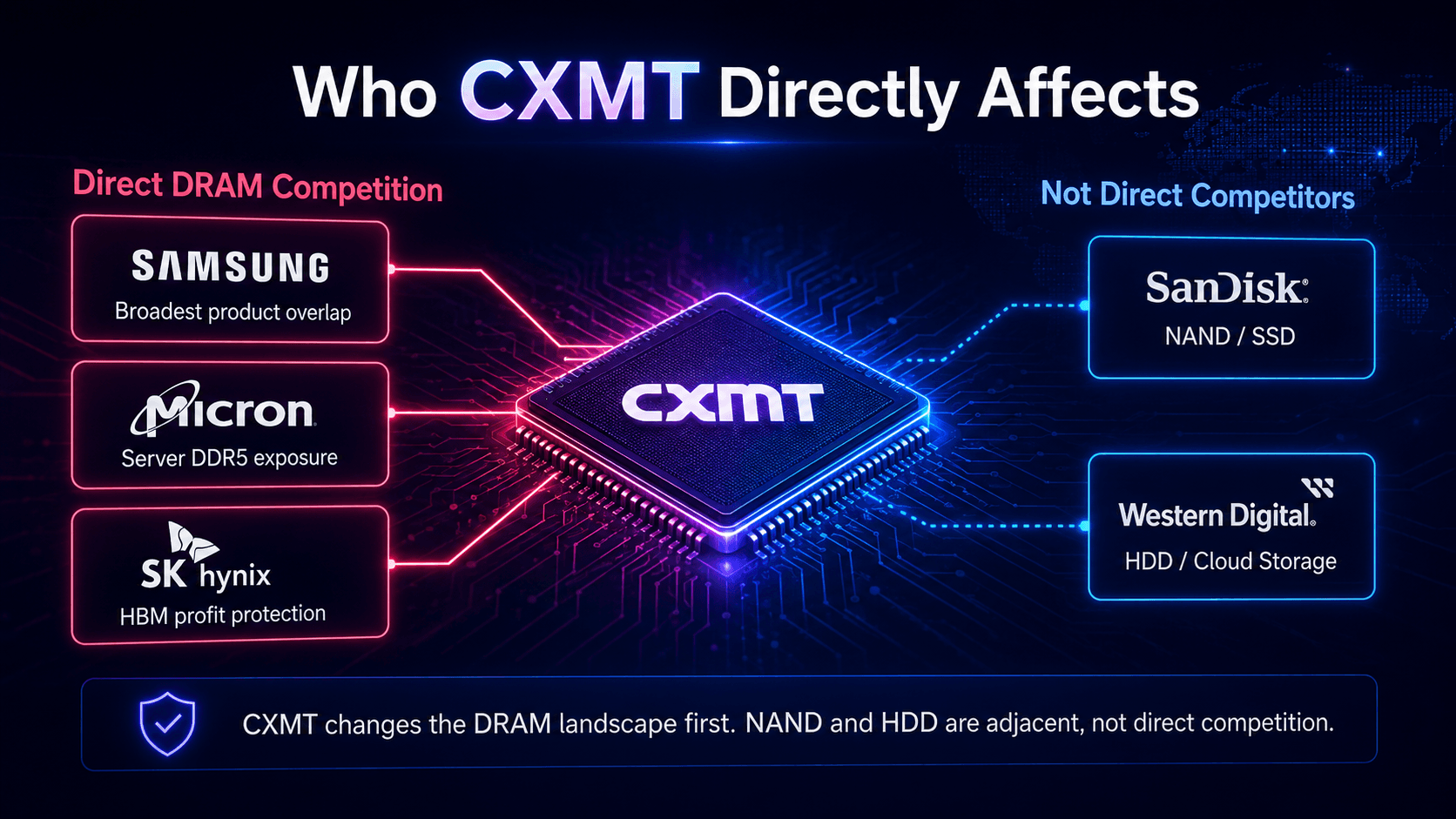
- Samsung, Micron and SK hynix are direct DRAM competitors; SanDisk and Western Digital are not.
- CXMT has proven DDR5 production and customer access but has not disclosed yield or cost per bit.
- The largest test will be whether CXMT can maintain margins during the next DRAM downcycle.
CXMT Is Still Primarily a Mobile-Memory Company
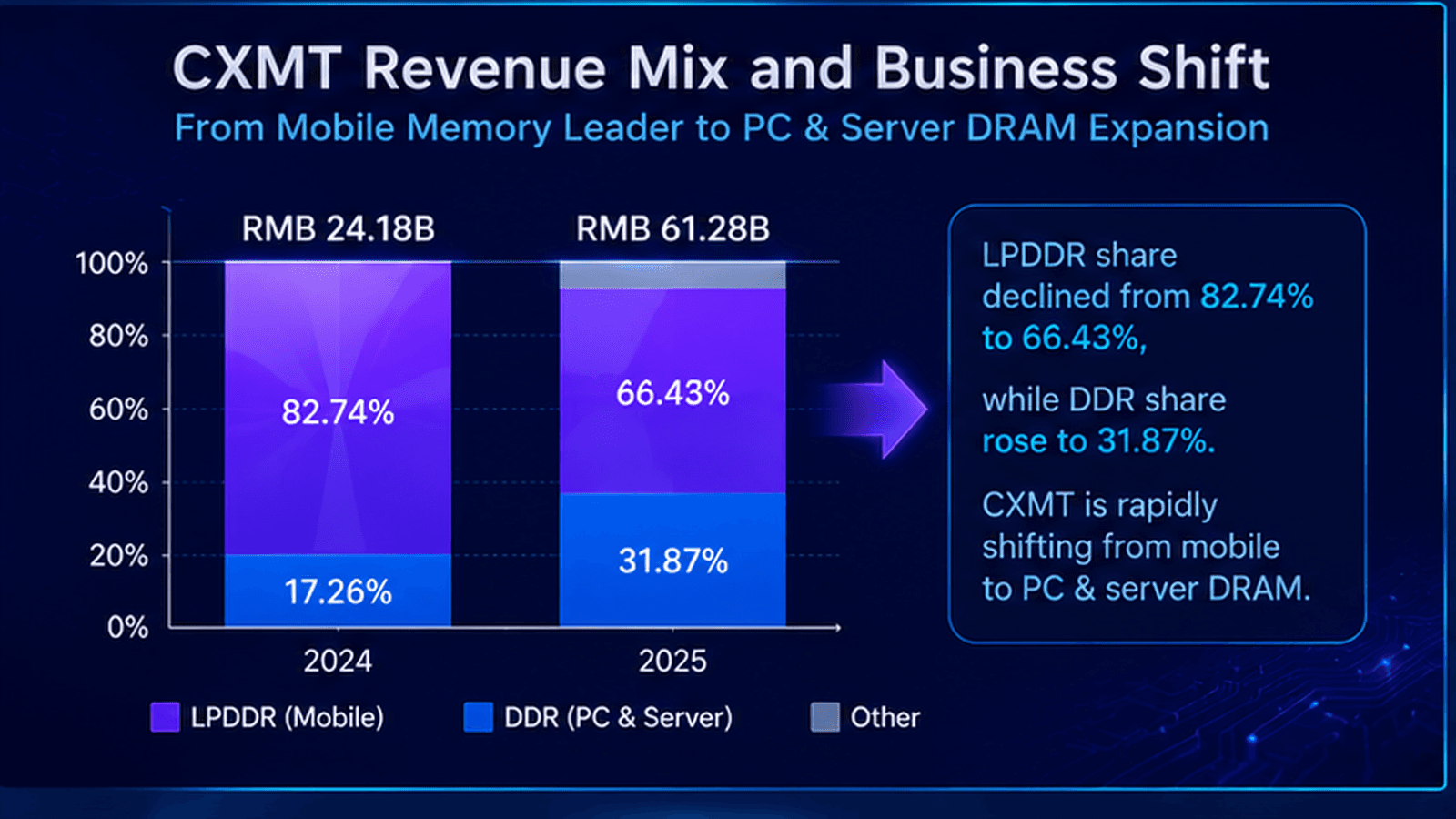
CXMT is frequently described as an emerging AI-memory challenger, but its current revenue mix tells a more precise story. In 2025, the company generated approximately RMB 61.3 billion in core business revenue. LPDDR products contributed RMB 40.7 billion, or 66.43%, while DDR products contributed RMB 19.5 billion, or 31.87%.
The direction of travel is important. LPDDR accounted for 82.74% of core revenue in 2024, which means the DDR contribution expanded sharply in 2025. That shift shows CXMT moving from a business dominated by smartphones and other mobile devices toward PCs and servers, but server memory has not yet become the foundation of the company.
This matters because the first competitive impact is unlikely to appear in advanced HBM. CXMT does not need to challenge SK hynix in the highest-end AI-memory market before it starts taking meaningful business from the global incumbents. It can first replace imported LPDDR and standard DDR used by Chinese smartphone, PC and server customers.
That market is already large enough to matter. CXMT’s current scale was built mainly through mobile memory, while DDR5 represents the next stage of its growth and the point at which competition with Micron and Samsung becomes more visible.
The Old DDR4 Narrative Is No Longer Accurate
CXMT should no longer be treated as a supplier dependent on outdated DDR4 products and low pricing. The company stopped producing its internally developed DDR4 products at the end of 2024 and now offers a broader fifth-generation DRAM portfolio.
Its public product lineup includes 16Gb, 24Gb and 32Gb DDR5 products with speeds of up to 8,000Mbps, as well as LPDDR5 and LPDDR5X products reaching up to 10,667Mbps. It also offers server modules such as RDIMMs and MRDIMMs, PC modules including CUDIMMs and CSODIMMs, and newer form factors such as LPCAMM.
The company’s DDR5 products have moved beyond research and sampling. Listing materials state that they have entered mass production, completed validation with core customers and reached batch delivery. That means the central debate is no longer whether CXMT can manufacture DDR5 at all.
The unresolved issue is manufacturing efficiency. A company can technically produce DDR5 and still remain structurally disadvantaged if yields are low, die sizes are large or effective bit output per wafer is materially below that of the global leaders. CXMT has proven that it can make and ship DDR5; it has not proven that it can do so at comparable cost.
CXMT’s First Disruption Is Happening Inside China’s Procurement System
CXMT’s near-term impact is most likely to appear in the purchasing decisions of Chinese smartphone makers, PC vendors and cloud providers. The company has disclosed relationships with Xiaomi, Honor, OPPO, vivo, Transsion and Lenovo, while also identifying Alibaba Cloud, ByteDance and Tencent as important customers or ecosystem partners.
That places CXMT across three end markets: mobile devices, personal computers and servers. The company is therefore not dependent on a single customer category, and its domestic customer base gives it a natural path to higher utilization, faster qualification cycles and repeated product learning.
Samsung’s very low smartphone market share in China does not reduce its semiconductor exposure in the way some investors assume. Galaxy handset sales and Samsung Semiconductor’s component business are separate. Samsung can sell LPDDR, DDR, NAND, image sensors and other components to Chinese manufacturers even when Chinese consumers buy almost no Samsung-branded phones.
The relevant question is not how many Galaxy phones Samsung sells in China. It is how much memory Samsung supplies to Xiaomi, OPPO, vivo, Honor, Lenovo and Chinese cloud companies. If those customers increase domestic DRAM procurement, the displaced order may come from Samsung, Micron or SK hynix regardless of the brand on the finished device.
Public disclosures do not show the precise LPDDR share held by each incumbent at individual Chinese customers. That prevents a reliable ranking of which company will lose the most revenue, but it does not change the broader conclusion: China’s domestic substitution is already moving from consumer devices toward PCs and servers.
Samsung Has the Broadest Product Overlap
Samsung competes with CXMT across mobile LPDDR, PC DDR and server DDR, giving it the broadest product overlap with CXMT’s current and emerging portfolio. The exposure comes from Samsung’s role as a component supplier to Chinese companies, not from its own smartphone sales in China.
CXMT’s LPDDR scale creates pressure in mobile devices, while its expanding DDR5 business extends the competition into PCs and standard servers. Samsung therefore faces potential share loss across more conventional DRAM categories than either Micron or SK hynix.
Samsung’s strategic response is to move more of its portfolio toward higher-value products, including HBM4, advanced server memory, SOCAMM formats and next-generation enterprise storage. The company is effectively trying to protect margins by increasing exposure to products that are harder for CXMT to replicate.
This creates a two-layer competition. CXMT can take share in conventional DRAM inside China, while Samsung attempts to move revenue and capital toward advanced AI memory before the domestic challenger can catch up.
Broad overlap does not prove that Samsung will suffer the largest financial loss. The missing data is Samsung’s actual share of DRAM shipments to individual Chinese device and cloud customers. The evidence supports describing Samsung as one of the most broadly exposed companies, but not automatically the largest loser.
Micron Can Continue Winning in HBM While Losing Server DRAM in China
Micron’s exposure is easier to observe because DRAM still accounts for the majority of its business. In its latest reported quarter, approximately 76% of Micron’s revenue came from DRAM, which means DRAM pricing, product mix and shipment volume remain central to the company’s earnings.
Micron’s AI growth story is increasingly tied to HBM and other high-value memory used with accelerators and cloud infrastructure. That provides access to a profit pool that CXMT cannot yet challenge directly at scale.
At the same time, Micron remains a major supplier of standard server DRAM, PC memory and mobile memory. These products are much closer to CXMT’s current technical capability and customer base. Micron can therefore continue gaining from global HBM demand while losing part of its conventional DDR5 business in China.
CXMT’s reported long-term server-memory agreement with Tencent is important for this reason. The contract is reported to exceed RMB 20 billion over approximately three to five years, which provides evidence that the company’s server business has moved beyond basic sampling or backup-supplier status.
The contract proves demand visibility, but it does not prove recognized revenue. Depending on delivery schedules, the same RMB 20 billion agreement could average roughly RMB 4 billion to RMB 6.7 billion per year, but a simple average would be misleading because shipments may be back-end loaded and linked to pricing, qualification, minimum-purchase obligations and production yield.
The correct conclusion is narrower. CXMT has entered the Chinese server-DRAM supply chain, which makes Micron’s standard DDR5 business more exposed than its HBM franchise. This does not invalidate Micron’s global AI-memory thesis, but it creates a separate regional market-share risk.
SK hynix Has the Strongest Profit Protection
SK hynix appears best protected at the profit level because its strongest competitive position is in HBM and advanced AI memory. CXMT has not disclosed meaningful HBM revenue, large-scale HBM customer qualifications or commercial production yields.
There is therefore not enough evidence to describe CXMT as a direct threat to SK hynix’s most profitable business today. The company’s HBM leadership gives it a stronger earnings buffer than the other incumbents as long as AI-memory demand and customer concentration remain favorable.
That protection is not absolute. SK hynix still sells mobile DRAM, PC DRAM and standard server DDR5, all of which remain exposed to Chinese substitution and future price pressure.
The difference is timing. CXMT can pressure SK hynix’s conventional DRAM business before it reaches the company’s core HBM profit pool, which suggests that the impact on revenue may appear earlier than the impact on profits.
SanDisk Is Not a Direct CXMT Competitor
SanDisk belongs to a different part of the memory industry. It sells NAND flash and SSDs, while CXMT sells DRAM.
The products perform different functions. DRAM holds data that a processor needs to access rapidly during operation, while NAND provides persistent storage after power is removed. A smartphone, PC or server can use CXMT DRAM and SanDisk NAND at the same time, so one product does not directly replace the other.
SanDisk’s latest reported quarterly revenue was approximately $5.95 billion. Datacenter revenue contributed about $1.47 billion, Edge revenue contributed $3.66 billion, and Consumer revenue contributed $820 million. These businesses are driven by NAND flash, enterprise SSDs, mobile storage and consumer storage rather than DRAM.
SanDisk may still fall when the market becomes concerned about Chinese memory expansion, but that is a sector-sentiment relationship, not a direct product relationship. The more relevant Chinese competitor for $SNDK ~ SanDisk is YMTC, which operates in NAND flash.
This distinction is important because broad “Chinese memory supply” headlines can pressure several stocks at once even when the actual competitive threat is concentrated in DRAM.
Western Digital Is Even Further Removed
Western Digital is now primarily a hard-disk-drive company following the separation of its flash business into SanDisk. Its products are designed to store large volumes of warm and cold data at relatively low cost in cloud and enterprise environments.
In its latest reported quarter, Western Digital generated approximately $3.34 billion in revenue, of which Cloud contributed about $2.97 billion, or roughly 89%. That revenue mix shows that Western Digital is now fundamentally a cloud-storage and high-capacity HDD company.
HDDs do not compete directly with DRAM. A data center may buy DRAM from CXMT or $MU ~ Micron, SSDs from SanDisk and high-capacity HDDs from $WDC ~ Western Digital, with each product serving a different function in the same infrastructure stack.
CXMT’s expansion could theoretically support more server deployment inside China, which would generate more training data, inference logs and enterprise data. That could eventually increase storage demand, but the transmission is too indirect to treat as a firm investment conclusion without evidence from Chinese cloud capital expenditure and HDD purchasing patterns.
Western Digital’s key variables remain cloud spending, HDD pricing, capacity transitions and competition from Seagate and Toshiba. CXMT is not one of its direct product competitors.
CXMT Has Already Proven Scale, Product Progression and Customer Access
CXMT has already demonstrated three capabilities that materially change its position in the industry. The first is scale. Its global DRAM market share reached approximately 7.7% in 2025, making it the fourth-largest supplier behind Samsung, SK hynix and Micron.
The second is product progression. Its DDR5 products have moved through mass production, customer qualification and commercial delivery, while its fourth-generation process platform has reportedly increased output per wafer and reduced unit costs.
The third is customer access. Relationships with major Chinese device makers and cloud companies provide a route toward higher utilization, larger orders and faster production learning.
These developments show that CXMT is no longer a small policy-supported experiment or a supplier restricted to obsolete products. It has become a credible fourth participant in the global DRAM market.
Scale alone, however, does not create pricing power. To become a durable global competitor, CXMT must prove that it can convert nominal wafer capacity into qualified bit output at costs that remain competitive through both strong and weak pricing environments.
Its Financial Performance Shows Both Progress and Cyclicality
CXMT’s growth has been dramatic. Revenue increased from approximately RMB 9.09 billion in 2023 to RMB 24.18 billion in 2024 and RMB 61.80 billion in 2025.
Core-business gross margin improved from negative 2.19% in 2023 to 5.00% in 2024 and 41.02% in 2025. That improvement reflects product upgrades, higher utilization, scale benefits and lower unit costs, but it also coincided with a strong increase in DRAM prices.
Research and development spending reached approximately RMB 9.59 billion in 2025, equal to 15.52% of revenue. That level of investment supports the argument that CXMT is still building process capability and product depth rather than simply harvesting a mature business.
The sharp rise in gross margin should not be treated as a normalized long-term result. CXMT, Micron, Samsung and SK hynix all benefited from the same favorable DRAM pricing cycle. The more important test will come when pricing weakens and utilization falls.
CXMT has proven that it can grow and earn money during an upcycle. It has not yet proven that it can preserve margins through a downcycle.
The Four Numbers Investors Still Need
The first missing number is DDR5 production yield. CXMT has confirmed mass production, customer validation and declining unit costs, but it has not disclosed an actual yield percentage.
That omission matters because nominal wafer capacity can overstate real supply. A product can be technically manufacturable but still uneconomic if too many dies fail or if effective bit output per wafer remains low.
The second missing number is cost per bit. CXMT describes its manufacturing progress through internal first- through fourth-generation process platforms and states that the latest platform improves die output per wafer and lowers unit costs.
It has not disclosed die size, effective dies per wafer, cost per gigabit or a direct manufacturing-cost comparison with Samsung, Micron or SK hynix. Investors therefore know that the cost curve is improving, but they do not know how close it is to the incumbents.
The third missing number is cloud-customer revenue conversion. Tencent’s reported contract supports the existence of real server demand, while Alibaba Cloud and ByteDance have also been identified as important customers or partners.
The company has not disclosed how much revenue from these customers has already been recognized, how quickly shipments will ramp, or which products they are purchasing. It is not yet possible to determine whether cloud customers contribute a small portion of revenue or are already becoming a major part of the business.
The fourth missing number is HBM revenue. CXMT has reportedly invested in HBM development and packaging capability, but it has not disclosed material HBM sales, commercial customers, production yields or a firm mass-production timetable.
HBM should therefore be treated as future optionality rather than current earnings. The evidence does not support valuing CXMT as if it already competes directly with SK hynix’s core HBM profit pool.
Nominal Capacity Is Not the Same as Effective Supply
External reports have discussed CXMT expanding monthly wafer capacity from roughly 300,000 wafers toward 500,000 or even 600,000 over time. Those figures matter, but they should not be interpreted as guaranteed saleable supply.
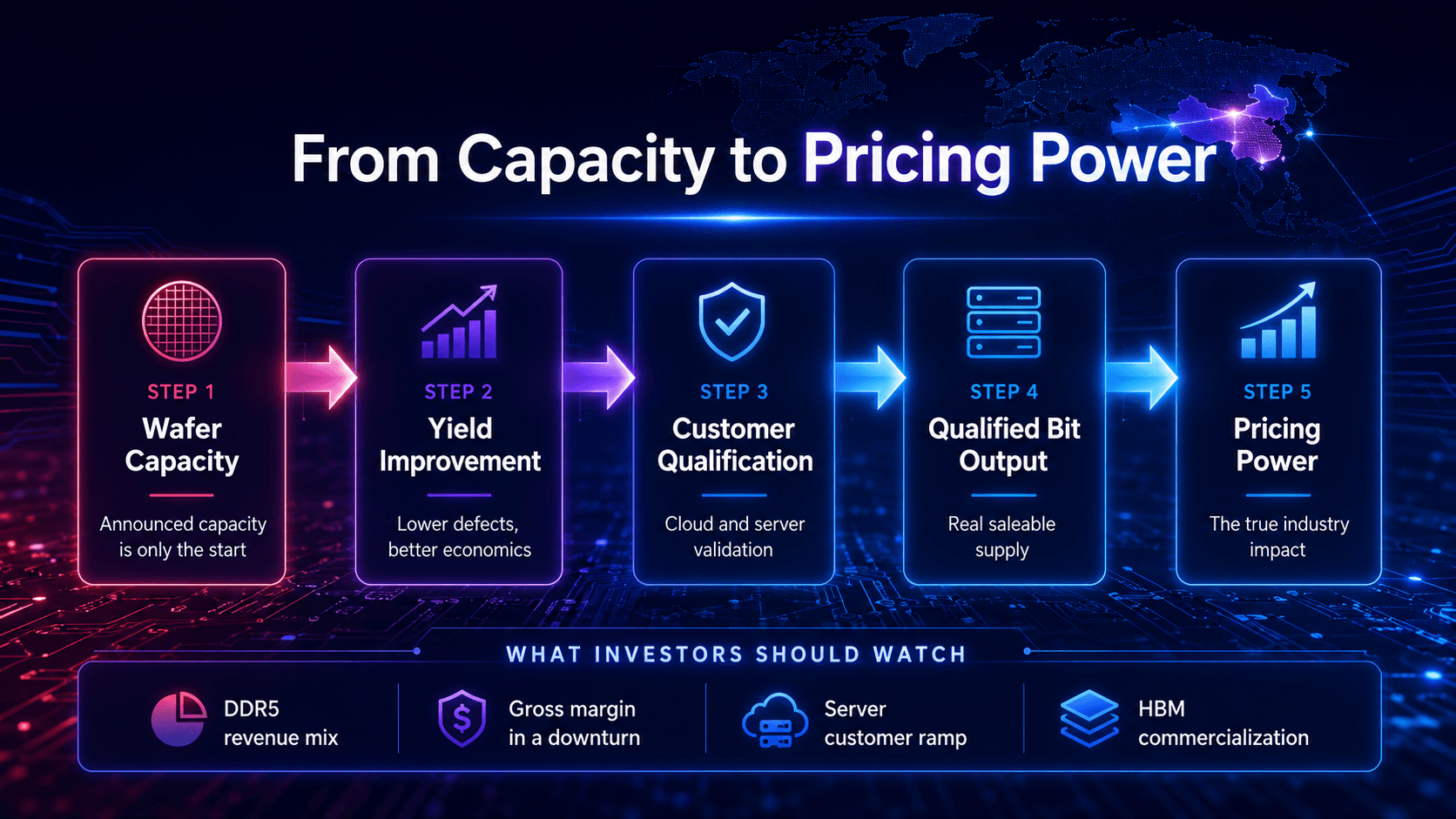
A new fab does not influence global pricing simply because the building is complete. Equipment must be installed, the process must stabilize, yields must improve, customers must qualify the products and commercial shipments must begin.
The variable that matters to the DRAM market is qualified bit output, not announced wafer starts. Two companies with the same nominal wafer capacity can produce very different amounts of usable memory if their die sizes, yields and process efficiency differ.
This is why the yield and cost disclosures are more important than the headline capacity target. CXMT is already large enough to influence supply at the margin, but the size of that impact still depends on the efficiency of the new capacity.
CXMT Does Not Automatically Create a DRAM Glut
CXMT’s expansion does not necessarily mean global DRAM prices are about to collapse. AI servers require much more DRAM per system, HBM consumes significantly more wafer area than conventional memory, and the three incumbents are allocating more production toward higher-value products.
These factors can reduce the amount of capacity available for ordinary DDR and LPDDR even while total capital expenditure rises. CXMT may therefore gain market share inside China without immediately creating an industry-wide oversupply.
A genuine pricing threat would require several conditions to occur together. CXMT would need to bring new capacity online, improve yields, convert customer qualifications into high-volume shipments and add qualified bit output faster than AI and server demand absorb it.
The incumbents’ response also matters. If Samsung, Micron and SK hynix continue moving capacity toward HBM and other high-value products, CXMT could expand in conventional DRAM without immediately destroying industry pricing.
The first effect may therefore be a change in customer share rather than a collapse in global margins.
What Investors Should Watch Next
The most useful indicators are operational rather than market-based. Investors should track DDR5 as a percentage of CXMT’s revenue, the contribution from server customers and the rate at which the fourth-generation platform reduces unit costs.
They should also distinguish announced wafer capacity from qualified bit output. New capacity becomes economically relevant only after yield improves, customer approval is completed and shipments begin.
Gross-margin performance during the next weaker DRAM pricing environment will be the strongest test. CXMT’s core-business gross margin reached 41.02% in 2025, but the industry was benefiting from strong pricing. Maintaining reasonable margins during a downturn would provide much stronger evidence that its cost structure is approaching that of the global leaders.
HBM should remain a separate monitoring variable. Evidence of formal product launches, customer qualification, commercial shipments and disclosed revenue would mark the point at which CXMT begins to approach the profit pool currently dominated by SK hynix, Samsung and Micron.
Conclusion
CXMT is already changing the competitive structure of China’s DRAM market. Its most direct impact falls on Samsung, Micron and SK hynix across mobile LPDDR, PC memory and standard server DDR5.
Samsung has the broadest product overlap, although its actual exposure to individual Chinese customers remains undisclosed. Micron can continue winning in HBM while losing part of its standard server-DRAM business in China. SK hynix has the strongest profit protection because CXMT has not yet demonstrated commercial HBM capability at scale.
SanDisk operates in NAND flash, and Western Digital operates in HDDs. Both may move with broader memory-sector sentiment, but neither is a direct product competitor to CXMT.
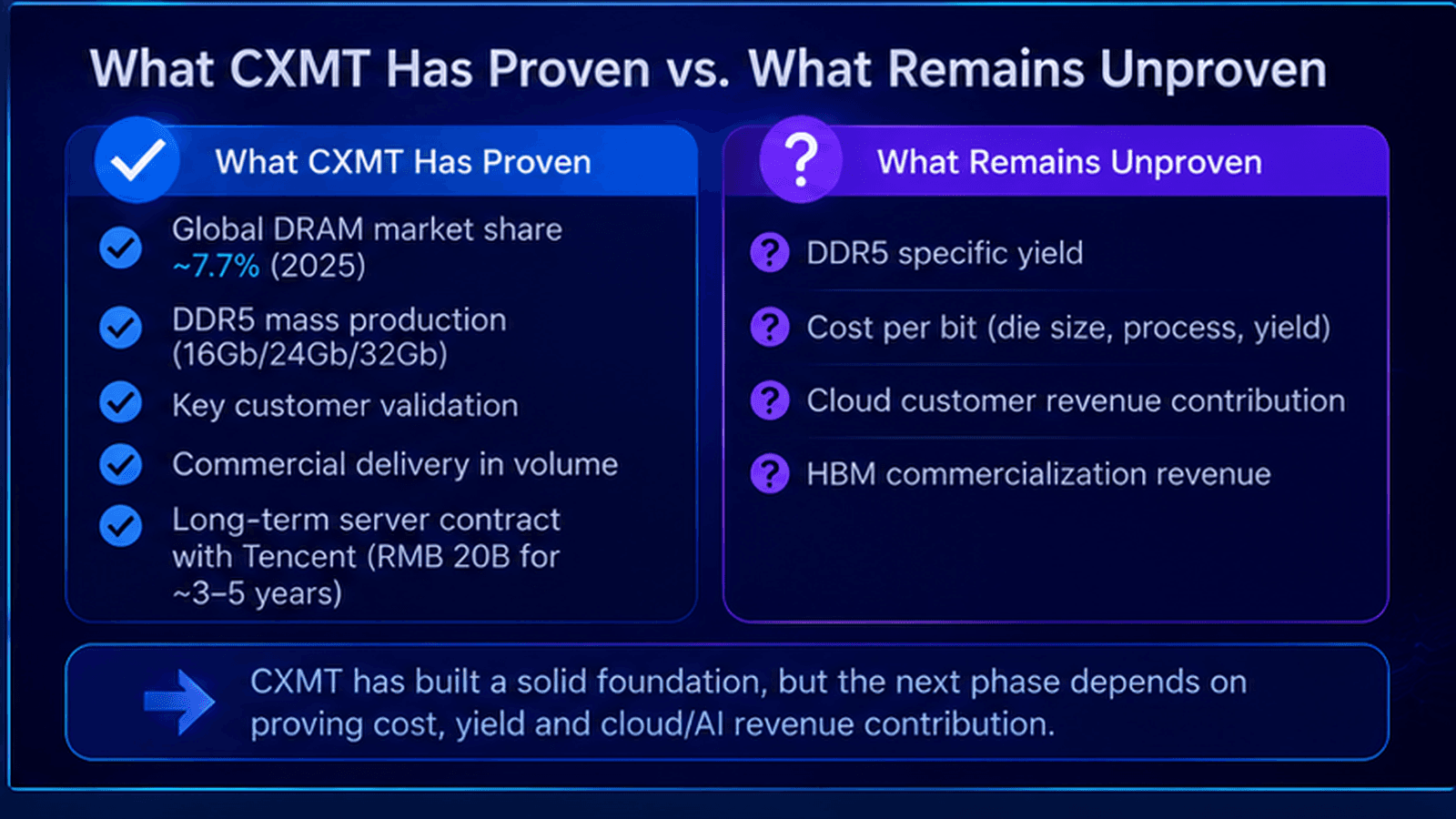
CXMT has already proven that it can reach global scale, manufacture mainstream DRAM, qualify products with major customers and expand into the server market. Its revenue rose from RMB 9.09 billion in 2023 to RMB 61.80 billion in 2025, while core-business gross margin improved from negative 2.19% to 41.02%.
What remains unproven is more important for long-term pricing power: actual DDR5 yield, cost per bit, cloud-customer revenue conversion and commercial HBM revenue.
The market already recognizes CXMT as the fourth-largest DRAM supplier. The next question is whether it can become the fourth company capable of protecting margins and influencing global pricing through a complete memory cycle.
Sources
- Shanghai Stock Exchange — CXMT prospectus — May 2026
- Shanghai Stock Exchange — CXMT exchange inquiry response — May 2026
- Reuters — China’s CXMT wins $3 billion memory supply deal with Tencent — June 29, 2026
- Micron Technology — Micron fiscal Q3 2026 results — June 24, 2026
- Samsung Electronics — Samsung Electronics Q1 2026 results — April 30, 2026
- SK Hynix — SK Hynix FY2025 financial results — January 2026
- Sandisk — Sandisk fiscal Q3 2026 results — April 30, 2026
- Western Digital — Western Digital fiscal Q3 2026 results — April 30, 2026
CXMT listing documents support the company-specific financial, product and customer disclosures. Company earnings materials support incumbent revenue and business-mix figures; Reuters supports the reported Tencent agreement and capacity-expansion context.
Related Reading
What Is CXMT? China’s DRAM Challenger to Samsung, SK Hynix and Micron
ChangXin Memory Technologies is already the world’s fourth-largest DRAM producer. Its Shanghai IPO could accelerate competition in DDR and mobile memory, although the company remains well behind the leaders in HBM.
Micron Is Trying to Escape the Memory Cycle. The Real Test Begins After 2027.
Micron’s AI memory boom is no longer just about one strong quarter. The real question is whether Strategic Customer Agreements, HBM demand, and record capex can turn a memory cycle into a more predictable AI infrastructure business.
SK Hynix Comes to Nasdaq. What It Means for Micron
SK Hynix’s Nasdaq debut ends Micron’s trading scarcity. The harder question is which company can preserve pricing power when new memory supply arrives in 2028.
HBM vs DDR5: What’s the Difference—and Why AI Needs Both
HBM supplies extreme bandwidth to AI accelerators, while DDR5 provides larger pools of system memory. Understanding the difference is essential for analyzing AI infrastructure and memory stocks.

CXMT Was the Headline. Korea’s Deleveraging Drove the Selloff
Why semiconductor stocks fell after strong earnings: CXMT changed the memory supply narrative, while Korea’s leveraged unwind amplified the selloff.
Invest better with thoughtful research.
Join readers who receive our best ideas and insights straight to their inbox.
Disclosure
This article is for research and education only. It is not investment advice.
Comments