SK Hynix is one of the world’s largest manufacturers of memory chips. It produces the DRAM used in servers, computers and mobile devices, the NAND flash used in solid-state drives, and the high-bandwidth memory that sits beside advanced AI accelerators.
The company has attracted far more investor attention since artificial intelligence began driving demand for HBM. According to market data cited in its U.S. registration statement, SK Hynix held approximately 56.4% of the global HBM market by revenue in the first quarter of 2026. That made it the market leader in one of the most important components inside modern AI systems.
Until recently, however, most American investors could not buy SK Hynix as easily as they could buy Micron. SK Hynix’s ordinary shares primarily traded in South Korea, while Micron traded directly on Nasdaq under the ticker $MU.
That changed when SK Hynix introduced American depositary shares on Nasdaq. The new U.S. listing gives investors direct access through the American market, but it does not turn SK Hynix into a U.S. company. Understanding that distinction is the first step toward understanding what the stock represents.
SK Hynix is a South Korean semiconductor company that manufactures DRAM, NAND flash, enterprise SSDs and high-bandwidth memory. U.S. investors can trade its Nasdaq-listed ADSs under $SKHY, with ten ADSs representing one Korean ordinary share. The Nasdaq listing makes the stock easier to buy, but SK Hynix remains a Korean company.
What Does SK Hynix Do?
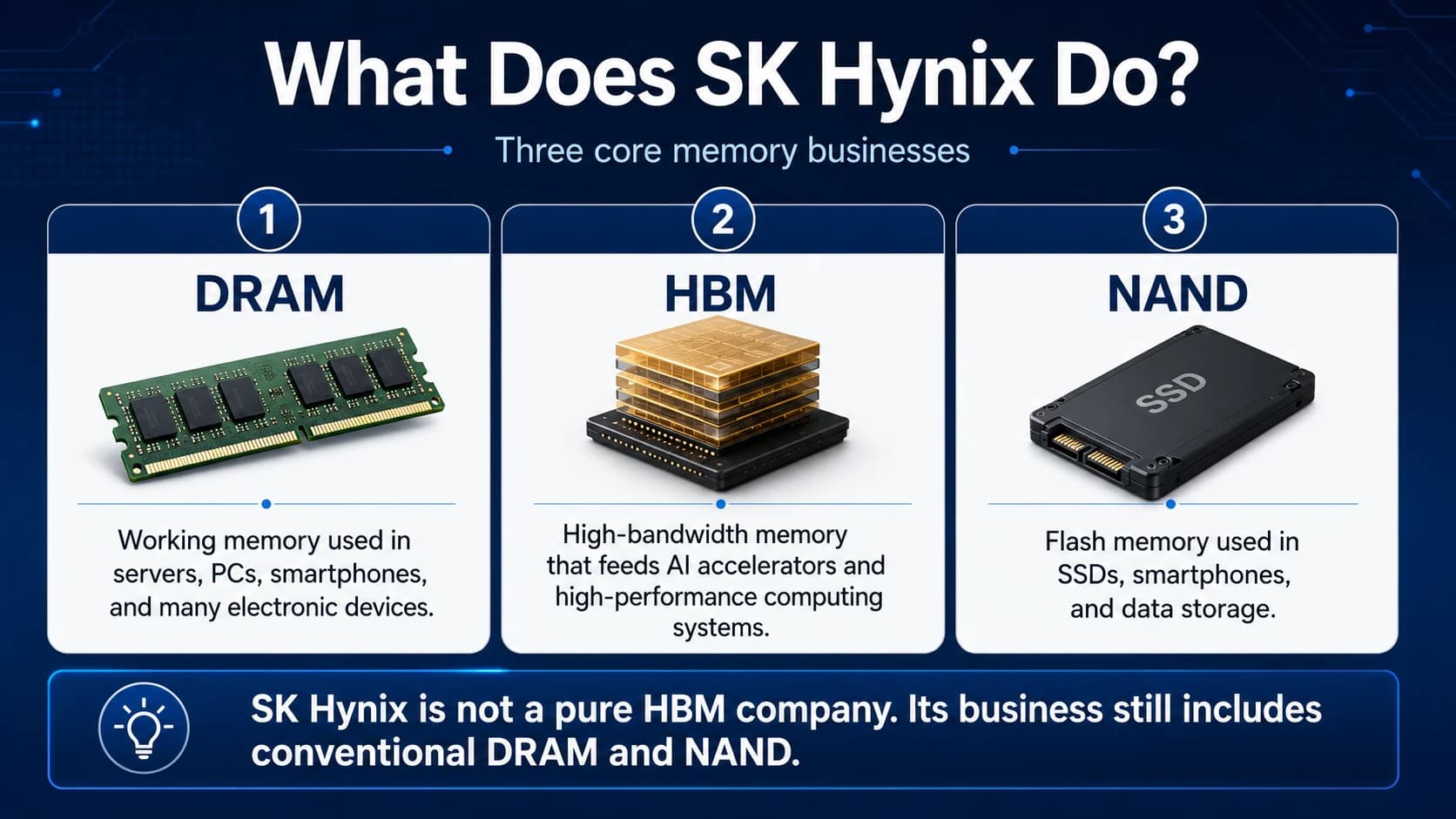
Memory chips allow computing systems to hold and retrieve data. SK Hynix operates across several types of memory, each serving a different purpose.
DRAM is the working memory used while a computer or server is running. When a processor needs rapid access to instructions and data, DRAM provides that temporary workspace. It is used in data centers, PCs, smartphones, automobiles and many other electronic devices.
NAND flash stores information even after the power is turned off. It is the underlying technology used in SSDs, smartphones, memory cards and enterprise storage systems.
HBM, or high-bandwidth memory, is a more advanced form of DRAM. Multiple memory dies are stacked vertically and connected through extremely small electrical pathways. Placing these stacks close to a GPU or AI accelerator allows large amounts of data to move much faster than with traditional memory modules.
That bandwidth has become increasingly important because AI chips must continuously move model weights, training data and intermediate calculations between compute cores and memory. A powerful processor can still sit idle when its memory system cannot supply data quickly enough.
SK Hynix’s early investment in HBM production, stacking, thermal management and advanced packaging helped it build a strong position as AI infrastructure spending accelerated. The company has also developed HBM4 and shipped samples of the next-generation HBM4E to major customers.
SK Hynix is nevertheless broader than its HBM reputation suggests. Its product portfolio still includes conventional DRAM, NAND, enterprise SSDs and memory for mobile, automotive and consumer applications.
That distinction matters for investors. HBM may be the fastest-growing and most valuable part of the business, but SK Hynix is not a pure HBM company. Its earnings can still be affected by pricing cycles in conventional DRAM and NAND.
What Is the SK Hynix U.S. Stock Ticker?
SK Hynix began trading on Nasdaq on July 10, 2026, on a temporary “when-issued” basis under the ticker $SKHYV.
Nasdaq announced that regular-way trading would begin on July 13, 2026, when the symbol changes to $SKHY.
The historical trading information from $SKHYV is expected to carry over to $SKHY. For investors searching for SK Hynix after regular trading begins, $SKHY is the relevant U.S. ticker.
The temporary $SKHYV ticker exists because when-issued trading can begin before the transaction reaches normal settlement. It should not be confused with a second class of permanent SK Hynix stock.
SK Hynix’s Korean ordinary shares continue to trade in South Korea. The Nasdaq security represents those underlying Korean shares through an American depositary structure.
What Is an SK Hynix ADR or ADS?
The terms ADR and ADS are often used interchangeably, although they technically refer to different parts of the same structure.
An American depositary share, or ADS, is the security investors buy and sell. An American depositary receipt, or ADR, is the certificate or arrangement through which a depositary represents the foreign shares.
For SK Hynix:
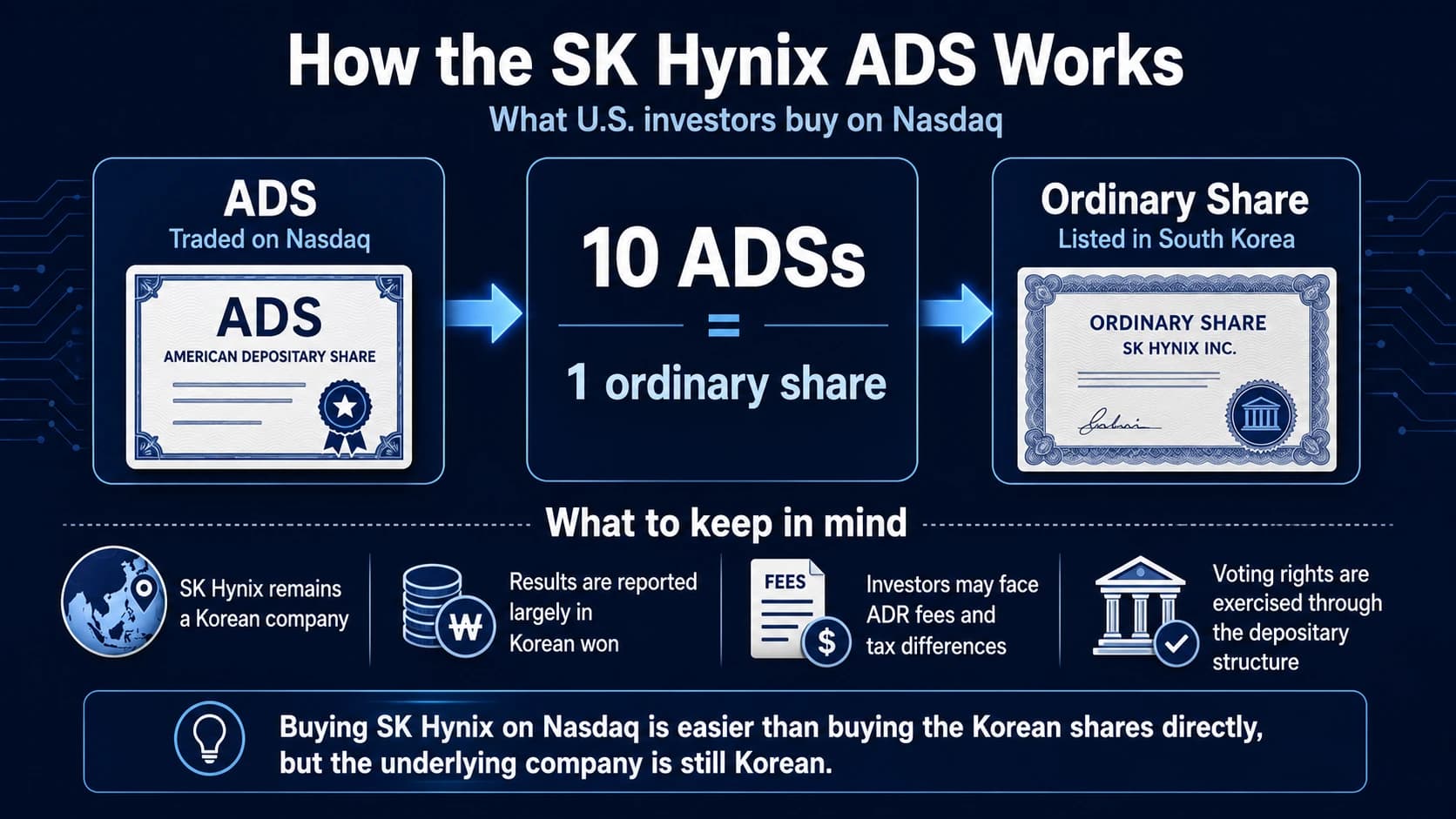
Ten Nasdaq-traded ADSs represent one SK Hynix ordinary share.
Another way to express the same ratio is that each ADS represents one-tenth of a Korean ordinary share. SK Hynix offered 177.9 million ADSs, representing 17.79 million newly issued ordinary shares.
Suppose an investor owns ten $SKHY ADSs. Economically, those ten ADSs represent one underlying SK Hynix ordinary share held through the depositary system.
The ADS ratio does not mean that ten ADSs should have the same numerical price as one Korean share without adjustment. The Korean share trades in won, while the ADS trades in U.S. dollars. Exchange rates and the depositary ratio must both be included when comparing the two prices.
Short-term differences can also appear because the U.S. and Korean markets trade during different hours. Over time, the depositary and market-arbitrage structure should keep the two securities economically connected, subject to currency movements, transaction costs and market conditions.
Is SK Hynix Now an American Company?
No.
SK Hynix remains a corporation organized under the laws of South Korea. Its headquarters, governance structure, primary manufacturing base and underlying cash flows remain tied to Korea even though its ADSs trade on Nasdaq.
A U.S. stock ticker changes how investors access the shares. It does not change the nationality of the underlying company.
This creates several differences from owning a U.S.-domiciled semiconductor company:
- SK Hynix reports much of its financial performance in Korean won.
- Dollar-based investors remain exposed to changes in the won-dollar exchange rate.
- Voting rights are generally exercised through the depositary structure.
- Dividends may be affected by foreign withholding rules and depositary charges.
- Corporate governance remains governed primarily by Korean law.
Investors should review the final prospectus and their broker’s treatment of foreign dividends, ADR fees and taxes before assuming the experience will be identical to holding an ordinary U.S. stock.
Why Did SK Hynix List on Nasdaq?
The listing solves two problems for SK Hynix.
The first is access. Many American investors, funds and brokerage accounts can trade Nasdaq securities more easily than Korean-listed ordinary shares. A U.S. listing can increase liquidity, expand analyst coverage and make SK Hynix easier to compare with Micron and other U.S.-traded semiconductor companies.
The second is capital.
SK Hynix priced 177.9 million ADSs at $149 each, raising approximately $26.5 billion before offering expenses. Because the transaction involved newly issued shares, the listing was also a large equity financing rather than merely a relabeling of existing Korean stock.
The company can use that capital to support new fabrication facilities, production equipment, advanced semiconductor tools and packaging capacity. That may strengthen SK Hynix’s ability to serve growing AI-memory demand.
It also introduces a longer-term question. New capital eventually becomes new production capacity. If SK Hynix, Micron and Samsung all expand aggressively, the memory market could move from shortage toward greater supply later in the decade.
For a deeper discussion of valuation, HBM competition and the 2028 supply cycle, readers can continue with SK Hynix Comes to Nasdaq. What It Means for Micron.
SK Hynix vs. Micron: What Is the Difference?
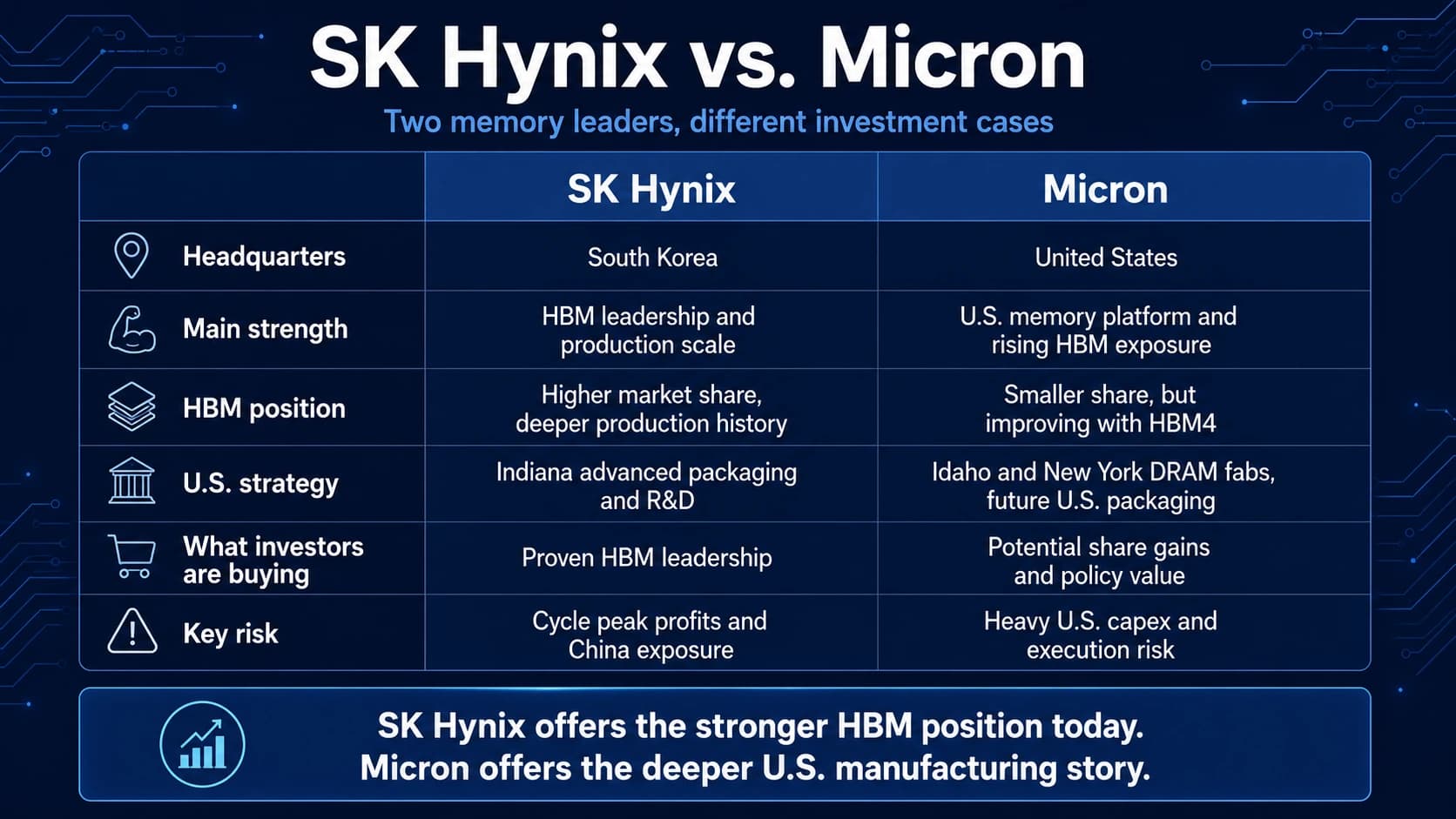
SK Hynix and Micron compete in many of the same markets. Both produce DRAM, NAND and high-performance memory for data centers. Their investment cases are nevertheless different.
SK Hynix enters the U.S. market as the established HBM leader. Micron enters the current AI cycle with a smaller HBM position but a meaningful opportunity to gain share.
Micron has already begun high-volume shipments of its 36GB, 12-layer HBM4 for Nvidia’s Vera Rubin platform. The company says the product provides more than 2.8 terabytes per second of bandwidth and more than 20% better power efficiency than its comparable HBM3E product. Micron’s AI memory test explains why better products and structural demand still need to translate into durable free cash flow.
That means SK Hynix’s lead remains important, but the market is no longer a one-supplier story.
| Question | SK Hynix | Micron |
|---|---|---|
| Where is the company based? | South Korea | United States |
| Main memory products | DRAM, HBM, NAND and SSDs | DRAM, HBM, NAND, NOR and SSDs |
| Main AI-memory advantage | Larger HBM share and longer volume-production history | Potential HBM share gains and improving product execution |
| U.S. stock ticker | $SKHY | $MU |
| Main U.S. manufacturing role | HBM advanced packaging and R&D in Indiana | Front-end DRAM fabs in Idaho and New York, plus existing Virginia operations |
| Main strategic appeal | Proven HBM leadership | U.S. manufacturing position and potential HBM upside |
| Important risks | Memory cyclicality, customer concentration, China exposure and Korean governance | High U.S. construction costs, execution risk and heavy capital spending |
The difference in U.S. manufacturing is particularly important.
The U.S. government has awarded SK Hynix up to $458 million in direct CHIPS funding to establish an HBM advanced-packaging fabrication and R&D facility in West Lafayette, Indiana. The project brings advanced packaging closer to American AI customers, but it is not designed as a complete front-end DRAM wafer fab.
Micron’s Idaho and New York projects go further into front-end production. The New York plan includes leading-edge DRAM fabs, while the Idaho expansion also focuses on high-volume advanced DRAM manufacturing.
SK Hynix therefore offers U.S. investors access to the current HBM leader. Micron offers exposure to an American memory manufacturer building a deeper domestic production base.
Does the SK Hynix Nasdaq Listing Hurt Micron?
It weakens one part of Micron’s investment case.
Before the SK Hynix listing, Micron was effectively the easiest large pure-play memory manufacturer for U.S. investors to own. Funds seeking direct exposure to DRAM, NAND and HBM had few comparable American-market alternatives.
With $SKHY, investors can allocate directly to the company with the larger HBM market share. Some money that previously entered $MU because of limited alternatives may move toward SK Hynix.
Micron still retains a different type of scarcity.
It remains the only U.S.-headquartered member of the three-company group that dominates advanced DRAM. It is also building leading-edge DRAM capacity in the United States and manufactures DRAM, NAND and NOR products across a broad portfolio.
SK Hynix removes Micron’s trading scarcity. It does not remove Micron’s industrial and policy scarcity.
The Nasdaq listing could even help Micron in some circumstances. If investors assign SK Hynix a higher valuation because of its HBM position, the stock may become a stronger public-market reference point for the entire memory industry. The listing can create capital competition and a new valuation benchmark at the same time.
Can U.S. Investors Buy SK Hynix Stock Directly?
Investors whose broker supports Nasdaq-listed ADSs should be able to trade SK Hynix under $SKHY after regular-way trading begins.
They are buying the ADS, not opening a Korean brokerage account or purchasing the ordinary share directly on the Korea Exchange.
Before placing an order, investors should check:
- Whether their broker has updated the temporary $SKHYV symbol to $SKHY.
- Whether the account supports foreign-company ADSs.
- How the broker handles ADR fees and foreign dividends.
- Whether options, margin or fractional-share trading are available.
- The difference between the U.S. market price and the value implied by the Korean ordinary share and exchange rate.
Trading access is easier than before. The business itself remains a foreign issuer with foreign-currency, governance and geopolitical exposure.
What Should Beginners Watch After Buying SK Hynix?
The first number many investors will watch is HBM market share. That is useful, but it does not tell the whole story.
A more complete view begins with four questions.
Can SK Hynix maintain its HBM lead? Samsung and Micron are both advancing their HBM4 products. Future returns will depend on yield, cost, power efficiency, packaging capacity and customer qualification—not only headline performance.
Can demand grow as quickly as supply? SK Hynix is raising capital and expanding production, while Micron and Samsung are building capacity of their own. Strong demand can absorb new supply; slower demand can pressure memory prices. Our guide to reading the AI cycle through CapEx and supply bottlenecks provides a broader framework for that question.
Does profit turn into free cash flow? Memory production requires expensive factories and constant investment in new process technology. High earnings do not automatically mean that the same amount of cash is available to shareholders. The same discipline applies when asking whether AI CapEx can earn an adequate payback.
How much risk comes from the underlying Korean company? Investors should consider currency movements, customer concentration, Chinese manufacturing exposure and the governance structure of the SK group alongside the AI-growth story.
These questions determine whether SK Hynix is simply earning unusually high profits during a favorable cycle or has permanently improved the economics of its business.
The Bottom Line
SK Hynix is a South Korean memory manufacturer with leading positions in DRAM, NAND and high-bandwidth memory. Its Nasdaq ADS gives American investors a much easier way to own the company, with ten ADSs representing one Korean ordinary share.
The listing makes SK Hynix easier to buy. It does not make the company American, remove memory cyclicality or turn the business into a pure HBM investment.
Compared with Micron, SK Hynix offers more established HBM leadership. Micron offers a stronger U.S. manufacturing position and the possibility of gaining HBM share from a lower starting point.
For beginners, the cleanest distinction is:
SK Hynix represents proven HBM leadership. Micron represents U.S. manufacturing scarcity and potential HBM share gains.
Choosing between them requires more than comparing current earnings multiples. Investors eventually need to decide which company can preserve pricing power and free cash flow as the industry builds more memory capacity.
That deeper question is examined in our full industry analysis of SK Hynix and Micron.
Frequently Asked Questions
What is SK Hynix?
SK Hynix is a South Korean semiconductor company that manufactures DRAM, NAND flash, enterprise SSDs and high-bandwidth memory. It held approximately 56.4% of the global HBM market by revenue in the first quarter of 2026, according to data cited in its U.S. registration filing.
What is the SK Hynix stock ticker in the United States?
SK Hynix used the temporary ticker $SKHYV for when-issued trading on July 10, 2026. Regular-way Nasdaq trading is scheduled to use $SKHY beginning July 13, 2026.
What does one SK Hynix ADS represent?
One SK Hynix ADS represents one-tenth of one Korean ordinary share. Ten ADSs therefore represent one ordinary share.
Is SK Hynix an American company?
No. SK Hynix remains a Korean corporation. The Nasdaq ADS changes where and how investors can trade an interest in the company, but it does not change its nationality or underlying governance structure.
Can U.S. investors buy SK Hynix?
Investors using a brokerage that supports Nasdaq-listed ADSs should be able to trade SK Hynix under $SKHY after regular-way trading begins. Brokerage availability and account permissions may vary.
Is SK Hynix a pure HBM company?
No. HBM is an important part of its DRAM business, but SK Hynix also produces conventional DRAM, NAND flash, enterprise SSDs and other memory products.
Does SK Hynix compete with Micron?
Yes. The companies compete in DRAM, NAND, HBM and data-center memory. SK Hynix currently has the stronger HBM market position, while Micron is expanding HBM4 production and investing heavily in U.S. DRAM manufacturing.
Does the SK Hynix listing make Micron less valuable?
The listing removes Micron’s position as the only easily accessible large memory manufacturer in the U.S. market. Micron still retains strategic value as a U.S.-headquartered DRAM manufacturer building advanced domestic fabs.
What are the main risks of investing in SK Hynix?
Major risks include memory-price cyclicality, large capital-spending requirements, customer concentration, currency movements, exposure to Chinese manufacturing assets and the possibility that competitors gain HBM market share.
Sources
| No. | Source | Publisher | Date | Type | What it supports |
|---|---|---|---|---|---|
| 1 | SK Hynix U.S. registration statement | SEC EDGAR | 2026 | SEC | HBM market share, business structure, customer concentration and risk disclosures. |
| 2 | SK Hynix final offering document | SEC EDGAR | 2026 | SEC | ADS ratio, offering size, newly issued shares, Korean corporate status and use of proceeds. |
| 3 | Nasdaq Trader notice | Nasdaq Trader | 2026-07 | Exchange notice | Temporary $SKHYV symbol and transition to regular-way trading under $SKHY. |
| 4 | SK Hynix corporate profile | SK Hynix | Current | Company information | DRAM, NAND, SSD and memory-product descriptions. |
| 5 | SK Hynix completes HBM4 development | SK Hynix | 2025–2026 | Company IR | HBM4 development and production progress. |
| 6 | Micron begins HBM4 high-volume production for Nvidia Vera Rubin | Micron Technology | 2026 | Company IR | Micron HBM4 specifications, Vera Rubin participation and production status. |
| 7 | SK Hynix Indiana CHIPS award | U.S. Department of Commerce / NIST | 2024-12 | Government | Indiana advanced-packaging facility, direct funding, loans and project scope. |
| 8 | CHIPS incentives award for Micron’s Idaho and New York projects | U.S. Department of Commerce / NIST | 2024-12 | Government | Micron’s front-end U.S. DRAM manufacturing strategy in Idaho and New York. |
Primary filings, exchange notices, company materials and U.S. government sources support the company, offering, product and manufacturing details in this guide.
Related Reading
SK Hynix Comes to Nasdaq. What It Means for Micron
SK Hynix’s Nasdaq debut ends Micron’s trading scarcity. The harder question is which company can preserve pricing power when new memory supply arrives in 2028.
Micron Is Trying to Escape the Memory Cycle. The Real Test Begins After 2027.
Micron’s AI memory boom is no longer just about one strong quarter. The real question is whether Strategic Customer Agreements, HBM demand, and record capex can turn a memory cycle into a more predictable AI infrastructure business.

How to Read the AI Cycle: CapEx, Supply Bottlenecks, and the Semiconductor Trade
AI infrastructure spending is still expanding, but the semiconductor equity trade is becoming more fragile. The next phase depends on CapEx, supply bottlenecks, usage, pricing, and earnings revisions.
Can AI CapEx Pay Off? Start With Token Cost, Then Watch the Payback Period.
Nvidia is showing that the unit cost of AI production is falling. Investors are asking whether cheaper tokens can turn into visible profits and free cash flow fast enough.
Invest better with thoughtful research.
Join readers who receive our best ideas and insights straight to their inbox.
Disclosure
This article is for research and education only. It is not investment advice.
Comments