Key Takeaways
- Salesforce's 23% post-earnings rally was not a revenue breakout; Q2 organic growth stayed near 7% after stripping out Informatica, but the quarter weakened the most aggressive version of the "AI destroys SaaS" thesis.
- Salesforce is replacing the per-seat SaaS formula with a hybrid model that monetizes human seats, agent actions, data usage, and outcomes, with the Flex Agreement as the bridge between the two pricing systems.
- Agentforce has passed a real-consumption test, with credit refills and paid production customers rising sharply, but the first-cycle full-renewal test, the key net-expansion signal, has not yet been reported.
- Data 360, not Agentforce, may end up being the longer-term revenue engine because every agent action still requires trusted enterprise data, permissions, and audit trails.
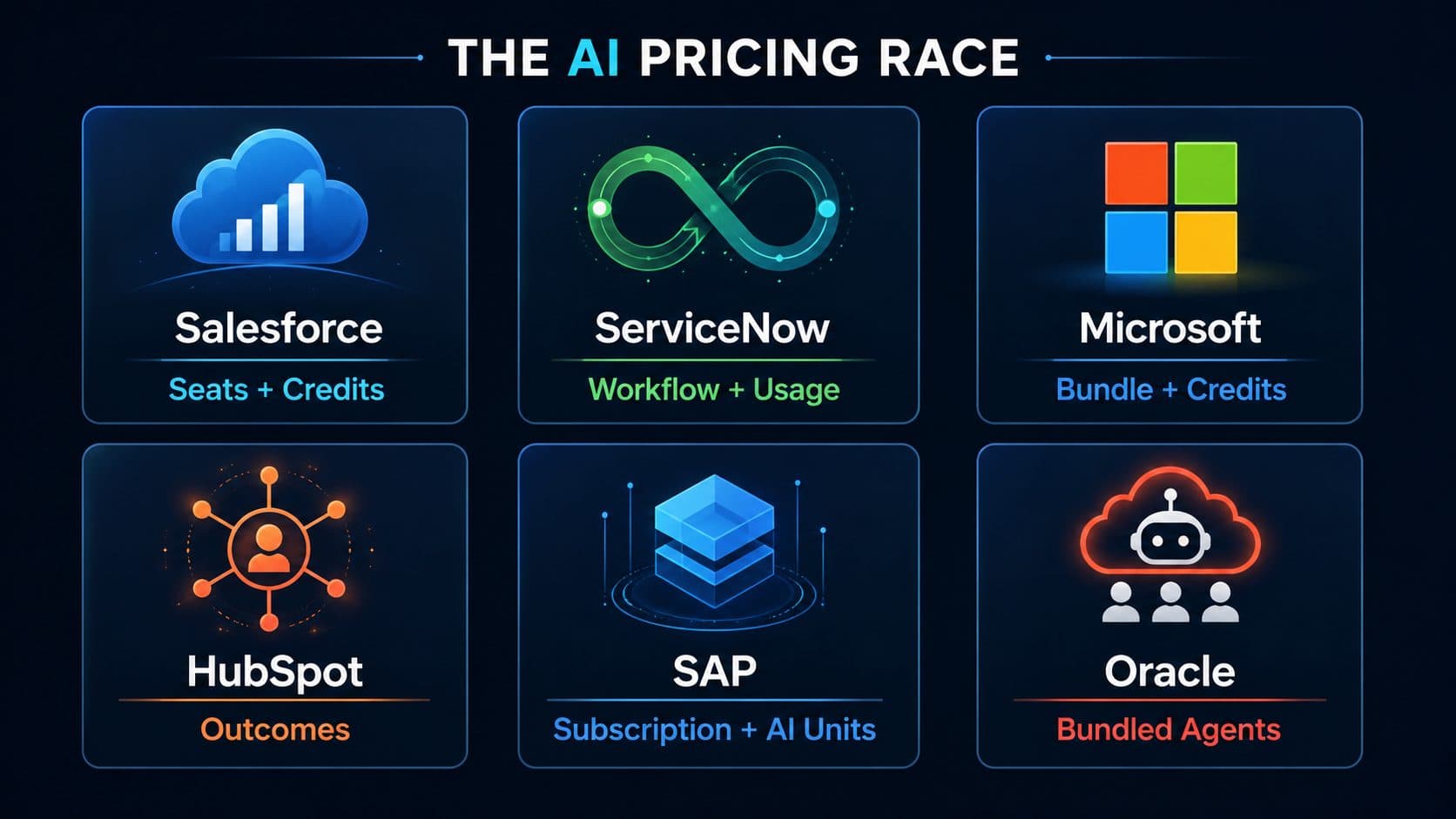
- ServiceNow, Microsoft, HubSpot, SAP, Oracle, and Adobe are rewriting the same pricing rules, and the next software moat will be defined by who controls enterprise data, identity, permissions, and execution, not by who owns the user interface.
Salesforce shares jumped 23% after earnings, their best one-day performance in six years. On the surface, investors were rewarding a better-than-expected quarter. The deeper shift was a retreat from one of the harshest assumptions weighing on software stocks over the past year: that AI agents would make employees more productive, reduce software seats, and steadily erode the per-user economics of traditional SaaS.
The quarter offered real evidence against that thesis. Salesforce's traditional seat business did not collapse, attrition remained near historic lows, contract duration improved, and growth in net new annual order value reached a four-year high. At the same time, Agentforce began generating actual consumption and repeat purchases, giving investors their first credible glimpse of a model in which revenue from human users and digital labor can coexist.
Still, a 23% rally was far larger than the underlying improvement in the quarter. Salesforce has not shown that organic growth is back above 10%, nor has it proved that Agentforce can offset any future seat contraction after customers complete a full renewal cycle. The repricing reflects a lower probability that AI will permanently destroy software terminal values. It does not mean the agent wars are over.
This Was Not a Revenue Breakout
Salesforce reported second-quarter revenue of $11.35 billion, up 11% year over year. Subscription and support revenue rose 12% to $10.82 billion, while current remaining performance obligations reached $33.5 billion, up 14% in constant currency. Operating cash flow increased 71%, free cash flow rose 81%, and the non-GAAP operating margin reached 34.1%. Together, those figures point to improving contract momentum, profitability, and cash generation. Salesforce Q2 FY27 earnings release
Revenue, however, beat consensus by only about $20 million, and $456 million of the total came from Informatica. Excluding that contribution, Salesforce's organic growth remained close to 7%. The company raised full-year revenue guidance by $200 million: roughly $100 million came from better organic expectations and about $200 million from the pending Contentful and Fin acquisitions, partly offset by an approximately $100 million foreign-exchange headwind.
Adjusted earnings of $5.90 per share also require normalization. Strategic investment gains contributed $2.53 per share, while buybacks reduced the share count and lifted EPS. Excluding the investment gain, adjusted EPS was approximately $3.37, only modestly above the $3.28 consensus estimate. Reuters
Investors were not chasing a sudden acceleration to 20% growth. Salesforce had fallen more than 20% earlier in the year, and the broader software sector had endured a persistent valuation discount based on the idea that agents would replace SaaS. When the quarter showed both stable traditional contracts and repeat AI consumption, the most aggressive link in the bearish argument weakened. A large portion of that valuation repair was compressed into a single trading day.
The Unit of Software Pricing Is Changing
The traditional SaaS revenue formula is straightforward:
Revenue = Paid employees × Price per seat
If AI raises output per employee, companies may need fewer people in sales, customer service, and back-office roles. A vendor that charges only by headcount will see revenue decline alongside its customers' workforces. Salesforce is building a hybrid model instead:
Revenue = Base platform fee + Human seats + AI premium + Agent actions + Data usage + Outcomes
Agentforce now supports several charging mechanisms. Flex Credits cost $500 per 100,000 credits, while a standard agent action consumes 20 credits, equivalent to about $0.10. Customers can also pay by conversation or buy per-user Agentforce licenses and premium editions. Agentforce 1 Editions start at $550 per user per month and bundle premium applications, Flex Credits, Data 360, and Slack. Salesforce Agentforce pricing
The most strategically important feature is the Flex Agreement. During a contract term, customers can convert traditional user licenses into Flex Credits and convert credits back into user licenses. Salesforce Flex Agreement
Consider a company that once bought 1,000 seats but needs only 800 employees after deploying AI. Salesforce would normally lose 200 seats. A Flex Agreement lets the customer redirect that budget toward agent consumption. Salesforce no longer has to defend every human seat as long as it can preserve the customer's total spending on human and digital labor within its platform.
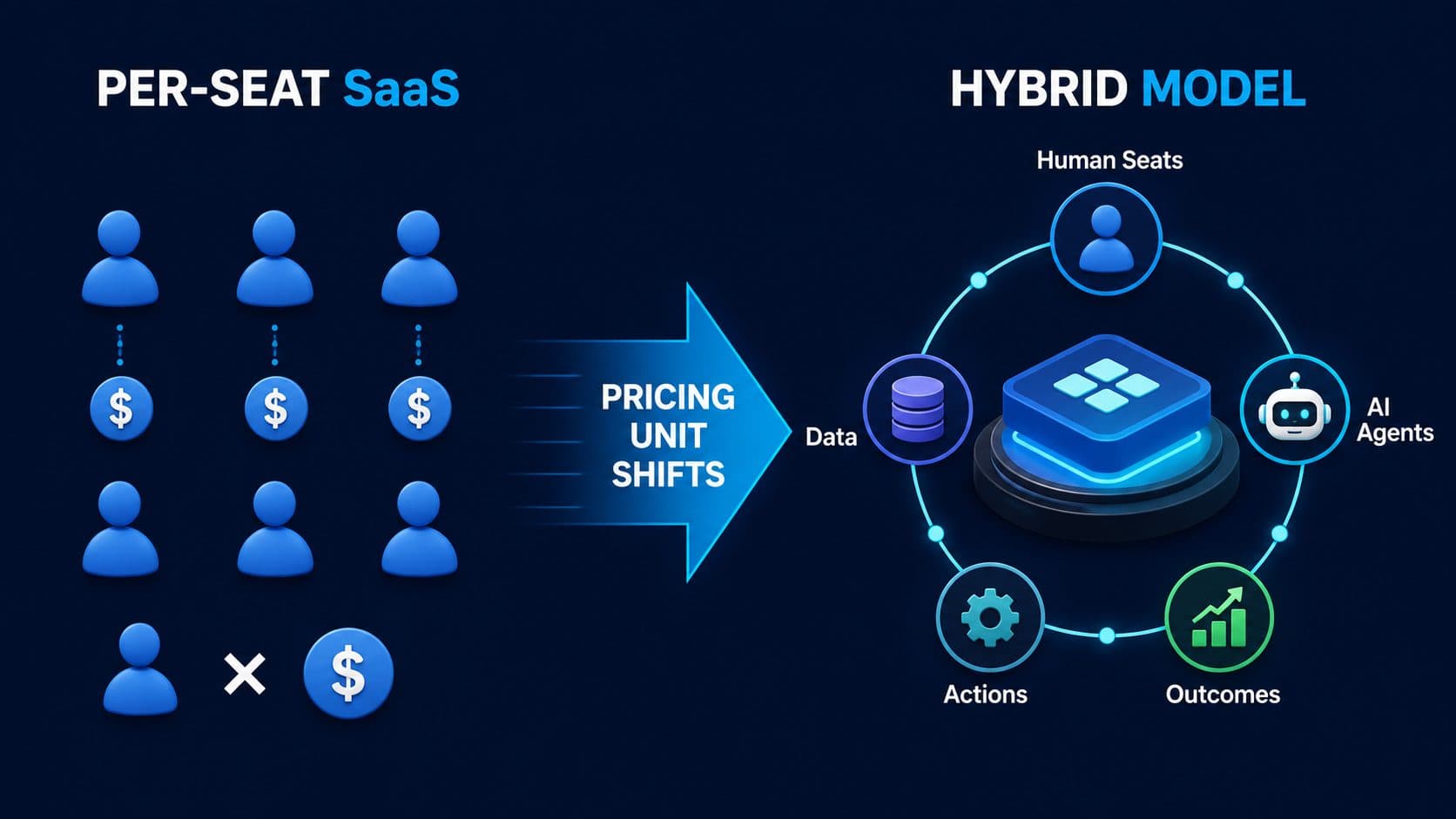
That design changes the meaning of software pricing power. Historically, pricing power meant raising the price per seat without increasing churn. In the next model, it will depend on whether a software company can move customer budgets from human seats into machine workloads, data calls, and business outcomes while maintaining the total contract value.
Agentforce Has Passed the Usage Test, but Not the Full Renewal Test
Agentforce annual recurring revenue exceeded $1.5 billion, growing more than 240% year over year. Combined ARR for Agentforce and Data 360 approached $3.9 billion, up more than 210%. The platform generated 3.2 billion Agentic Work Units in the second quarter, a 97% sequential increase, while bookings for premium SKUs such as Agentforce One Edition doubled from the prior quarter. Salesforce Q2 FY27 results
The most valuable signal is not the ARR growth rate. It is that roughly half of Agentforce bookings came from customers replenishing credits. Salesforce also added about 2,000 customers in paid production, up 70% sequentially. An initial purchase proves willingness to experiment, production deployment shows the product has moved beyond a pilot, and a credit refill demonstrates actual usage and willingness to pay again.
A refill is not the same as a successful renewal. Buying more credits after exhausting an allocation within the original contract proves that demand exists. Only a renewed commitment at the end of the contract, and a new total contract value above the old one, can prove that Agentforce produces net expansion.
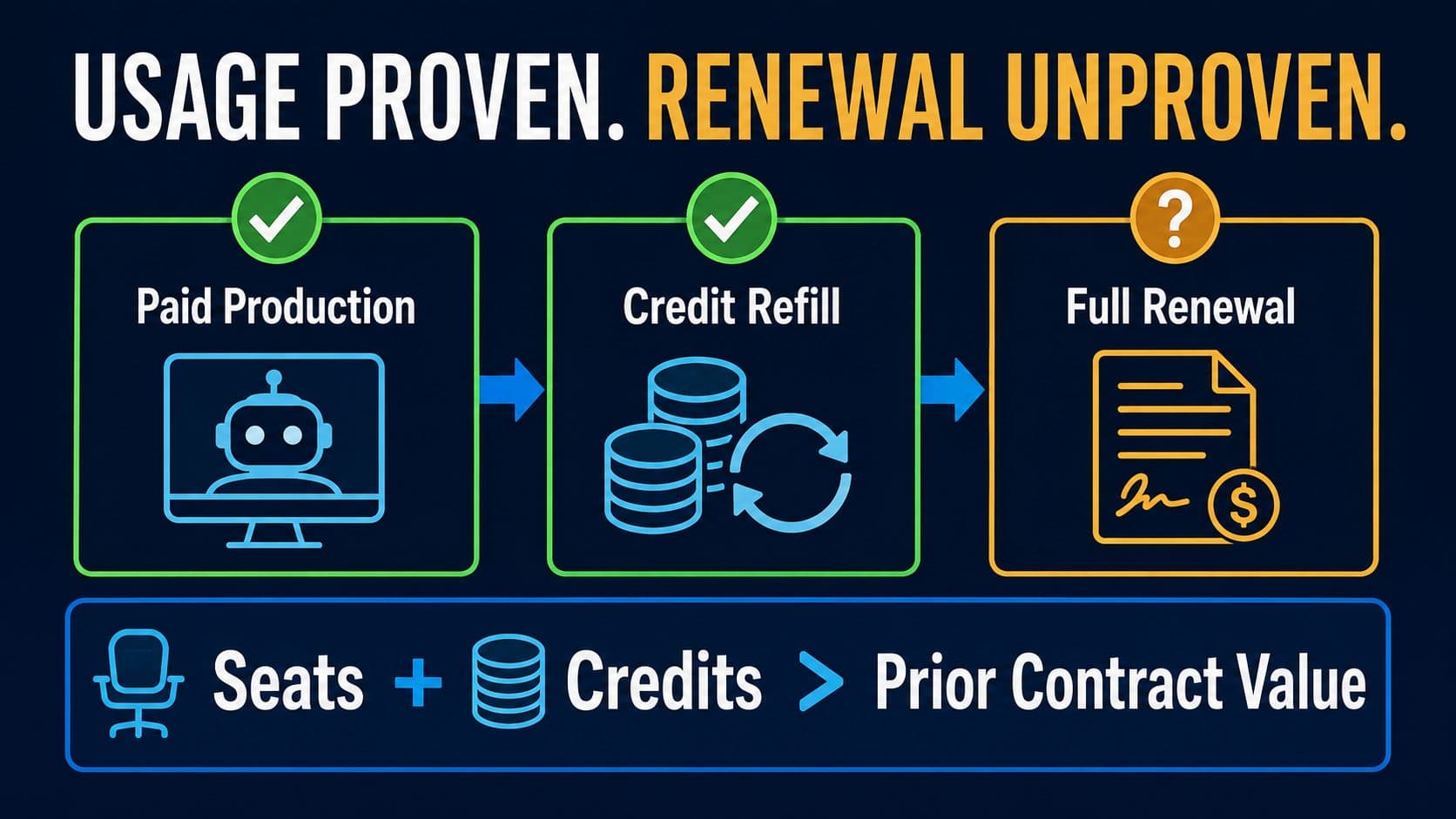
Flex Credits launched in May 2025, so the first cohort of annual customers began reaching renewal from mid-2026. The equation to watch is:
Post-renewal seat value + Post-renewal credit value > Pre-renewal total contract value
Salesforce has not disclosed first-cycle Agentforce renewal rates, changes in traditional seats among renewing customers, the value of credits converted from licenses, or changes in total ACV before and after deployment at the same customer. We can now say Agentforce has passed a real-consumption test. We cannot yet say it has passed the full-renewal test for net expansion.
The 240% Growth Rate Is Less Clean Than It Looks
Beginning in FY27, Salesforce reorganized subscription revenue into two broad categories. Agentforce Apps includes Sales, Service, Marketing, Commerce, Slack, and Agentforce Apps Flex Credits. Data 360, Headless Platform & Other includes Data 360, platform credits, Headless, Informatica, MuleSoft, and Tableau.
Second-quarter Agentforce Apps revenue was $7.193 billion, up 8%. Data 360, Headless Platform & Other generated $3.618 billion, up 20%, with the latter category also benefiting from the Informatica acquisition. Salesforce Q2 financial disclosures
Put beside Agentforce ARR growth of 240%, these figures imply that the fast-growing AI business remains a small part of Salesforce or is offsetting weakness in mature products. The new classification puts established Sales and Service revenue, Slack, and Agentforce credits into the same $7.193 billion bucket. Investors cannot identify Agentforce's true net contribution.
The ARR definition has also expanded. Starting in Q2, Salesforce included Slackbot, Headless 360, and other AI products in Agentforce ARR. The $3.4 billion combined Agentforce and Data 360 ARR disclosed in Q1 explicitly included $1.1 billion of Informatica Cloud ARR. Neither the $1.5 billion Agentforce figure nor the $3.9 billion combined figure should therefore be treated as pure, organically developed Agentforce revenue.
That does not invalidate the demand signal, but it raises the research burden. The market is assigning Salesforce a higher valuation because of Agentforce at the same time that the company's reporting makes it harder to separate incremental AI revenue from displaced traditional software revenue. If future quarters still omit Agentforce revenue, consumption rates, and customer-level total ACV, the 240% growth headline deserves a continued disclosure discount.
Agentforce May Be the Entry Point, but Data 360 Could Be the Long-Term Revenue Engine
To issue a refund, revise a quote, update a sales opportunity, or execute an approval, an AI agent must read customer data, historical contracts, permissions, business rules, and real-time transaction status. As model costs decline, data preparation, identity resolution, permission governance, and auditable access become more important, not less.
Salesforce's usage data already reflects this path. Data 360 ingested 52 trillion records in Q1 and 104 trillion in Q2. Zero Copy records increased from 35 trillion to 82 trillion, more than doubling in one quarter. To deploy agents, customers often need to unify data, process unstructured content, and establish permissions first, ultimately driving consumption across Data 360, Informatica, and integration products.
The resulting revenue chain may prove more durable:
Agent demand → Data unification → Permission governance → Real-time calls → Data 360 consumption
Agentforce makes the business outcome visible; Data 360 gives the agent trusted context. Models can be swapped, but customer data, permission structures, and business states are difficult to migrate. Salesforce may ultimately be trying to control the context layer through which every agent must pass to access enterprise data and execute commercial actions.
One Agent Action Can Create Multiple Revenue Layers
Salesforce's AI monetization does not stop with the action itself. Executing a task consumes Flex Credits. Reading, unifying, and processing data increases Data 360 usage. Session Tracing records interactions, tool calls, error rates, and decision paths, then stores that information in Data 360. Storage beyond the allocated Session Tracing allowance consumes additional Data 360 credits. Agentforce Session Tracing
Once an agent can change a price, send a contract, or approve a refund, enterprises also need long-term field history, event monitoring, encryption, permission audits, and compliance records. That can support additional demand for Field Audit Trail, Shield, and related governance products.
A single agent action can therefore generate several layers of revenue:
Action usage + Data usage + Trace storage + Monitoring and analytics + Security and audit
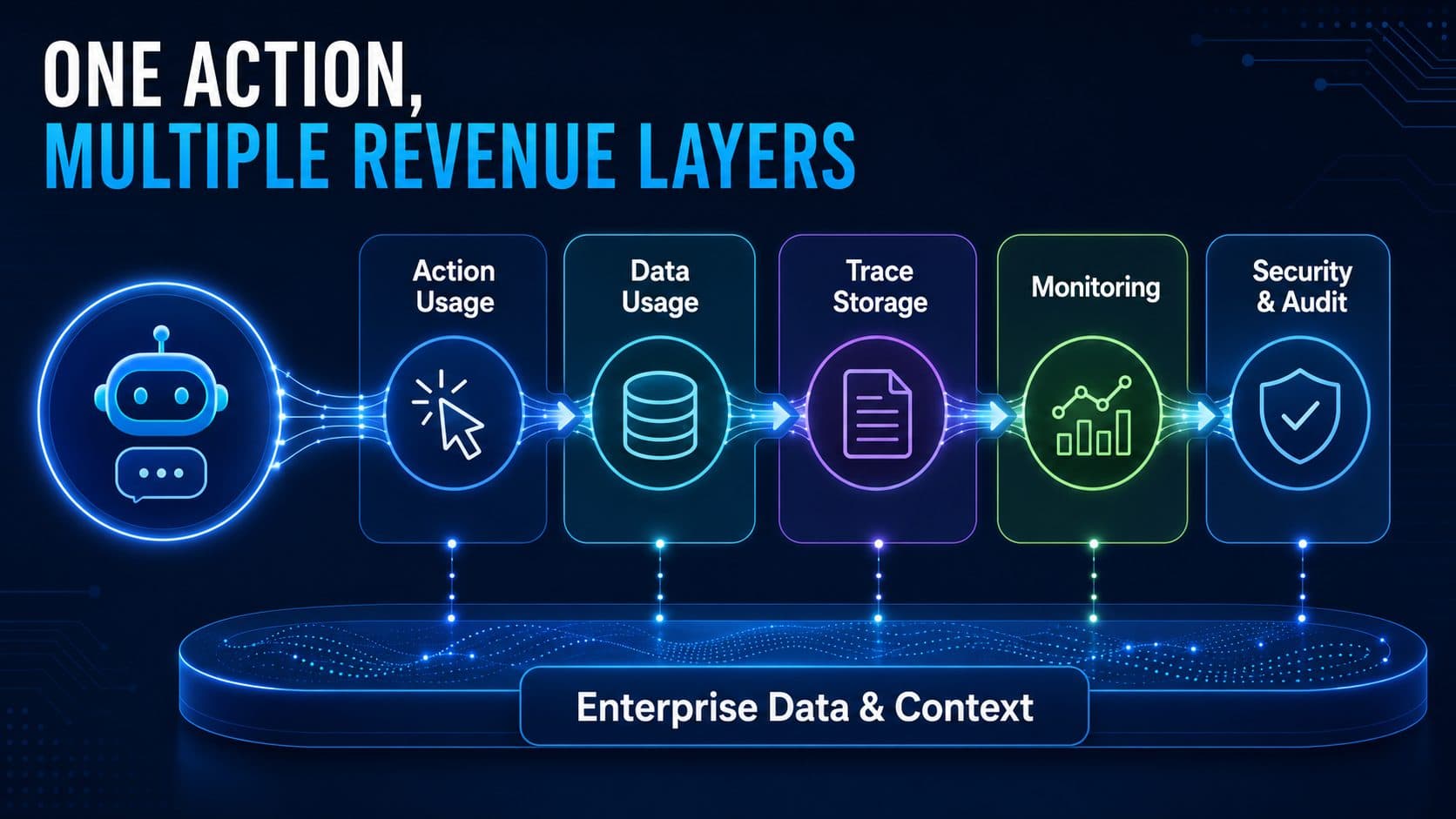
This may be the most underappreciated part of the model. Enterprises can choose Claude, OpenAI, or another model, but they cannot easily eliminate data permissions, behavioral tracing, and accountability records. Lower model prices may not weaken Salesforce. As agents gain more authority, governance and audit requirements should become more valuable.
Agent Unit Economics Remain a Black Box
The marginal cost of adding a user to traditional SaaS is low. Every completed agent action, however, may incur model inference, retrieval, voice, data-processing, and third-party API costs. Software gross margins will need a different formula:
Gross profit per outcome = Outcome revenue − Model cost − Data cost − Third-party share − Failure and human handoff cost
Salesforce reports AWUs, ARR, production customers, and credit replenishment, but it does not map AWUs to paid actions or separate free, bundled, and paid usage. Investors cannot calculate revenue from 3.2 billion AWUs, much less determine Agentforce's standalone gross margin.
Falling model costs could expand margins, but competition could force Salesforce to pass all of those savings to customers. Microsoft can cross-subsidize across Copilot, Dynamics, and Azure. Oracle includes many prebuilt Fusion agents in existing subscriptions at no extra charge. HubSpot now charges $0.50 only when its Customer Agent successfully resolves an issue. Whether Agentforce becomes a high-margin business will depend on the spread between the rate of price compression and the rate of inference-cost decline.
Competitors Are Rewriting the Same Rules
ServiceNow offers the strongest operating comparison today. Second-quarter subscription revenue grew 23% in constant currency, cRPO increased 21.5%, AI product ACV surpassed $1 billion, and net new ACV deals above $1 million rose nearly 40%. ServiceNow controls IT tickets, assets, approvals, risk, and cross-functional workflows, placing it in direct competition with Salesforce for the enterprise agent control layer. ServiceNow Q2 2026 results
Microsoft is the largest source of pricing pressure. Microsoft 365 Copilot has more than 30 million paid seats, while Dynamics 365 grew 12% in constant currency. Copilot Studio uses both seats and credits, and Microsoft can package Office, Teams, identity, Power Platform, Dynamics, and Azure within the same enterprise agreement. That lowers the incremental procurement cost of adopting agents. Microsoft FY26 Q4 results
HubSpot has moved faster on outcome-based pricing. Second-quarter revenue grew 17% in constant currency, customer count increased 14%, and average subscription revenue per customer rose 4%. Breeze Customer Agent shifted from charging per conversation to charging $0.50 per successful resolution; there is no charge when an issue is handed to a person or remains unresolved. Prospecting Agent charges for recommended qualified leads. HubSpot Q2 2026 results and HubSpot outcome pricing
SAP's cloud ERP revenue rose 27% in constant currency in the second quarter, while current cloud backlog grew 26%. Basic Joule functionality is included in cloud subscriptions, with premium agents charged by usage through AI Units. SAP owns critical finance, procurement, inventory, manufacturing, and human-resources data, giving it a formidable context advantage in core back-office processes. SAP Q2 2026 results
Oracle has chosen to bundle many prebuilt AI agents into Fusion Applications at no additional cost, using AI to strengthen suite renewals and cloud migration rather than rushing to monetize agents separately. Cloud Applications grew 9% in constant currency, well below OCI. Its $638 billion RPO is driven largely by major AI infrastructure contracts and should not be used as evidence of agent pricing power in applications. Oracle FY26 Q4 results
Adobe's AI-first ARR has surpassed $500 million and roughly tripled year over year, but it still represents only about 2% of total ARR of $27.1 billion. Adobe is expanding free access to Firefly, Express, and Acrobat while delaying some Creative Cloud price increases, prioritizing user acquisition and workflow adoption. It has demonstrated rapid growth in AI usage, but not as clearly as Salesforce or ServiceNow that AI is raising total contract value. Adobe Q2 FY26 results
The Software Industry Will Not Share This New Pricing Power Equally
This earnings cycle has repaired the software industry's survival case, but it will not lift every vendor's long-term value equally. AI is concentrating pricing power among a smaller group of platforms that control enterprise data, identity, permissions, business rules, and execution.
Systems of record and workflow platforms can preserve base subscriptions while adding charges for agent actions, data consumption, and outcomes. Vendors with deep industry data and compliance workflows can also tie prices to business results. Point solutions with lightweight interfaces, easily replicated features, little proprietary data, and no execution authority remain exposed to seat contraction and price compression.
The next software moat will not be defined solely by how often users open an interface. Employees may work through Claude, ChatGPT, Slack, or Copilot. If those agents still need Salesforce data, permissions, and business actions, Salesforce can operate as a tollbooth in the background. If the model platform controls the user interface, agent orchestration, and billing while Salesforce merely returns data, Salesforce's valuation may gradually converge toward that of a back-end system of record.
Claudeforce therefore contains both opportunity and risk. Salesforce is willing to let Claude become the user interface in exchange for keeping Salesforce data and workflows as the execution foundation. The long-term outcome will depend on who owns the agent identity, who determines the call path, who bills the customer, and whether Salesforce can continue charging for commercial actions initiated by third-party agents.
What to Track Next
Agentforce already has enough promotional metrics. The next phase requires operating variables that can validate revenue quality: first-cycle full renewal rates; combined seat-and-credit ACV changes at the same customer; the share of purchased credits actually consumed; expiring and unused credits; the number of production customers that sustain consumption; and gross profit per successful business outcome.
Credits do not roll over beyond the contract term. Prepaid but unused balances could create breakage similar to shelfware licenses in traditional software. Salesforce discloses total deferred revenue but does not separate Flex Credits that have been purchased, consumed, or expired. It is too early to claim that expired credits materially support profit, but low utilization could still cause customers to reduce commitments at renewal.
Financial analysis also needs to keep stripping out acquisition contributions from Informatica, Contentful, and Fin. Investors should watch whether the broad Agentforce Apps category can accelerate meaningfully from its current 8% growth. If Agentforce ARR keeps rising rapidly while total Agentforce Apps revenue remains in the high single digits, AI may simply be offsetting mature-product weakness. If category growth, total ACV, and organic cRPO rise together, the second growth curve will finally be visible in consolidated results.
What Salesforce Has Rewritten, and What It Has Yet to Prove
The most important message from this quarter is that AI does not automatically destroy enterprise software. Traditional seats are still growing, attrition has not deteriorated, Agentforce is seeing real production use and repeat consumption, and Data 360 is handling more data calls. Software vendors have found a way to move customer budgets from human seats toward digital workloads.
Salesforce is rewriting the unit by which software is priced. Traditional software sold access; the next generation of platforms will charge for people, agents, data, business actions, and governance at the same time. A customer can reduce headcount without reducing Salesforce revenue, provided the resulting digital-labor consumption stays on the same platform.
The unproven elements are just as important. The Agentforce growth definition has broadened, organic revenue remains near 7%, standalone AI margins are undisclosed, and net expansion after the first complete renewal cycle is not yet visible. Flex Agreements may become an innovative way to preserve total customer budgets, or they may temporarily obscure the growth pressure created as seats convert into credits.
Over the next several quarters, Salesforce's valuation will depend less on how many new agents it launches and more on whether this equation holds:
Growth in total customer spending > Seat contraction + Contract discounts + Agent operating costs
If it does, Salesforce can evolve from a CRM that charges per employee into a platform that takes a share of enterprise digital labor, giving the software industry a new growth model. If total contract value fails to expand, Agentforce may only make the migration of mature SaaS revenue more orderly, and the 23% rally will look more like the reversal of an excessively bearish scenario.
This quarter supplied the first meaningful positive evidence. The renewal, consumption, and margin tests that will determine Salesforce's long-term pricing power are only beginning.
Sources
| No. | Source | Publisher | Date | Type | What it supports |
|---|---|---|---|---|---|
| 1 | Salesforce Q2 FY27 earnings release | Salesforce Newsroom | 2026-08-26 | Company IR | Q2 FY27 revenue, subscription revenue, cRPO, operating cash flow, free cash flow, non-GAAP operating margin, full-year guidance, and Informatica contribution. |
| 2 | Salesforce Delivers Record Second Quarter Fiscal 2027 Results | Salesforce Investor Relations | 2026-08-26 | Company IR | Agentforce ARR, combined Agentforce and Data 360 ARR, Agentic Work Units, paid production customers, and the new Agentforce Apps / Data 360 subscription categories. |
| 3 | Salesforce raises annual revenue forecast | Reuters | 2026-08-26 | Other | Adjusted EPS normalization, investment gain contribution, and FY27 guidance bridge between organic growth, acquisitions, and FX. |
| 4 | Agentforce Pricing | Salesforce | n.d. | Company IR | Flex Credits pricing, per-action cost, Agentforce 1 Editions bundle, and the structure of per-user, per-conversation, and consumption-based SKUs. |
| 5 | Salesforce Flex Agreement press release | Salesforce Newsroom | 2025-05-15 | Company IR | Conversion of traditional user licenses into Flex Credits and the back-conversion mechanic. |
| 6 | Agentforce Session Tracing release notes | Salesforce Help | n.d. | Company IR | Session Tracing storage behavior and the path from agent actions to additional Data 360 credit consumption. |
| 7 | ServiceNow Reports Second Quarter 2026 Financial Results | ServiceNow Investor Relations | 2026 | Company IR | Subscription revenue growth, cRPO, AI product ACV, and net new ACV as the closest operating comparable to Salesforce. |
| 8 | Microsoft FY26 Q4 earnings release and webcast | Microsoft Investor Relations | 2026-07-29 | Company IR | Microsoft 365 Copilot seat count, Dynamics 365 growth, and the bundling power of Copilot, Office, Teams, and Azure in enterprise agreements. |
| 9 | HubSpot Reports Q2 2026 Results | HubSpot Investor Relations | 2026 | Company IR | HubSpot revenue, customer count, average subscription revenue per customer, and the move to outcome-based pricing. |
| 10 | HubSpot Customer Agent and Prospecting Agent outcome pricing | HubSpot | n.d. | Company IR | Outcome-based pricing benchmarks: Breeze Customer Agent at $0.50 per successful resolution and Prospecting Agent per qualified lead. |
| 11 | SAP Q2 2026 results and financial documents | SAP Investor Relations | 2026 | Company IR | SAP cloud ERP growth, current cloud backlog, Joule AI Units, and the back-office context advantage from SAP's data footprint. |
| 12 | Oracle Q4 FY26 earnings release | Oracle | 2026-06-10 | Company IR | Oracle Cloud Applications growth, the bundling of prebuilt agents into Fusion, and the RPO contribution from AI infrastructure contracts. |
| 13 | Adobe Q2 FY26 10-Q | U.S. Securities and Exchange Commission | 2026 | SEC | Adobe AI-first ARR, total ARR, and the strategy of expanding free access to Firefly, Express, and Acrobat. |
Salesforce figures are based on the Q2 FY27 earnings release, investor relations materials, and product pricing pages. Competitor figures are based on each company's own Q2 2026 earnings disclosures and SEC filings. Forward-looking statements, including renewal outcomes, margin evolution, and the size of the AI business, are subject to the disclosures and risks in each company's filings.
Related Reading

Microsoft Earnings: Who Benefits From AI CapEx?
Microsoft’s Azure growth showed that AI infrastructure spending is translating into cloud revenue, while hyperscaler CapEx continues to support memory, networking, optical connectivity, and GPU cloud capacity.

Why Jensen Huang Is Betting on Open AI Models: How AI Value Could Shift Beyond Models
NVIDIA's support for open-weight AI is best understood as an infrastructure strategy. If models become easier to access, the scarce profit pools may move toward compute, data and applications.

Intel’s Earnings Changed the AI Bottleneck Map
Agentic AI is expanding infrastructure demand across GPUs, CPUs and memory. Intel’s rebound is real, but its durability will be tested when premium product mix and supply scarcity begin to fade.

Is the AI Bubble About to Break? The Real Risk May Be Hiding in the Credit System
AI demand is still growing, but as GPUs, long-term compute contracts, project finance, and customer credit become more tightly connected, the real risk may be hiding in how the expansion is funded.
Invest better with thoughtful research.
Join readers who receive our best ideas and insights straight to their inbox.
Disclosure
This article is for research and education only. It is not investment advice.
Comments