Key Takeaways
- Agentic AI expands infrastructure demand beyond GPU inference into CPU orchestration, execution environments and multiple tiers of memory.
- Intel’s 59% DCAI growth was led primarily by a 48% increase in server ASP and premium product mix, while server volume rose 9%.
- A durable Intel recovery requires unit growth, competitive stability and consolidated free cash flow after Foundry losses and capital expenditure.
Intel’s second-quarter earnings can easily be framed as a corporate comeback.
Revenue reached $16.1 billion, up 25% year over year. Data Center and AI, or DCAI, generated $6.26 billion of revenue, an increase of 59%, while segment operating profit rose to $2.47 billion. DCAI’s operating margin approached 40%, compared with roughly 16% a year earlier. Intel described the quarter as its fastest revenue growth in more than 15 years.
The more consequential information, however, was buried inside the composition of that growth.
Intel’s 10-Q shows that DCAI revenue increased by approximately $2.3 billion, with about $2.0 billion of the increase coming from servers. Server average selling prices rose 48%, while server volume increased only 9%. Intel attributed most of the ASP increase to a richer mix of premium products, with demand-driven pricing contributing to a lesser extent.
That distinction defines the investment debate.
The industry case for higher CPU demand is becoming stronger. Agentic AI requires far more than GPU inference: it also needs CPU-based orchestration, program execution, database interaction, storage management and large numbers of independent runtime environments. At the same time, Intel’s current financial acceleration remains heavily influenced by the Xeon product cycle, premium product mix and constrained supply.
The most defensible conclusion is that Intel’s rebound is product-cycle and mix-led, operating inside a structurally expanding AI infrastructure market.
The structural opportunity is real. Intel’s ability to capture it over multiple years remains under evaluation.
Agentic AI turns an inference request into a computing workflow
Traditional generative AI concentrated infrastructure demand around model training and inference. A user submitted a prompt, the system loaded the relevant context, ran the model and generated an answer.
Agentic AI changes the structure of the task.
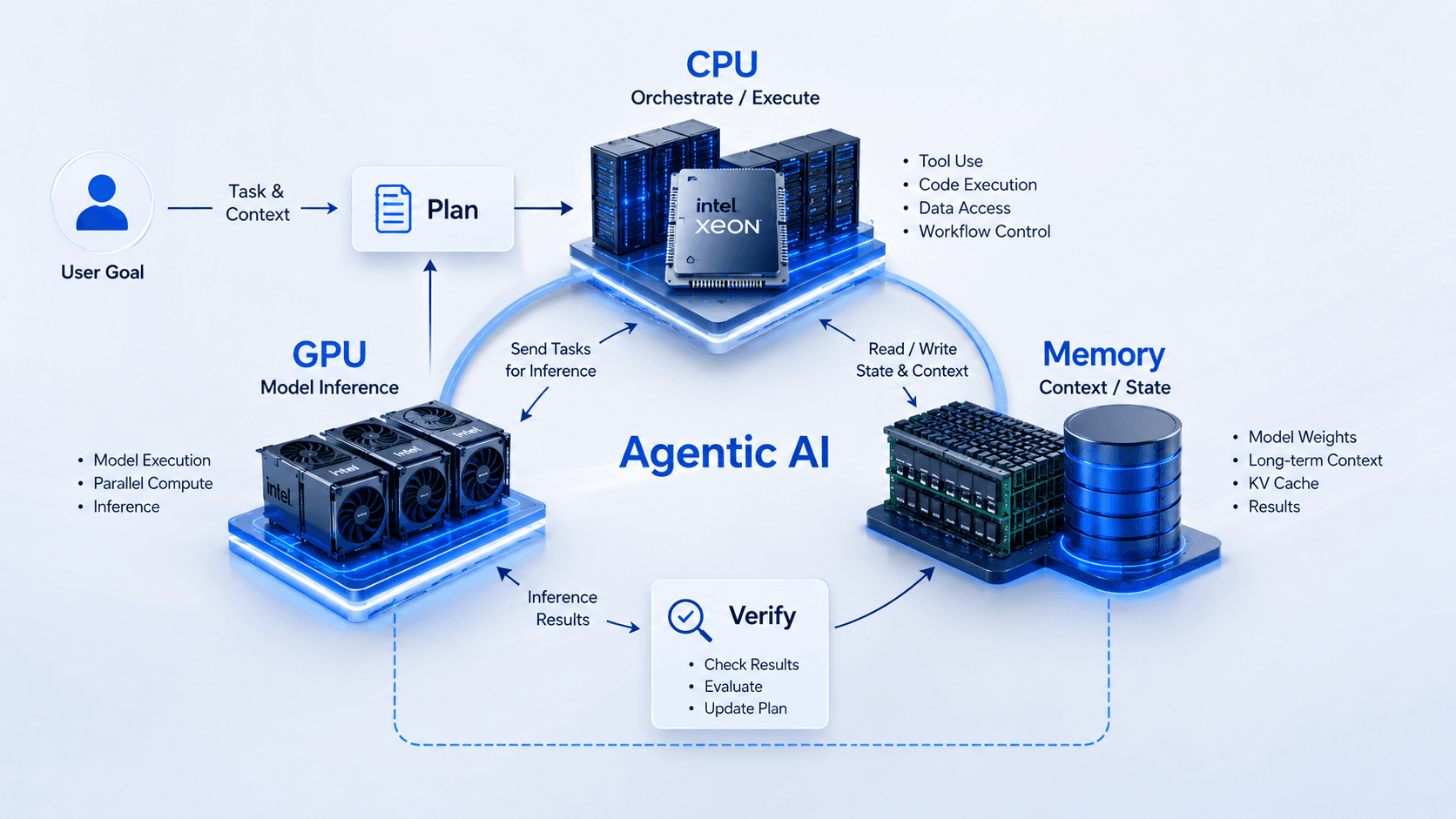
An agent may first break a goal into smaller steps, then call a model, retrieve information, query a database, run code, use an external tool, inspect the result and revise its plan. A multi-agent system can create additional model calls, parallel runtime environments and intermediate states before the original task is completed.
The infrastructure cost of one completed task therefore depends on more than the size of the model or the number of output tokens. It increasingly reflects the number of reasoning loops, tool calls, execution environments, database interactions and retained context generated along the way.
GPUs still perform the most computationally intensive model work. CPUs schedule and execute the broader workflow. Memory holds model weights, working data, application state, long-term context and intermediate results.
This is why the expansion of agentic AI can increase demand for all three layers at the same time.
$NVDA ~ Nvidia’s product roadmap provides direct evidence of this architectural shift. Nvidia has positioned its Vera CPU around workloads in which AI systems plan tasks, operate tools, access data, run code and validate results. A Vera CPU rack integrates 256 CPUs and is designed to support more than 22,500 independent CPU environments, according to the company.
The significance extends beyond the specifications. Nvidia, the company most closely associated with GPU acceleration, is building dedicated CPU infrastructure because increasingly complex AI workflows cannot be executed entirely inside GPU racks.
The CPU is evolving from a supporting processor inside an accelerated server into part of the control and execution plane of the AI system.
$MU ~ Micron is observing the same transition from the memory side. The company has said that agentic AI is expanding data-center architecture beyond accelerator racks to include CPU racks for control and execution, as well as storage racks for rapidly expanding context stores.
Micron expects industry data-center DRAM and NAND bit shipments in 2026 to more than double their level from two years earlier. It also expects high-teens server unit growth, including mid-teens growth in traditional servers and even faster expansion in servers equipped with AI accelerators.
Nvidia and Micron are approaching the market from different parts of the infrastructure stack, yet their product strategies point toward the same conclusion: AI infrastructure is broadening from accelerator-centric clusters into systems built around GPU computation, CPU execution and multiple tiers of memory and storage.
That provides independent support for Intel’s demand narrative. It does not yet determine how much of the new CPU market Intel will capture.
What Intel’s 59% DCAI growth actually tells us
Intel’s server revenue can be reduced to a basic relationship:
Server revenue = server volume × average selling price.
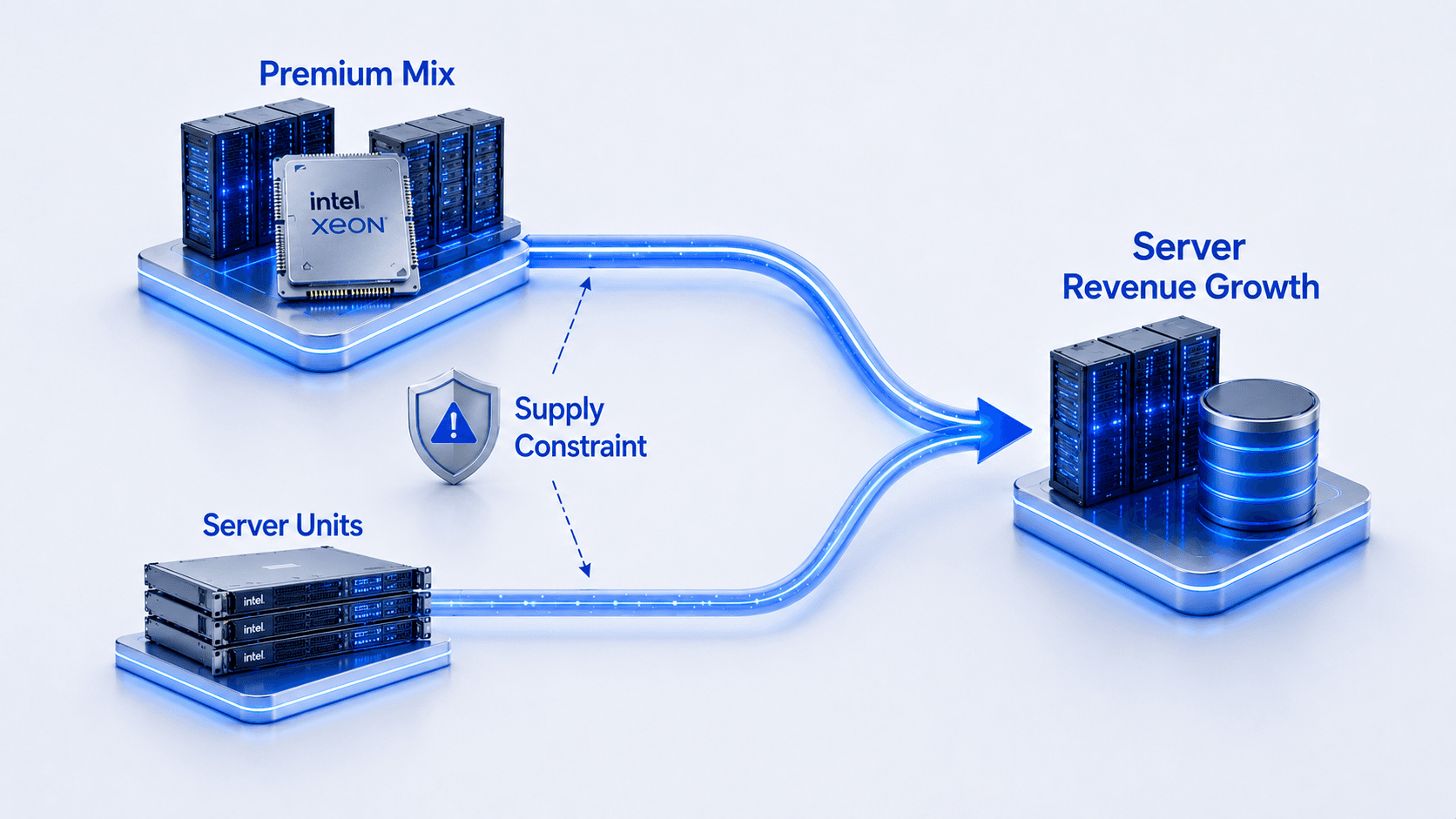
Intel reported a 9% increase in server volume and a 48% increase in ASP. Multiplying the two produces a directional revenue increase of approximately 61%:
1.09 × 1.48 = 1.61
This is not a precise attribution of the revenue increase because price and volume interact. It nevertheless makes the direction clear: Intel’s server growth was dominated by ASP and product mix, while unit growth provided a smaller but still meaningful contribution.
That does not make the growth low quality.
A richer mix of higher-core-count, higher-performance processors can create real economic value. Customers may be willing to pay more because newer processors consolidate workloads, improve performance per rack or lower total operating costs. Intel’s DCAI margin expansion suggests that this premium mix is already producing substantial operating leverage.
The durability question comes from the size of the ASP increase.
A 48% improvement is unlikely to represent a normal annual pricing environment. Intel said the gain primarily reflected a shift toward premium products rather than broad-based price increases. As Xeon 6 adoption matures and the comparison base rises, the benefit from mix should become harder to repeat at the same rate.
Supply constraints add another layer of complexity.
Intel has said demand exceeds its available supply, with limitations involving internal manufacturing capacity as well as memory, substrates and other industry components. This can suppress the number of processors Intel is able to ship, meaning the reported 9% unit increase may understate underlying demand.
The same shortages can also strengthen product mix and pricing. When supply is scarce, Intel can allocate limited capacity toward its highest-value products. Customers with urgent requirements may also accept higher pricing or more expensive configurations.
Supply constraints are therefore doing two things at once: hiding part of the potential unit demand while amplifying ASP and profitability.
The true quality of Intel’s recovery will become easier to assess when those constraints begin to ease.
The server refresh and the AI architecture shift are happening together
Intel’s rebound contains a clear product-cycle component.
Xeon 6 is ramping rapidly, more capable processors are becoming a larger percentage of shipments, and customers that delayed server upgrades are replacing older systems. Manufacturing yields and production cycle times are also improving, allowing Intel to monetize demand more efficiently.
Intel has continued to expand the roadmap with products including Xeon 6+ based on its 18A process. The company has also highlighted rack-level AI systems combining Xeon processors with external accelerators, including configurations involving SambaNova hardware and Nvidia Blackwell GPUs.
These deployments illustrate where Intel wants Xeon to sit inside the next generation of AI infrastructure: alongside accelerators, handling data preparation, orchestration, tool execution and enterprise workloads surrounding the model.
They do not yet establish the size of the resulting business.
Intel has referred to new strategic customers, long-term agreements and stronger demand across hyperscale and enterprise markets. The company has not provided enough public detail to determine how much of that demand represents new agentic AI infrastructure, traditional server replacement, supply agreements or general cloud capacity growth.
The distinction matters because “production-ready” technology is not the same as material commercial deployment. A system can be technically available while contributing little to current revenue.
There are still early signs of demand broadening beyond standard server processors. Intel’s non-server DCAI revenue reached $951 million, an increase of $304 million, driven largely by custom silicon and ASIC demand. Management also said revenue from purpose-built silicon nearly tripled year over year.
This makes the product-cycle-versus-structural-growth debate less binary than it first appears.
Intel is benefiting from a powerful Xeon refresh, premium product mix and constrained supply. It is also operating in a market where AI systems require more general-purpose compute around each generation of accelerators.
Both forces can be true simultaneously.
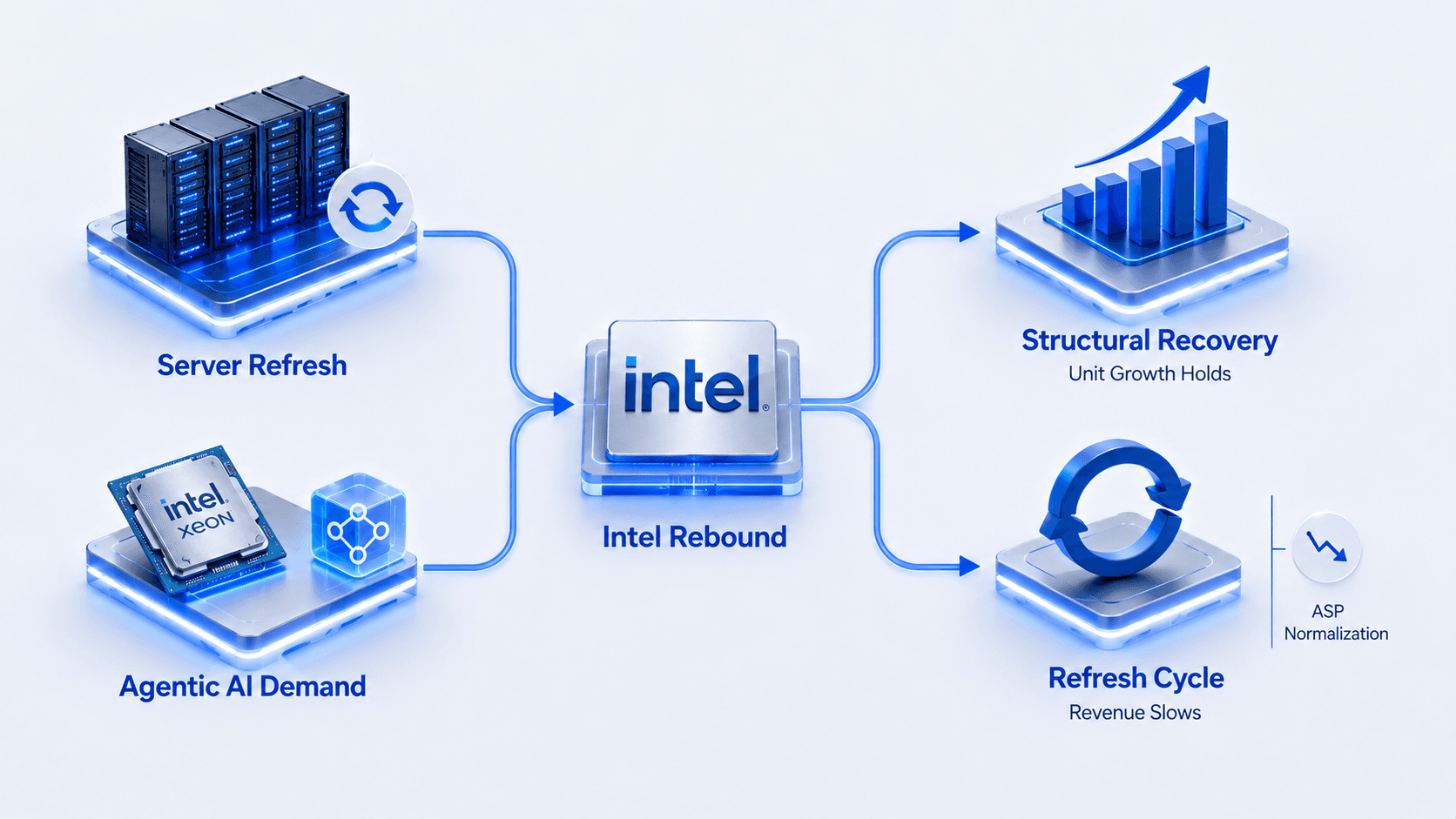
The separation will become clearer over the next several quarters. As supply improves and Xeon 6 faces more difficult comparisons, server unit growth will need to carry a larger share of the revenue increase.
Continued expansion driven by units would strengthen the case that AI is enlarging Intel’s addressable market. A sharp slowdown as ASP normalizes would make the rebound look more like an unusually strong replacement cycle.
Intel’s third-quarter revenue guidance reinforces the need for caution. The company expects total revenue of $15.8 billion to $16.8 billion, with a midpoint of $16.3 billion, only modestly above the second quarter.
This does not establish the direction of DCAI on its own, but it shows why the current 59% growth rate should not be extrapolated mechanically.
A larger CPU market does not automatically produce higher Intel market share
Agentic AI can expand the market for server CPUs while Intel continues to face intense competitive pressure.
The competitive set now extends beyond $AMD ~ AMD and its EPYC server processors. Hyperscalers are developing proprietary Arm-based CPUs, while Nvidia is positioning Vera as a purpose-built processor for AI orchestration, runtime environments and data-center infrastructure.
Nvidia’s entry carries two messages for Intel.
First, it validates the importance of the market. Nvidia would not build dedicated CPU racks for agentic workloads if general-purpose processing remained a minor supporting function.
Second, Nvidia is attempting to capture the same economic value that Intel expects Xeon to address. The company can integrate Vera CPUs with its GPUs, networking, DPUs and storage architecture, potentially giving customers a more tightly coordinated system.
Intel retains meaningful structural advantages. The x86 ecosystem remains deeply embedded in enterprise software, databases, virtualization platforms, internal applications and existing cloud infrastructure. Compatibility and migration costs matter, especially for workloads that cannot easily be rewritten around a new architecture.
Those advantages provide defense, but they do not guarantee leadership in newly built AI factories.
The performance metrics that matter are changing. Customers increasingly care about performance per watt, memory capacity and bandwidth, accelerator connectivity, the number of independent environments a system can support and the total cost of completing an AI task.
Intel will need to prove that Xeon remains competitive under those criteria, rather than relying primarily on its installed base.
Industry growth can also conceal company-specific weakness. A rising server market can lift Intel’s revenue even while competitors gain share. The cleanest future comparison will be between industry server unit growth and Intel’s own volume growth after supply constraints ease.
If the industry continues to grow at a high-teens rate while Intel remains in the high single digits, the market may be carrying Intel despite ongoing share pressure. If Intel’s unit growth moves closer to or above the industry rate, the recovery will become much more company-specific.
CPU demand is the industry conclusion. Intel’s share of that demand is the company conclusion.
The first is gaining evidence. The second still requires proof.
DCAI’s 40% operating margin is not Intel’s full economic return
Intel’s segment reporting creates another potential source of misinterpretation.
DCAI reported approximately $2.47 billion of operating profit and a margin close to 40%. Intel Foundry, however, recorded an operating loss of approximately $2.09 billion during the same quarter.
Intel operates an internal foundry model in which product businesses such as DCAI pay manufacturing charges to Intel Foundry. This allows DCAI to present economics resembling those of a fabless semiconductor business, while the Foundry segment carries manufacturing infrastructure, process development, underutilized capacity and factory ramp costs.
The economics shareholders own are consolidated.
Intel generated consolidated operating profit of approximately $1.8 billion, substantially less than the profit reported by DCAI alone. The difference illustrates why DCAI’s margin cannot be treated as a direct measure of the profitability Intel ultimately retains from selling server processors.
Foundry revenue also needs to be interpreted carefully.
Intel Foundry generated approximately $5.77 billion of revenue, but roughly $5.48 billion came from transactions with Intel’s own product businesses. External Foundry revenue was only $293 million, and part of the reported increase reflected the treatment of Altera as an external customer following its separation from Intel.
The current numbers provide stronger evidence of improving internal manufacturing activity than of a commercially scaled external foundry business.
For this Intel thesis, Foundry matters first as the production engine behind Xeon. The immediate questions are whether 18A can support competitive server products, whether yields improve fast enough, and whether Intel can expand supply without destroying capital efficiency.
External foundry customers may become important over time, but they are not yet the main economic validation of the current recovery.
Capital intensity raises the hurdle further.
Intel has increased its expected 2026 capital expenditure to more than $20 billion and has said 2027 capital spending will be significantly higher than in 2026. The company is investing in manufacturing equipment, clean-room capacity, substrates, memory commitments and other resources needed to relieve supply constraints and support future products.
These investments may be necessary to capture the opportunity. They also mean that higher DCAI revenue and segment profit will not automatically translate into free cash flow.
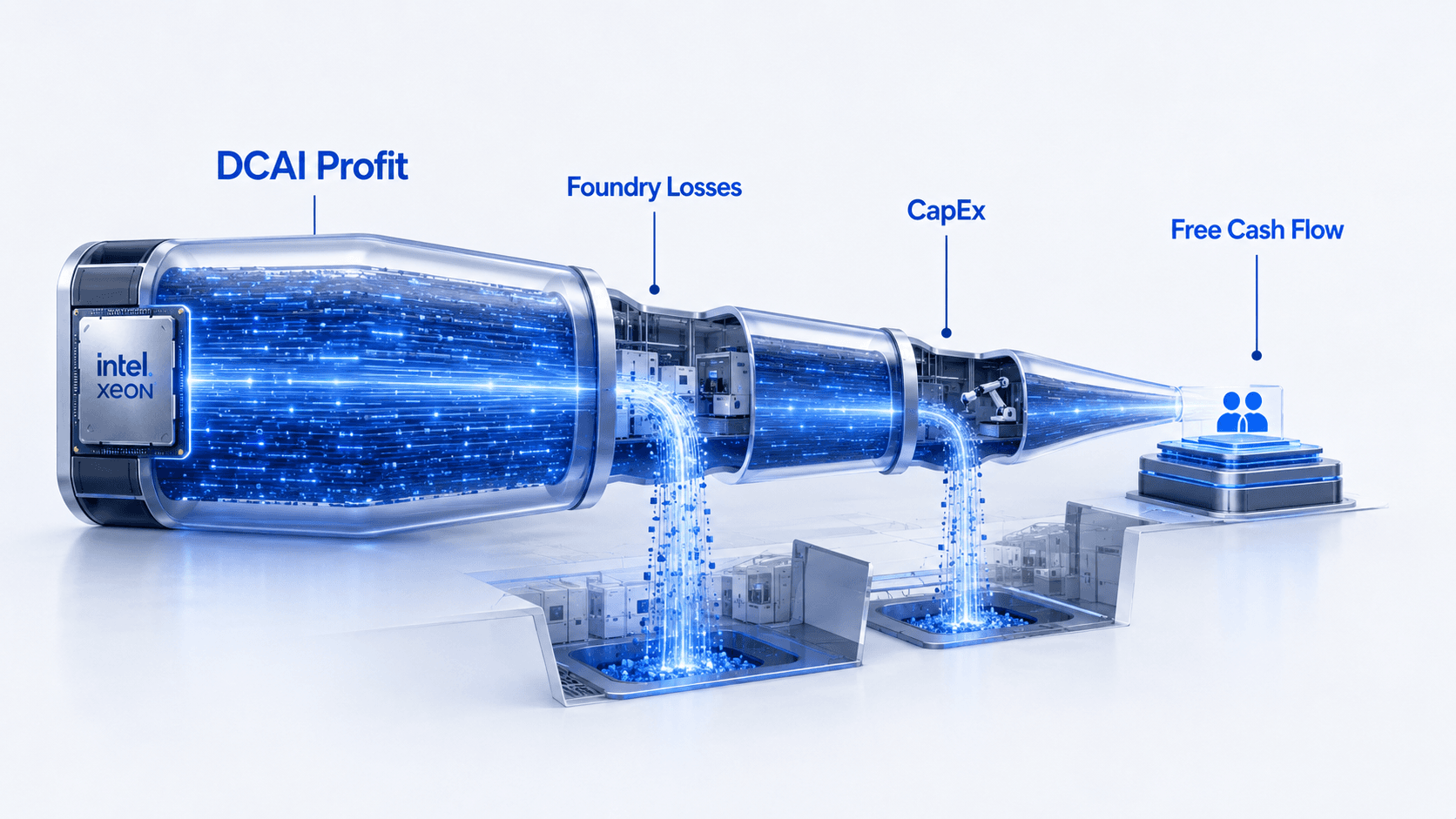
The central financial question is whether incremental DCAI profit can cover Foundry losses, advanced-process spending and capital expenditure while still producing an acceptable return for shareholders.
A structurally growing market can still create disappointing equity returns when the cost of participating in that market absorbs most of the operating improvement.
What the new bottleneck map means for Nvidia
Intel’s rebound does not indicate that AI infrastructure spending is rotating away from GPUs.
Agentic systems can require more model calls, longer contexts, additional reasoning steps and repeated verification. Each completed task may consume substantially more inference than a conventional chatbot response. GPU demand can therefore continue rising even as CPU and memory become more important.
For Nvidia, the broader system creates an opportunity to capture more of the infrastructure stack.
The company can sell GPUs for model computation, Vera CPUs for execution environments, BlueField processors for data movement and security, networking products for cluster communication, and storage architecture for context and KV cache.
Nvidia is increasingly positioning itself as the architect of the entire AI factory rather than the supplier of a single accelerator.
The broader bottleneck map also changes how investors should interpret total AI capital expenditure. A larger share of each system’s cost may flow toward CPUs, memory, networking, storage, power and cooling. Nvidia can capture some of those layers, but not necessarily all of them.
Its long-term advantage will depend on whether system integration allows Nvidia to preserve the economic importance of the GPU while customers focus more heavily on the total cost of completing an AI task.
What it means for Micron
Micron has exposure to nearly every layer of the architecture.
GPU expansion increases demand for HBM. CPU racks require server DRAM. Persistent agents, vector databases, checkpoints, long-context workloads and KV-cache storage increase demand for NAND and data-center SSDs.
That gives Micron a broader demand surface than a company tied to one processor architecture. Whether the CPU is supplied by Intel, Nvidia, AMD or a hyperscaler’s proprietary design, the system still requires memory.
Memory can also become the constraint that limits how many CPU and GPU systems can be delivered.
Micron has said that customers are moderating the growth of DRAM content per server in order to maximize server shipments under tight allocation conditions. This creates a complex economic relationship: rising memory prices support Micron’s revenue and margins, while extreme scarcity can limit the number or configuration of systems customers are able to deploy.
Micron is therefore both a beneficiary of the AI infrastructure expansion and a potential bottleneck within it.
The long-term demand case can remain intact while the familiar memory cycle continues to influence pricing, product mix and capital spending.
The current verdict
Intel’s earnings changed the AI bottleneck map because they showed that the CPU layer can once again generate material revenue growth, pricing improvement and operating leverage during the AI infrastructure buildout.
The quarter did not complete the case for a durable Intel recovery.
Server ASP increased 48%, while volume rose 9%, indicating that premium product mix played the leading role in the current acceleration. DCAI’s 40% operating margin must be evaluated alongside Foundry losses and rising capital expenditure. Agentic AI is expanding the CPU market, but Nvidia, AMD, hyperscaler-designed processors and other architectures are competing for the same incremental demand.
The most evidence-based interpretation is:
Intel’s current revenue rebound is being led by the server product cycle and premium mix. Agentic AI is giving that recovery a potentially longer runway by expanding the amount of CPU infrastructure required around accelerators. The industry shift is becoming well supported; Intel’s ability to convert it into durable economic value remains under verification.
Three developments will determine which interpretation ultimately wins.
Server unit growth must take over more of the revenue burden as ASP comparisons normalize. Intel must stabilize its competitive position as Nvidia and hyperscalers build alternative CPU platforms. DCAI’s additional profit must convert into consolidated free cash flow after Foundry losses and capital spending.
If unit growth remains strong after supply improves, market share stabilizes and free cash flow begins to reflect the DCAI recovery, the second quarter will look like the beginning of a durable change in Intel’s earnings structure.
If revenue slows once premium mix normalizes and manufacturing investment continues to absorb most of the product profit, the quarter will look more like the strongest phase of another server replacement cycle.
Intel’s earnings have changed the map. The next several quarters will determine how much of the new territory Intel can actually own.
Primary Sources
- Intel Reports Second-Quarter 2026 Financial Results
- Intel Second-Quarter 2026 Form 10-Q
- Intel Q2 2026 Earnings Call
- Nvidia Launches Vera CPU for Agentic AI
- Micron Investor Materials
Related Reading
Why Does Qualcomm Trade at Only 19x Earnings Despite Its Data Center and Physical AI Ambitions?
Qualcomm is targeting $40 billion in non-handset revenue by fiscal 2029, including more than $15 billion from data centers. The market still values the company primarily through its smartphone exposure. The next earnings report will test whether the transition is beginning to appear in revenue, margins, and guidance.
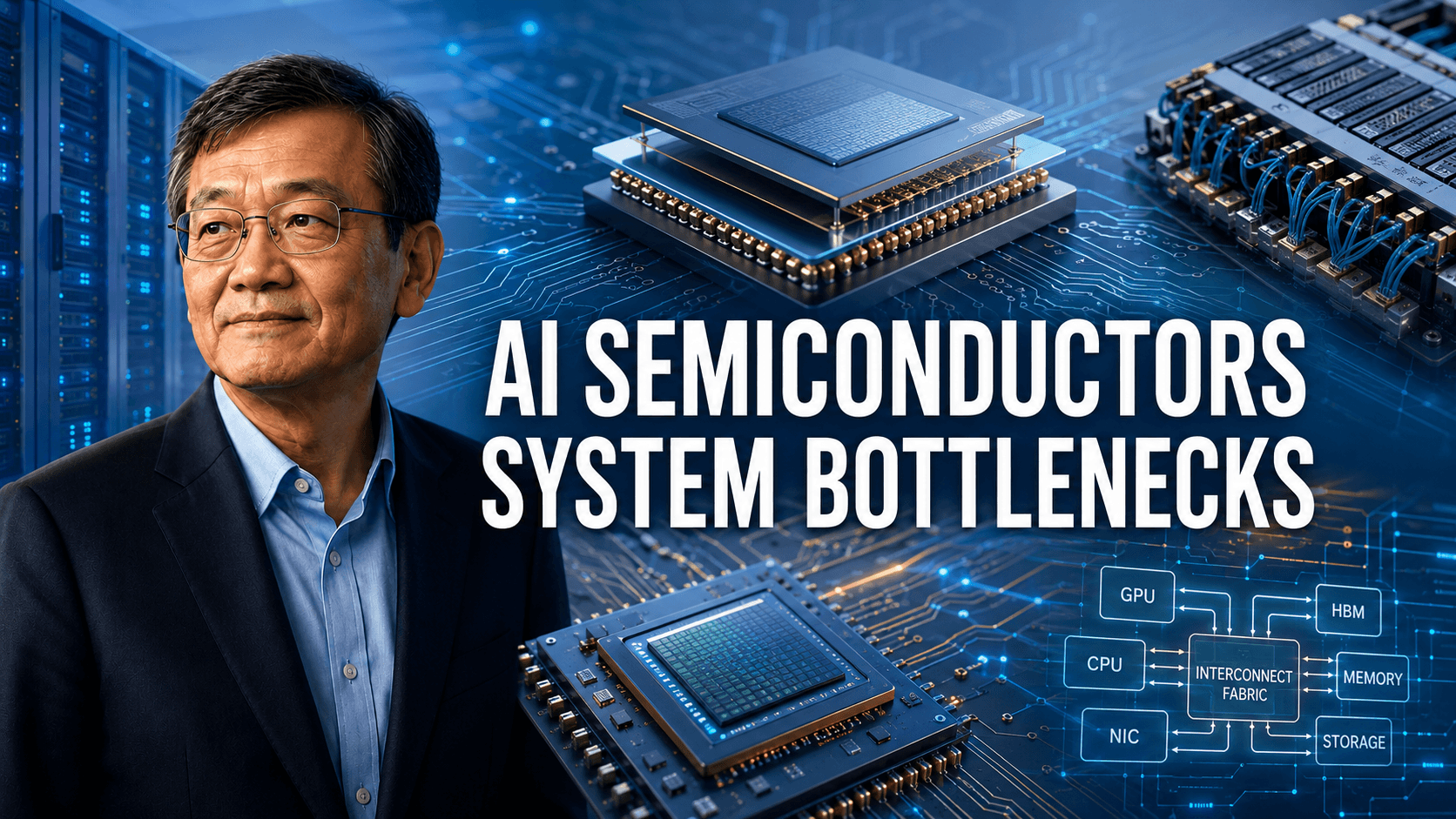
AI Semiconductors Are No Longer Just About Compute. They Are About System Bottlenecks.
AI semiconductors are no longer just about raw compute. The real question is which system bottlenecks customers must solve next.

Micron Earnings Eve: The Market Has Already Bought the Growth. Now It Needs to Know Where the Profits Come From.
Micron’s earnings are not a low-expectation setup. The market already knows HBM demand is strong. The real question is whether Micron’s profits reflect a traditional memory upcycle or a structural AI-driven shift in memory supply.
Invest better with thoughtful research.
Join readers who receive our best ideas and insights straight to their inbox.
Disclosure
This article is for research and education only. It is not investment advice.
Comments