
Key Takeaways
- Microsoft’s earnings showed that AI infrastructure demand remains strong, with Azure revenue growing 43% year over year.
- Google and Meta continue aggressive AI investment, but their paths from infrastructure spending to revenue are different.
- Continued AI CapEx supports demand across HBM memory, AI networking, optical connectivity, and GPU cloud infrastructure.
Microsoft’s latest earnings report provided one of the clearest signals about the current AI infrastructure cycle.
The company continues to invest heavily in AI capacity, but the market reaction showed that investors are focusing less on the size of spending and more on how quickly those investments translate into business growth.
Microsoft shares moved higher after earnings, while Alphabet and Meta received a more cautious response despite maintaining aggressive AI investment plans.
The difference comes from the connection between AI infrastructure spending and revenue generation.
Why Did Microsoft Stock Rise After Earnings?
Microsoft did not slow down its AI investment.
The company reported quarterly capital expenditures of approximately $41 billion and maintained a fiscal 2026 CapEx outlook of around $175 billion.
A portion of Microsoft’s infrastructure expansion uses long-term data center leases and finance lease arrangements, which affects how some investments appear in financial statements.
However, investors were already aware of these accounting factors.
The more important data point was revenue growth.
Microsoft reported:
- Microsoft Cloud revenue of $59.3 billion
- Azure revenue growth of 43% year over year
Azure growth showed that AI infrastructure spending is being absorbed by customers through cloud demand.
The business model is relatively direct:
AI infrastructure → Azure capacity → enterprise AI services → cloud revenue
This connection is what changed investor sentiment.
The concern was not simply how much Microsoft spends on AI.
The market wanted evidence that the spending could generate meaningful revenue growth.
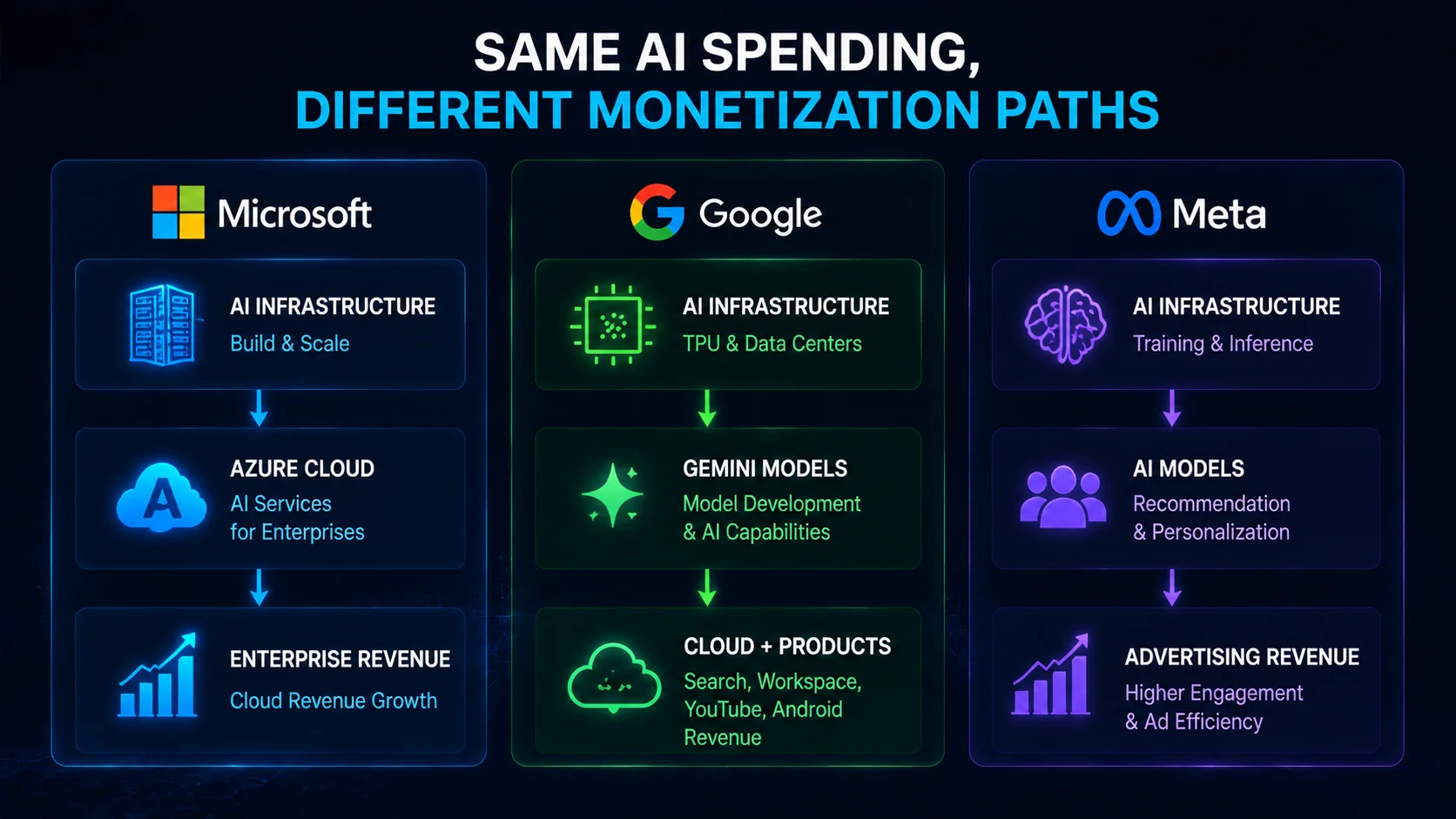
Google and Meta Show Different AI Investment Models
Microsoft’s results do not mean every AI infrastructure investment will receive the same market response.
Alphabet and Meta are pursuing different strategies.
Google: Large AI Investment, Longer Monetization Path
Alphabet continues to expand AI infrastructure spending.
The company raised its 2026 capital expenditure outlook to approximately $195 billion–$205 billion.
The investment focuses on:
- Data centers
- TPU infrastructure
- Gemini models
- Google Cloud capacity
Google controls important parts of the AI stack, including its own AI chips and global data center infrastructure.
However, the path from investment to financial returns is longer:
AI infrastructure → TPU/Gemini capability → products and cloud services → revenue growth
Google Cloud continues to grow strongly, but investors are watching how quickly AI investment improves:
- Revenue growth
- Operating margins
- Free cash flow
Meta: AI Investment Must Improve Advertising Economics
Meta’s AI strategy is different.
The company is not primarily building AI infrastructure to sell cloud capacity.
Its investment supports:
- Recommendation systems
- Advertising models
- Llama ecosystem
- Consumer AI products
Meta expects 2026 CapEx of approximately $130 billion–$145 billion.
The financial path is:
AI models → better recommendations → higher engagement → stronger advertising performance
The opportunity is significant because advertising is Meta’s core business.
The challenge is proving how quickly AI investment improves:
- Advertiser returns
- Revenue growth
- Profitability
Which Companies Benefit From AI Infrastructure Spending?
The continued expansion of AI infrastructure by Microsoft, Google, and Meta directly affects several parts of the semiconductor and data center supply chain.
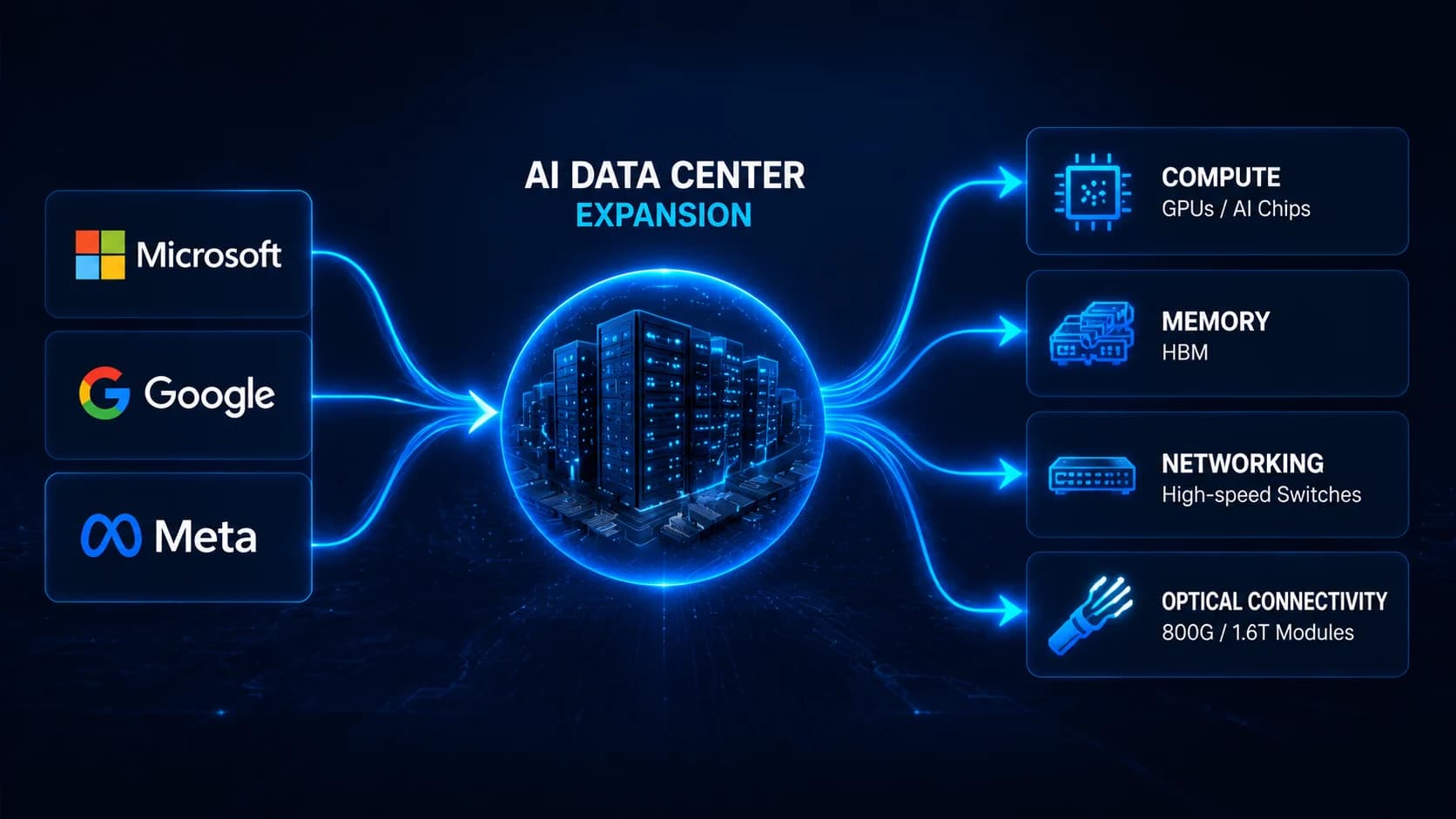
HBM Memory: AI Servers Need More Bandwidth
AI servers require significantly more high-bandwidth memory than traditional servers.
The growth of AI workloads increases demand for:
- HBM memory
- Advanced packaging
- AI semiconductor capacity
Micron Technology (MU)
Micron is one of the clearest examples of AI memory demand.
The company reported record fiscal Q3 revenue of $41.46 billion and highlighted strong demand driven by AI-related memory demand.
The investment logic:
More AI servers → More HBM demand → Higher memory value per server
The market continues to debate whether memory is approaching a traditional cycle peak.
The key question is whether AI server demand changes the traditional memory cycle.
AI Networking: More GPUs Create More Data Movement
Large AI clusters require high-speed communication between thousands of processors.
This creates demand for:
- Ethernet switching
- Custom silicon
- High-speed interconnect technology
Marvell Technology (MRVL)
Marvell reported fiscal 2026 revenue of approximately $8.2 billion, up 42% year over year, with data center growth supported by AI demand.
The logic:
Larger AI clusters → Higher networking requirements → More demand for connectivity infrastructure
Broadcom (AVGO)
Broadcom benefits from AI networking through:
- Ethernet switching
- Custom AI accelerators
- Data center connectivity
The key indicators are AI networking demand and hyperscaler infrastructure expansion.
Optical Connectivity: AI Clusters Need Faster Networks
As AI clusters become larger, optical communication becomes increasingly important.
The industry is moving toward:
- 800G
- 1.6T optical connectivity
Lumentum (LITE)
Lumentum reported fiscal Q3 revenue of $808 million, up approximately 90% year over year, supported by data center and cloud networking demand.
Corning (GLW)
Corning benefits from the physical expansion of AI data centers through optical fiber infrastructure.
The market debate is not whether AI requires more connectivity.
It is how quickly demand converts into sustainable earnings growth.

GPU Cloud Infrastructure: AI Demand Beyond Hyperscalers
AI demand is also creating opportunities for specialized GPU cloud providers.
Nebius (NBIS)
Nebius represents a different part of the AI infrastructure chain.
The company invests directly in GPU capacity and sells computing resources to AI customers.
The opportunity depends on:
- GPU utilization
- Customer contracts
- Financing costs
- Data center efficiency
Strong AI demand supports the business model, but profitability depends on capital efficiency.
Amazon AWS Is the Next Test for AI Infrastructure Spending
Microsoft and Alphabet have already provided two important signals.
Amazon’s upcoming AWS earnings will add another data point.
Investors will watch:
- AWS growth
- AI service adoption
- Bedrock demand
- Trainium and Inferentia adoption
- Capital expenditure plans
AWS will help determine whether AI-driven cloud growth is broadening across major cloud providers.
Frequently Asked Questions
Why did Microsoft stock rise after earnings?
Microsoft shares rose because Azure growth showed that AI infrastructure investment is translating into cloud revenue growth. Azure revenue increased 43% year over year, reducing concerns that AI spending would only increase costs.
Is AI CapEx slowing down?
Microsoft, Google, and Meta continue expanding AI infrastructure spending. The focus has shifted toward how efficiently that investment generates revenue and returns.
Which companies benefit from AI infrastructure spending?
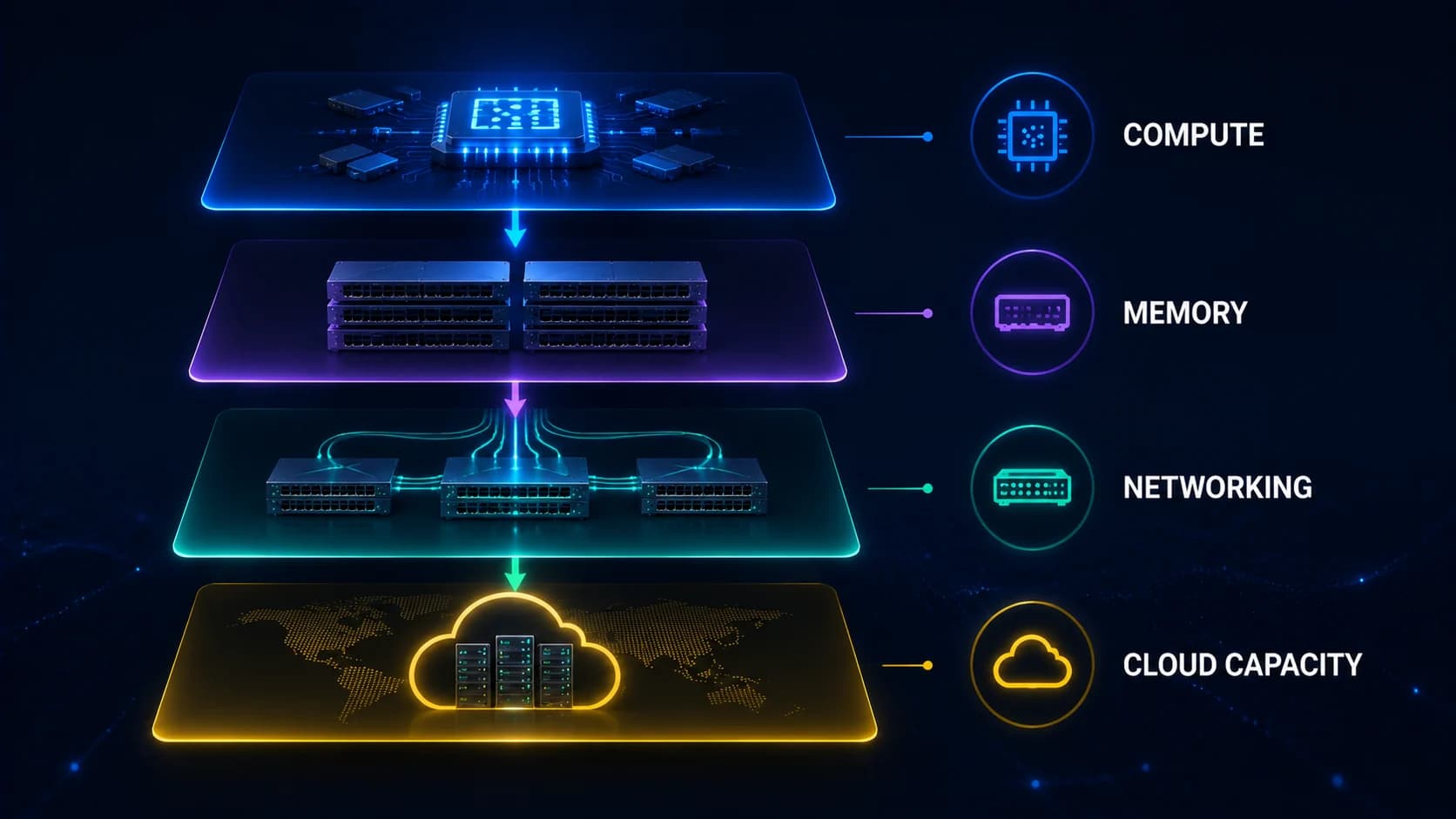
AI infrastructure beneficiaries include companies involved in HBM memory, AI networking, optical connectivity, and GPU cloud infrastructure.
Examples include:
- Micron Technology (MU)
- SK Hynix
- Marvell Technology (MRVL)
- Broadcom (AVGO)
- Lumentum (LITE)
- Corning (GLW)
- Nebius (NBIS)
Does AI spending benefit semiconductor companies?
AI spending supports demand for GPUs, HBM memory, advanced packaging, networking chips, and optical infrastructure.
The impact depends on each company’s position in the AI supply chain.
Will Amazon AWS earnings confirm the AI spending trend?
AWS results will provide another important test. Strong AI-related cloud growth would support the view that AI infrastructure demand remains broad across major cloud providers.
Conclusion
Microsoft’s earnings did not change the AI investment thesis.
The market already expected large AI infrastructure spending.
The important update was that demand remains strong and hyperscalers continue expanding capacity.
For investors tracking AI infrastructure, the key variables remain:
- HBM supply
- AI networking demand
- Optical connectivity upgrades
- Cloud infrastructure utilization
The companies positioned at these bottlenecks will determine where the next wave of AI infrastructure value is captured.
Sources
| No. | Source | Publisher | Date | Type | What it supports |
|---|---|---|---|---|---|
| 1 | Microsoft FY2026 Q4 earnings release | Microsoft Investor Relations | 2026-07-29 | Company IR | Microsoft Cloud revenue and Azure year-over-year growth. |
| 2 | Microsoft FY2026 Q4 earnings conference call | Microsoft Investor Relations | 2026-07-29 | Company IR | Quarterly capital expenditures, finance leases, and updated 2026 CapEx expectation. |
| 3 | Alphabet investor earnings materials | Alphabet Investor Relations | 2026-07-29 | Company IR | Alphabet’s 2026 capital expenditure outlook and AI infrastructure priorities. |
| 4 | Meta Reports Second Quarter 2026 Results | Meta Investor Relations | 2026-07-29 | Company IR | Meta’s 2026 capital expenditure outlook. |
| 5 | Micron Reports Record Results for Fiscal Q3 2026 | Micron Investor Relations | 2026-06-24 | Company IR | Micron fiscal Q3 revenue and AI-related memory demand. |
| 6 | Marvell fiscal 2026 proxy statement | Marvell Investor Relations | 2026-05-13 | SEC | Marvell fiscal 2026 revenue growth and data-center demand. |
| 7 | Broadcom Announces First Quarter Fiscal Year 2026 Results | Broadcom Investor Relations | 2026-03-04 | Company IR | AI networking and custom accelerator demand. |
| 8 | Lumentum Announces Fiscal Q3 2026 Results | Lumentum Investor Relations | 2026-05-05 | Company IR | Lumentum fiscal Q3 revenue and year-over-year growth. |
| 9 | Corning Upgrades and Extends Springboard Plan | Corning | 2026-05-06 | Company IR | Corning’s AI data-center optical connectivity exposure. |
Related Reading

Can AI CapEx Pay Off? Start With Token Cost, Then Watch the Payback Period.
Nvidia is showing that the unit cost of AI production is falling. Investors are asking whether cheaper tokens can turn into visible profits and free cash flow fast enough.

How to Read the AI Cycle: CapEx, Supply Bottlenecks, and the Semiconductor Trade
AI infrastructure spending is still expanding, but the semiconductor equity trade is becoming more fragile. The next phase depends on CapEx, supply bottlenecks, usage, pricing, and earnings revisions.

HBM vs DDR5: What’s the Difference—and Why AI Needs Both
HBM supplies extreme bandwidth to AI accelerators, while DDR5 provides larger pools of system memory. Understanding the difference is essential for analyzing AI infrastructure and memory stocks.

NVIDIA’s Next Bottleneck Isn’t GPUs. It’s Data Movement.
Why AI factories are moving from copper to optical connectivity — and which suppliers deserve deeper research
Invest better with thoughtful research.
Join readers who receive our best ideas and insights straight to their inbox.
Disclosure
This article is for research and education only. It is not investment advice.
Comments