Key Takeaways
- HBM demand is still strong: 2027 supply negotiations remain unresolved, HBM bit shipments are expected to grow another 50%–60% and suppliers still appear to hold pricing power into the next pricing cycle.
- Memory stocks have recovered from the July selloff but traded in a range for a month, suggesting that the market already knows HBM is tight and now needs a fresh reason to push earnings assumptions several years further out.
- HBM supply is structurally hard to add: HBM4 stacks combine advanced DRAM dies, 4 nm logic base dies, TSVs, packaging and customer qualification, and new fabs like SK Hynix Indiana are scheduled to ramp HBM4E only in late 2029.
- The HBM industry has a deep moat, but the company moat inside the SK Hynix / Samsung / Micron oligopoly is weaker; meaningful HBM4 or HBM4E share shifts could become the most powerful company-specific catalyst.
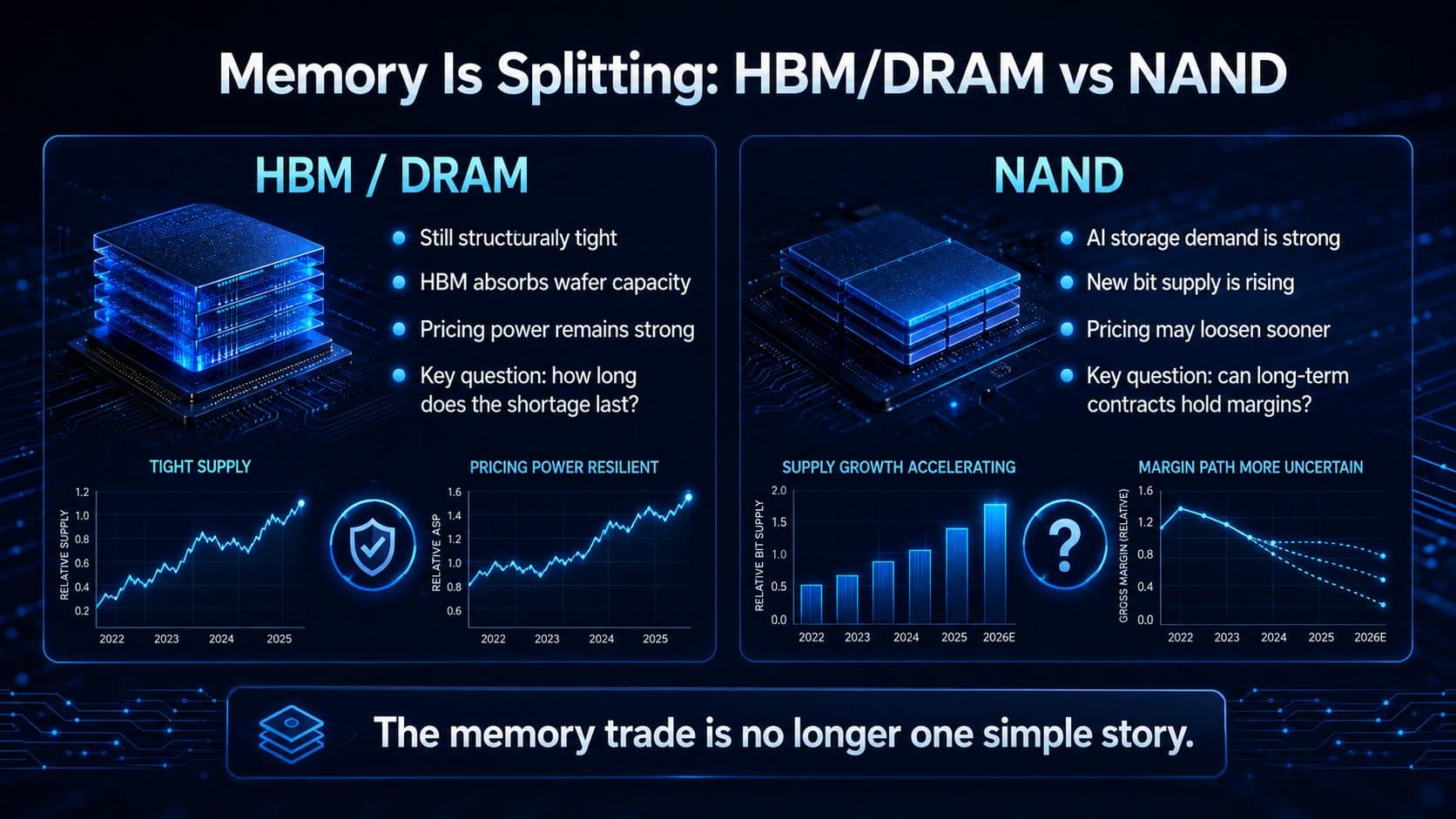
- HBM/DRAM and NAND are starting to split: TrendForce still sees DRAM bit supply up roughly 24% in 2027 but structurally tight because HBM absorbs wafer capacity, while NAND supply may loosen in the second half of 2027 as bit output and new capacity rise.
Memory stocks have bounced from the selloff, but the recovery has settled into a range. The market may now need a fresh reason to push earnings expectations higher.
A month after the sharp selloff in memory stocks, the group is in an interesting place.
SK Hynix and Samsung recovered from their lows, then spent much of the past month trading in a range. The same pattern has shown up in the U.S. Micron ($MU) rebounded meaningfully from the July decline, while Sandisk ($SNDK) recovered even more sharply, but neither trade has returned to the kind of one-way price discovery that defined the earlier part of the year.
The easy explanation would be that investors took profits and moved on. There was certainly a major leverage unwind in Korea. Leveraged ETF assets fell sharply during the selloff, and hedge funds were forced to reduce risk. But the available flow data do not show capital abandoning memory altogether. U.S. memory and semiconductor ETFs continued to attract money during the correction, while foreign investors returned aggressively to Korean equities after the initial deleveraging.
That leaves a more useful question.
If investors still want memory exposure, what are they waiting for?
The answer probably lies less in another headline saying AI demand is strong, and more in whether the next set of data can force the market to raise its assumptions for memory earnings several years out.
The market already knows AI needs more memory
The first leg of the memory rally was driven by a series of discoveries that kept moving in the same direction.
AI accelerators needed more HBM than the industry had expected. HBM production consumed more DRAM capacity than many investors appreciated. Server DRAM tightened as HBM absorbed wafer capacity, while AI inference created a second demand shock in enterprise SSDs and NAND.
Each step forced analysts to raise price assumptions, margins and earnings estimates. The stocks could rise sharply while forward valuation still looked inexpensive because the denominator—earnings—was moving higher almost as quickly as the share price.
That part of the story is now widely understood.
The current supply data still look strong. TrendForce said in August that negotiations for 2027 HBM supply remained unresolved months into the process, with SK Hynix pushing for higher HBM4 pricing and Samsung and Micron also seeking meaningful increases. It expects HBM bit shipments to rise another 50%–60% in 2027 and still sees suppliers retaining pricing power.
Server DRAM remains tight as well. HBM continues to absorb manufacturing capacity, supplier inventories remain low, and buyers have been shifting some server configurations toward lower-capacity RDIMMs to control memory costs.
So there is little evidence that the core demand story has suddenly broken.
The problem is that "HBM is tight" is no longer new information.
For another large rerating, investors may need evidence that the shortage lasts longer than currently assumed, that one supplier takes materially more share, or that future supply again falls short of expectations.
That makes the next part of the HBM story much harder than the first.
Why HBM supply cannot respond quickly
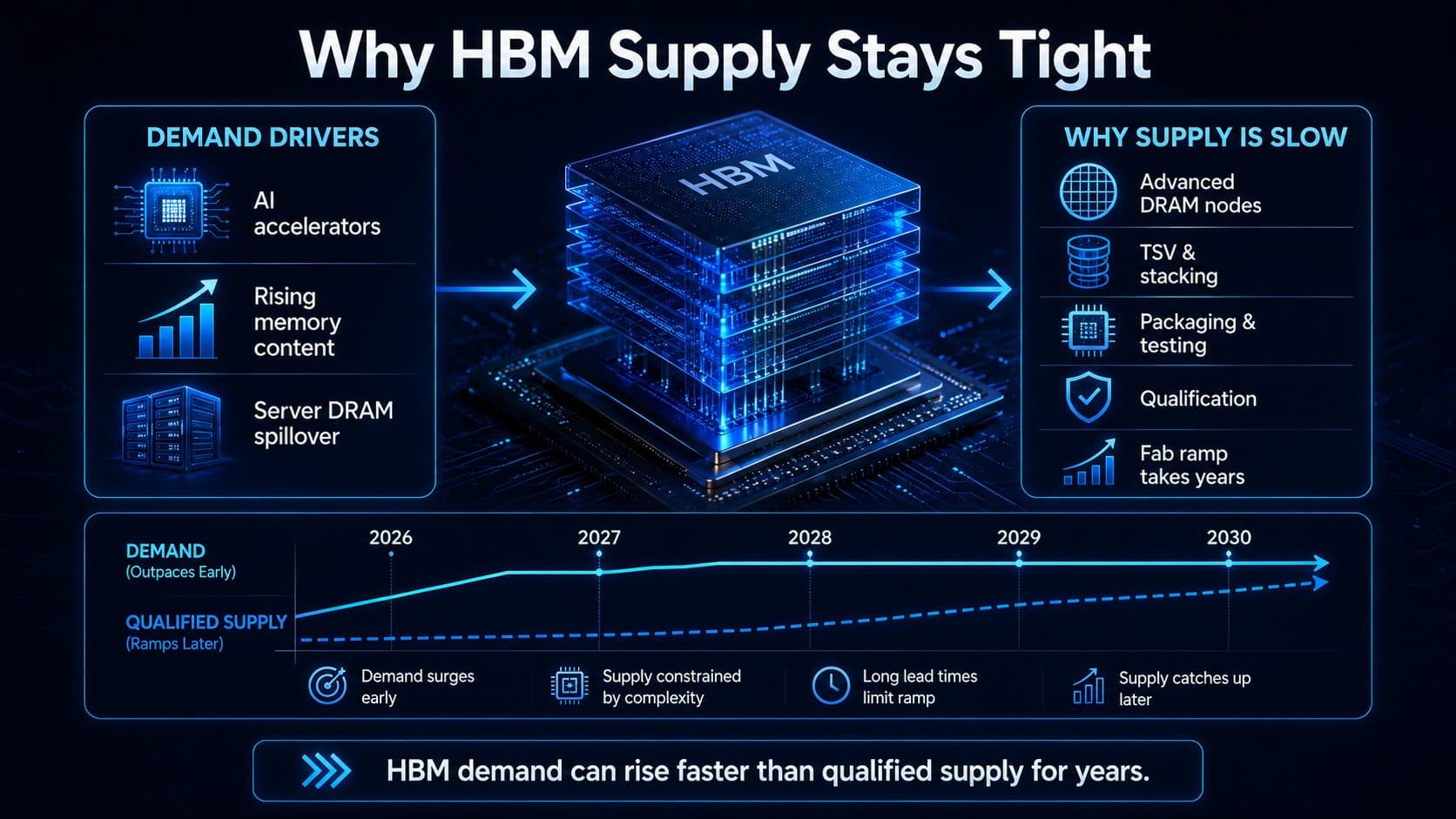
One reason the market has not yet abandoned the memory shortage thesis is that HBM supply is difficult to add.
HBM4 is far removed from conventional commodity DRAM. Samsung's current HBM4 combines advanced DRAM dies with a 4-nanometer logic base die, 2,048 I/O connections and bandwidth of up to roughly 3.3 TB/s per stack. Micron's 12-high HBM4 for NVIDIA Vera Rubin delivers more than 2.8 TB/s per stack and is already in high-volume production.
Those specifications matter because increasing HBM output requires more than adding wafer starts.
The manufacturing process combines advanced DRAM nodes, TSVs, die stacking, logic base dies, thermal management, yield improvement, advanced packaging, testing and customer qualification. A new fab can be funded today and still take years before it produces large volumes of qualified HBM.
SK Hynix's new Indiana project illustrates the lag. The company expects the cleanroom to open in 2028, with HBM4E production planned for the third quarter of 2029. At the same time, management has said the broader memory shortage could extend into 2030.
That supply response is unusually slow for an industry known for boom-and-bust capacity cycles.
It also explains why today's very high margins do not automatically imply oversupply next year. Capital expenditure can rise quickly. Qualified HBM output cannot.
For investors, this is one of the strongest arguments that the current cycle could remain tighter for longer than older DRAM cycles. (For a basic comparison of HBM and the conventional DRAM that feeds CPUs and servers, see HBM vs DDR5: What's the Difference—and Why AI Needs Both.)
But it does not mean every HBM supplier has an equally durable moat.
HBM has a deep industry moat. The company moat is weaker.
There is a useful distinction between the barrier protecting the HBM industry and the barrier protecting an individual HBM vendor.
For a new entrant, reaching the latest generation of HBM is extremely difficult. The technology, manufacturing know-how, packaging capability and qualification requirements create a formidable barrier. That is why the high-end market is still dominated by SK Hynix, Samsung and Micron.
Inside that oligopoly, however, customers can still shift allocation.
This year's HBM4 qualification cycle already showed how quickly that can matter. Samsung improved its position as validation progressed, while delays around SK Hynix affected parts of its expected ramp. Micron has also continued to gain relevance as its HBM4 production moves into major AI platforms.
That leads to a more useful way of thinking about the moat.
HBM has a strong industry moat, but it does not give one supplier permanent ownership of the profit pool.
SK Hynix's roughly 58% share of the HBM market earlier this year is a major advantage, but it is not structurally locked in. Samsung and Micron can gain share if they execute better on yield, qualification, pricing or supply.
This changes what can drive the next phase of the trade.
The first rally could be driven by the HBM market itself getting much larger. The next one may require investors to identify which supplier captures more of that larger market.
A meaningful shift in HBM4 or HBM4E allocation could create a much stronger company-specific catalyst than another industry report saying HBM demand remains high.
High HBM profits are also encouraging companies to use less of it
There is another consequence of unusually high memory profits that matters over a longer time horizon.
When one component becomes expensive enough, customers stop asking only where they can buy more of it. They also begin asking whether the system can be redesigned to use less.
That process is already visible in AI infrastructure.
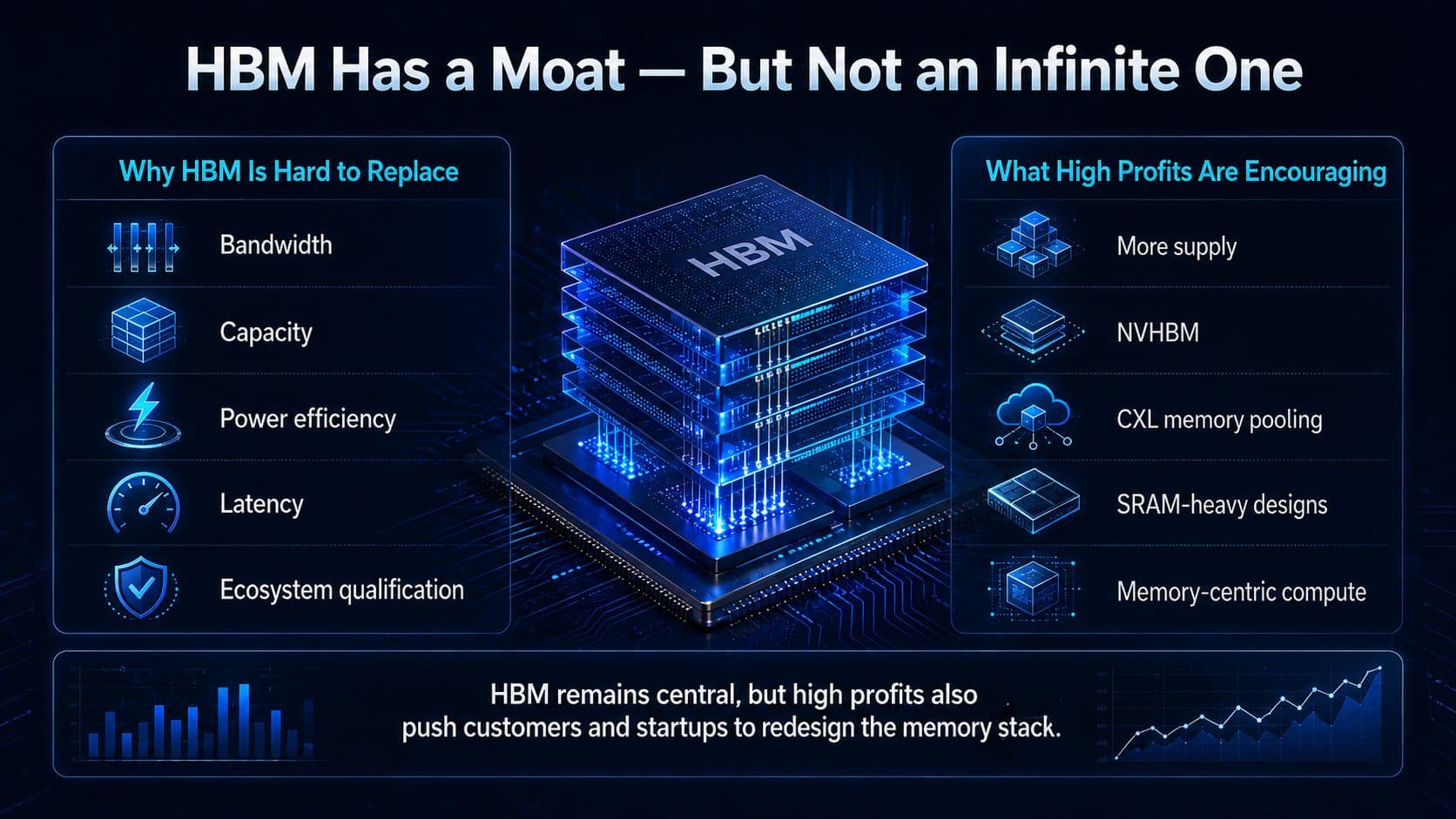
NVIDIA's NVHBM is one example. It does not eliminate HBM. Instead, NVIDIA moves more of the memory-controller functionality into a customized HBM base die, aiming to improve effective bandwidth and power efficiency while freeing area on the accelerator die.
That is an evolutionary response: keep HBM, but extract more performance from every stack.
Other companies are pursuing more radical architectures.
Cerebras places a very large amount of SRAM directly on its wafer-scale processor and has emphasized that its architecture does not rely on the conventional HBM-plus-CoWoS design used by many GPU systems. The goal is to keep more data close to compute and reduce the cost of moving data back and forth.
d-Matrix is working on another version of the same problem through memory-centric computing and stacked DRAM. CXL takes a different approach again: instead of replacing HBM, it allows systems to pool and share larger amounts of lower-cost memory so that data that does not require HBM-level bandwidth can sit elsewhere.
None of these approaches currently offers a universal substitute for HBM.
SRAM is fast but expensive and area-intensive. CXL improves capacity utilization but carries much higher latency than local HBM. Alternative accelerators remain optimized for specific workloads rather than replacing GPU-plus-HBM infrastructure across the entire AI market.
Still, HBM does not have to disappear for these technologies to matter financially.
Suppose AI compute doubles while better memory architecture reduces the amount of HBM required per unit of compute by 20%. HBM demand would still grow strongly, but not as quickly as it would under a simple assumption that memory content rises linearly with compute.
That difference matters enormously when investors are valuing the profits of memory suppliers five years out.
| Approach | What it is trying to solve | Replaces HBM? | Potential impact on HBM economics | |---|---|---|---| | Cerebras / on-chip SRAM | Reduce data movement | For some workloads | Can lower HBM dependence in certain inference tasks | | d-Matrix / memory-centric compute | Move compute closer to memory | Partially | Changes the memory hierarchy | | CXL memory pooling | Share capacity and offload warm data | No | Can reduce local high-cost memory requirements | | NVIDIA NVHBM | Improve HBM efficiency | No | Keeps HBM central but shifts more system control toward accelerator designers | | New HBM/DRAM capacity | Increase direct supply | Direct competition | Reduces scarcity and pricing power |
The reason HBM remains so important today is not that nobody is trying to replace it. It is that no alternative currently matches its combination of bandwidth, capacity, latency, power efficiency and cost across mainstream high-performance AI systems.
That is a meaningful moat.
It is not an infinite one.
New capacity is still the more immediate risk
Alternative architectures may matter over several years. For the next part of the cycle, ordinary supply response is still likely to matter sooner.
Samsung is expanding. SK Hynix is expanding. Micron is expanding. CXMT is pushing into more advanced DRAM products. (For a deeper look at how CXMT is reshaping the global DRAM market, see How CXMT Is Reshaping the Global DRAM Market.)
The basic memory equation has not changed:
pricing power depends on how fast demand grows relative to bit supply.
Memory does not need demand to decline in order for the cycle to turn. If demand grows 20% and supply grows 30%, pricing can still fall.
This is why investors are increasingly looking beyond 2026 and even 2027.
Current industry forecasts still favor suppliers. TrendForce expects DRAM bit supply to increase by roughly 24% in 2027, yet it still sees structural tightness because HBM is consuming more wafer capacity and new fabs take time to ramp.
The real turning point would come when future supply growth begins to outpace future demand growth on a sustained basis.
That could happen through faster fab ramps, better HBM yields, improved packaging throughput, broader supplier qualification or Chinese capacity growing faster than expected.
CXMT does not need to win NVIDIA HBM4 sockets immediately to affect global DRAM economics. Additional DDR and LPDDR output can still change the balance in conventional DRAM and force Samsung, SK Hynix and Micron to compete more aggressively elsewhere.
So the long-term bullish case for HBM depends on more than AI demand staying high.
It also depends on supply remaining difficult enough to preserve scarcity.
NAND may show the next phase of the cycle before HBM does
This is also where the memory trade begins to split.
HBM and DRAM remain structurally tight. NAND looks less certain.
TrendForce still sees a NAND shortage in 2026, with AI servers and enterprise SSDs driving demand. But its 2027 outlook is different: rising bit output, new capacity and weaker consumer demand could allow NAND supply growth to exceed demand growth, with the market beginning to loosen in the second half of 2027.
That distinction matters for Sandisk.
Sandisk's latest quarterly revenue reached about $9 billion, up 51% sequentially, with roughly two-thirds of that increase coming from pricing. Full-year Datacenter revenue rose 437%.
Those are extraordinary numbers.
Management is also trying to convince investors that the business should no longer be valued as a traditional NAND cycle. It has signed multiyear agreements covering roughly half of FY2027 bit volumes and around two-thirds of FY2028 bits, while its FY2028–FY2030 model calls for non-GAAP gross margin near 80%.
If those contracts can protect volume and pricing after NAND supply normalizes, the market may conclude that Sandisk's normalized earnings are structurally higher than they were in previous cycles.
If NAND supply loosens and pricing falls despite strong AI storage demand, the opposite conclusion becomes more likely.
That is why HBM, DRAM and NAND may not move together forever even though investors currently group them under the same AI memory theme.
Why buybacks were not enough
The recent capital-return announcements in Korea help explain where investor attention has moved.
SK Hynix announced a 40 trillion won share repurchase and cancellation program. Samsung followed with plans for 90 trillion to 110 trillion won of shareholder returns in 2026.
These are enormous numbers.
Yet neither announcement created a new sustained trend in memory stocks.
The reason may be fairly simple: buybacks change capital allocation and share count. They do not materially change the market's view of 2028 HBM supply, 2029 pricing or long-term memory margins.
A buyback can improve EPS mechanically. A longer shortage changes the earnings base itself.
For a sector whose profits have already expanded dramatically, the latter is likely to matter much more.
That is why the market may now be waiting for a different kind of catalyst.
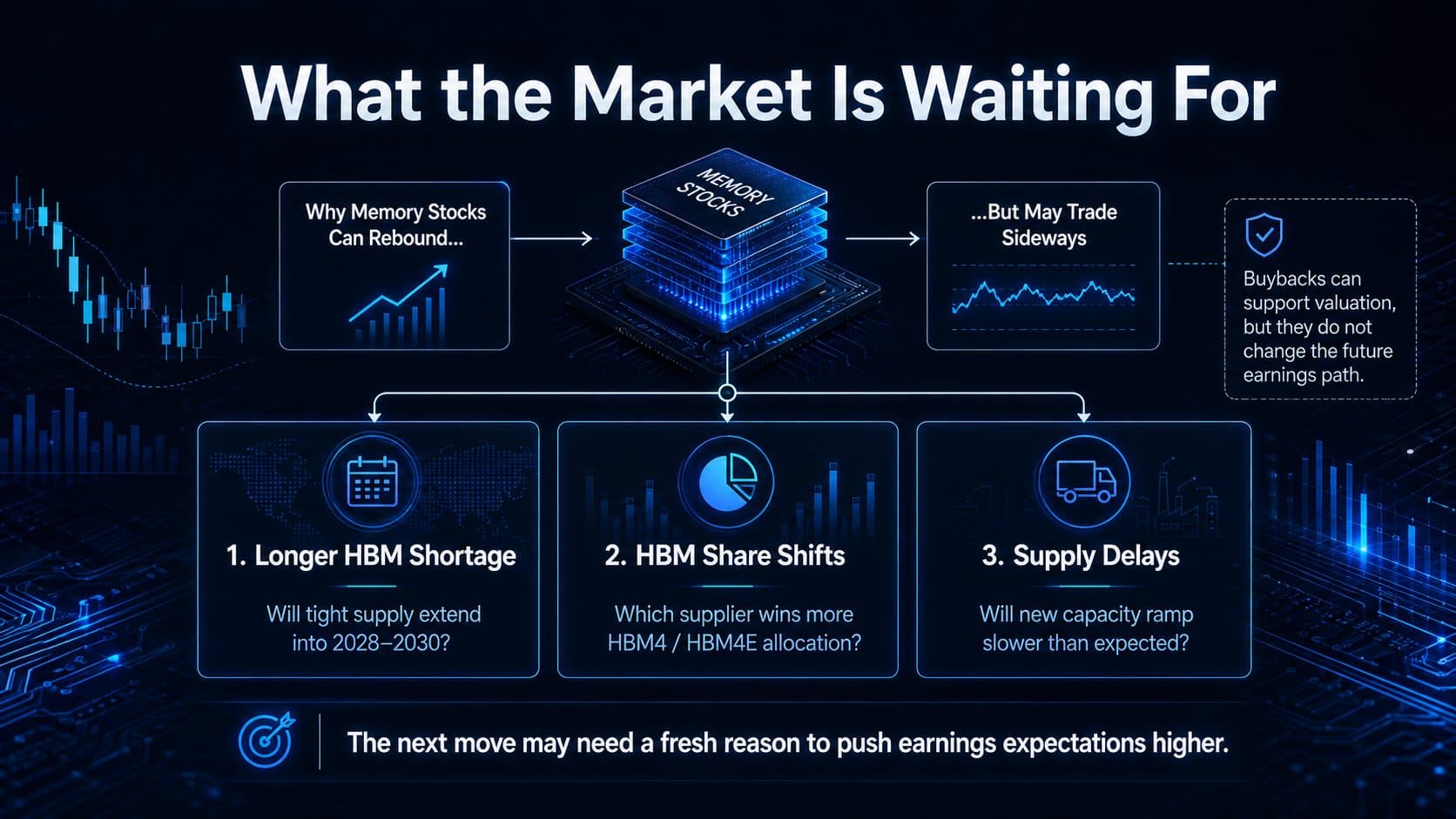
What could drive the next move in memory stocks?
The most important variable is probably how far the shortage extends.
The market already expects 2027 to remain tight. A stronger catalyst would be evidence that HBM capacity remains constrained well into 2028, 2029 or even 2030—through longer customer commitments, continued seller-led pricing, slower fab ramps or another round of capacity being booked years in advance.
The second source of upside is likely to come from market-share changes.
The HBM industry can continue growing without every supplier outperforming. If Micron, Samsung or SK Hynix begins taking materially more HBM4 or HBM4E allocation than investors expect, the resulting earnings revisions could become much more powerful than another increase in the overall HBM demand forecast.
Supply is the third variable to watch closely.
A delayed fab, weaker-than-expected yield improvement, another packaging bottleneck or slower qualification can all reduce expected future supply. That would push ASP and margin assumptions higher again and restart the earnings-revision cycle that powered the first leg of the memory rally.
Long-term customer agreements are important too, but they still need to survive a real downturn before they can be treated as proof that memory economics have permanently changed.
For now, the key question is narrower.
Can the industry keep pushing out the date when supply finally catches up?
If it can, investors may have to raise their view of normalized earnings again.
If it cannot, today's extraordinary profits can coexist with strong AI demand while the stocks spend more time digesting the huge rerating that has already taken place.
That is the tension sitting underneath the memory trade now.
Sources
| No. | Source | Publisher | Date | Type | What it supports |
|---|---|---|---|---|---|
| 1 | TrendForce HBM and DRAM market reporting | TrendForce | 2026-08 | Research | 2027 HBM supply negotiations, HBM bit shipment growth, HBM4 pricing, 2027 DRAM bit supply, 2026–2027 NAND supply outlook and AI server / enterprise SSD demand. |
| 2 | Sandisk investor relations and FY filings | Sandisk | 2026 | Company IR | Quarterly revenue, datacenter revenue growth, multiyear contract coverage of FY2027–FY2028 bit volumes and FY2028–FY2030 non-GAAP gross margin framework. |
| 3 | SK Hynix investor relations and earnings materials | SK Hynix | 2026 | Company IR | HBM market share, Indiana cleanroom and HBM4E timing, capital return and 40 trillion won share repurchase announcement. |
| 4 | Samsung Electronics investor relations | Samsung Electronics | 2026 | Company IR | HBM4 qualifications, capital return plans of 90–110 trillion won for 2026 and HBM4 product specifications. |
| 5 | Micron Technology investor relations | Micron Technology | 2026 | Company IR | 12-high HBM4 production for NVIDIA Vera Rubin, HBM4 product specifications and broader DRAM product roadmap. |
| 6 | NVIDIA NVHBM and product disclosures | NVIDIA | 2026 | Company IR | NVHBM architecture description and HBM-related product strategy. |
Article references TrendForce public reporting on 2027 HBM and DRAM/NAND supply. Company and product references are based on public investor materials from SK Hynix, Samsung Electronics, Micron Technology, Sandisk, NVIDIA, Cerebras, d-Matrix, and the broader memory industry.
Related Reading
HBM vs DDR5: What’s the Difference—and Why AI Needs Both
HBM supplies extreme bandwidth to AI accelerators, while DDR5 provides larger pools of system memory. Understanding the difference is essential for analyzing AI infrastructure and memory stocks.
How CXMT Is Reshaping the Global DRAM Market
CXMT has proven it can manufacture mainstream DRAM at scale and enter China’s server supply chain. What remains unproven is whether it can match Samsung, Micron and SK hynix on yield, cost per bit and profitability through a full memory cycle.
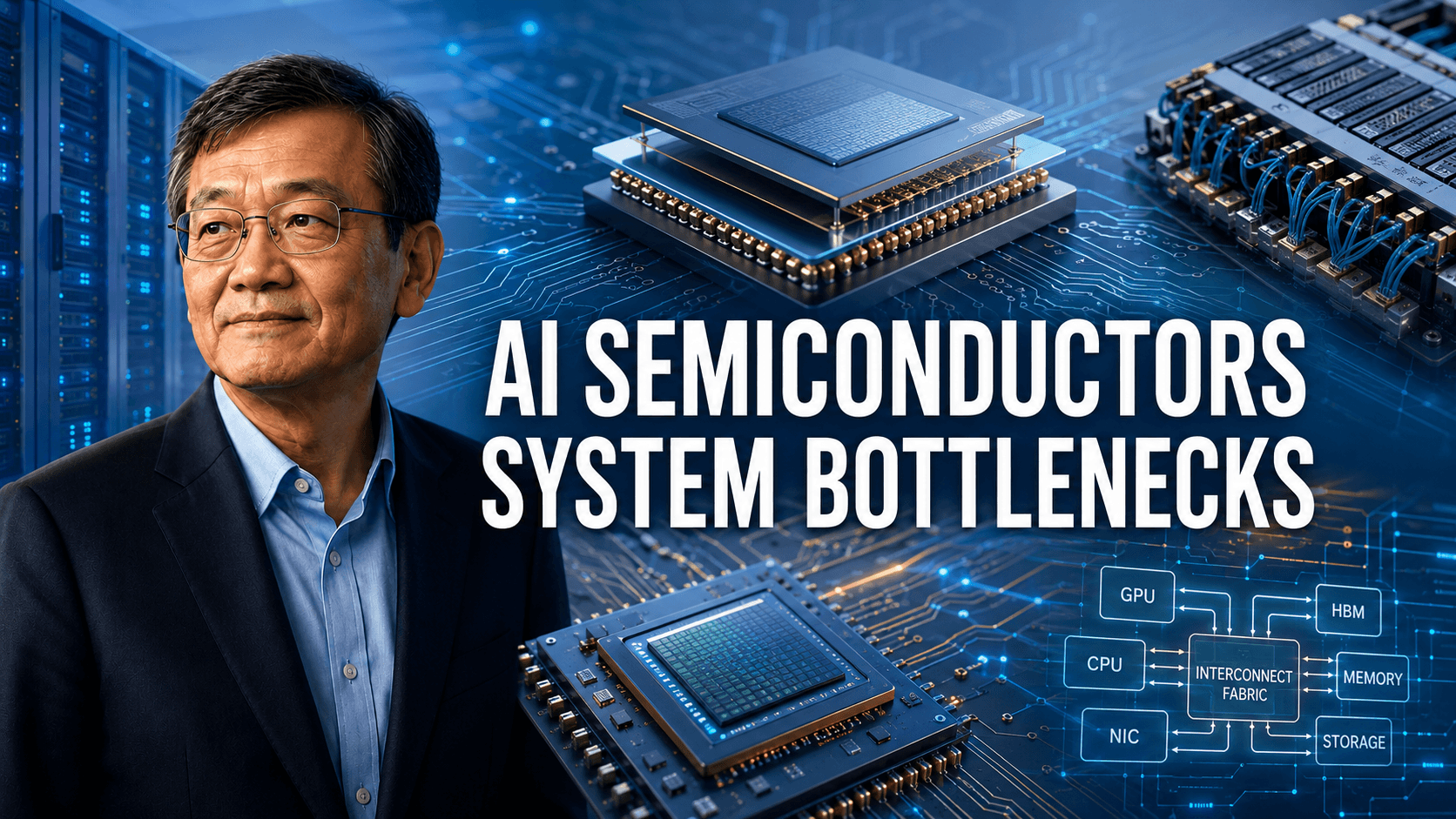
AI Semiconductors Are No Longer Just About Compute. They Are About System Bottlenecks.
AI semiconductors are no longer just about raw compute. The real question is which system bottlenecks customers must solve next.
Invest better with thoughtful research.
Join readers who receive our best ideas and insights straight to their inbox.
Disclosure
This article is for research and education only. It is not investment advice.
Comments