Key Takeaways
- America is not simply defending the dollar. It is rebuilding dollar credibility by pulling global capital toward U.S. assets through strong-dollar policy, Treasury demand, controlled Fed uncertainty, stablecoins, strategic infrastructure, and gold reserves.
- Scott Bessent's economic-statecraft message reframes supply chains, market access, financial innovation, and dollar leadership as national-power tools.
- Kevin Warsh's lower-guidance Fed style matters because markets must price the possibility of tighter policy even if repeated rate hikes never arrive.
- Short-term Treasuries and dollar stablecoins can absorb safety and digital liquidity, while long-term Treasuries face term-premium, fiscal, and inflation-risk pressure.
- Gold can be pressured by dollar strength in the short run while still retaining its strategic role as reserve-system insurance.
On June 23, 2026, Treasury Secretary Scott Bessent spoke at the Economic Club of New York's America 250 gala dinner and laid out a broader economic-statecraft framework for the Trump administration. The next morning, in a CNBC interview, he expanded the market-facing version of that message, including comments on Federal Reserve communication, Kevin Warsh, forward guidance, and the dot plot.
Those two moments belong together. Bessent's message was not only about tariffs, trade deficits, or supply-chain resilience. It was a statement about how the United States wants to use economic power in a world where globalization, technology, capital markets, and national security can no longer be treated as separate subjects.
For three decades, investors largely assumed that the U.S. macro system rested on three stabilizers: global supply chains would help keep goods inflation low, the dollar system would support America's financing advantage, and the Federal Reserve would reduce interest-rate volatility through transparent communication. That arrangement is now being reworked. The United States is not leaving globalization, but it is trying to control the terms under which globalization operates.
The old model asked where companies could produce at the lowest cost. The new model asks which supply chains can survive coercion, sanctions, war, energy shocks, and geopolitical fragmentation. That shift matters for every major asset class because it changes how investors should think about the dollar, Treasuries, gold, stablecoins, AI infrastructure, and non-U.S. assets.
The core thesis is straightforward: America is not merely defending the dollar. It is rewriting dollar credibility.
The New American Playbook
Bessent's economic-statecraft message should not be read as a normal trade-policy speech. Its deeper claim is that the United States can no longer separate economic policy from national security. Strategic sectors such as semiconductors, AI, quantum computing, advanced manufacturing, shipbuilding, critical minerals, and pharmaceuticals are increasingly being treated as national-power assets rather than ordinary commercial industries.
That does not mean Washington wants to produce every component at home. It means the U.S. wants to decide which supply chains are too important to be left to pure cost optimization. Market access, technology transfer, financial rails, sanctions compliance, and industrial capacity are being folded into the same national-interest framework.
This marks a clear break from the old globalization playbook. Old globalization treated market access as broadly open; the new system treats it as conditional. Old globalization optimized for low prices; the new system is willing to pay for resilience and control. Old globalization assumed the dollar system functioned mainly as a global public good; the new system increasingly treats it as a strategic instrument.
For investors, the question is no longer just whether a company looks cheap on conventional metrics. The more important question is whether an asset sits inside or outside America's strategic perimeter. Companies tied to AI infrastructure, power, defense, critical minerals, cybersecurity, advanced manufacturing, and dollar-based financial infrastructure may receive a strategic premium. Companies dependent on fragile global arbitrage, low-margin imports, opaque sourcing, or China-linked chokepoints may deserve a higher risk discount.
That is how state policy enters asset pricing. It does not replace earnings, cash flow, or valuation. It changes the risk premium attached to them.
Why America Needs a Strong Dollar
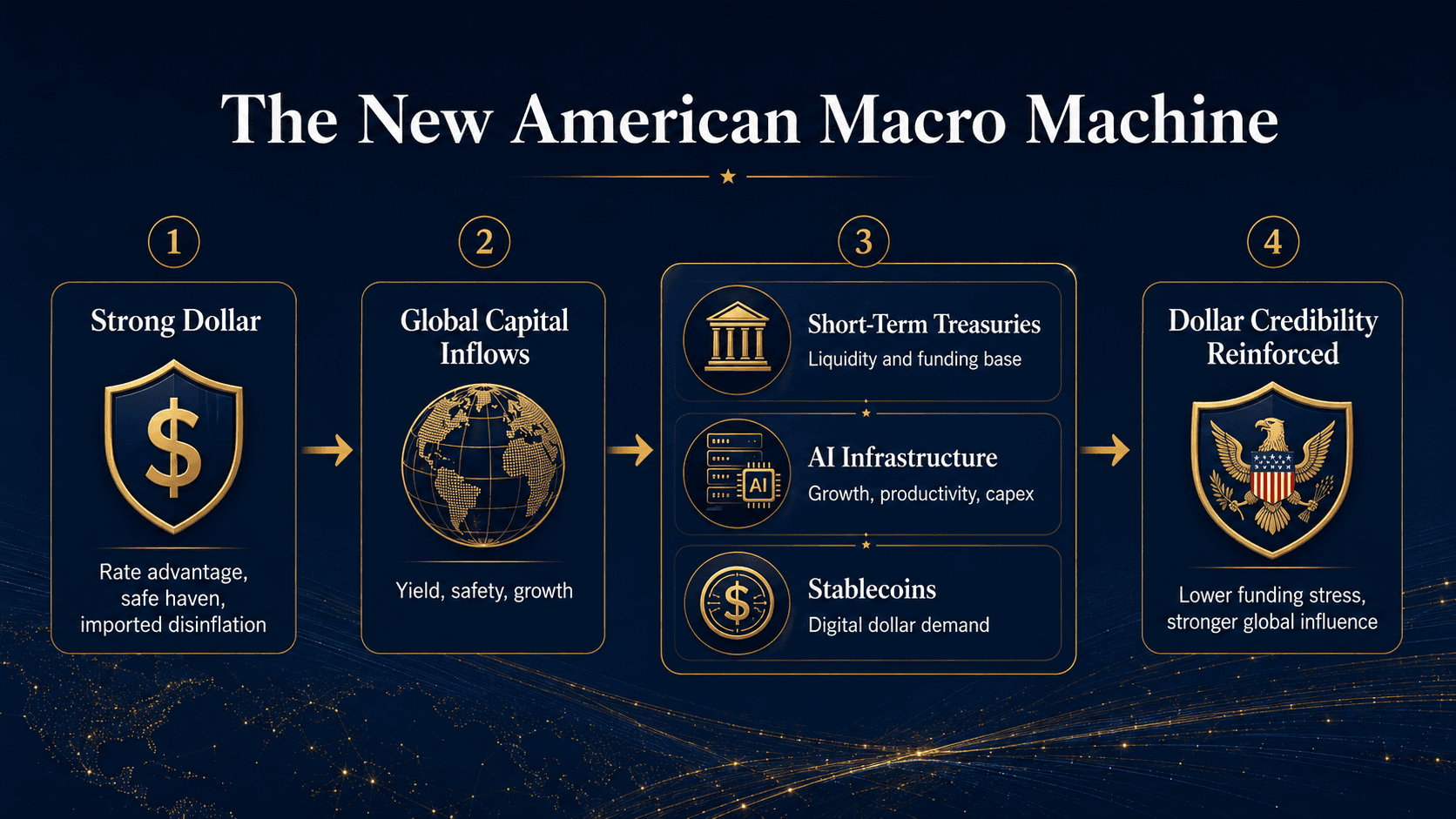
The United States needs a strong dollar because the dollar now has to do several jobs at once. It helps contain imported inflation, attracts global capital, supports Treasury demand, and reinforces the idea that dollar assets remain the safest and deepest pool of liquidity in the world.
The inflation channel is the most immediate. Tariffs, reshoring, energy uncertainty, and supply-chain redundancy can all raise costs. A stronger dollar can offset part of that pressure by making imported goods and dollar-priced commodities less expensive for U.S. buyers. It is not a full solution, but it helps cushion the domestic price impact of a less efficient supply chain.
The capital-flow channel is just as important. When investors see high U.S. short-term yields, deep Treasury markets, dominant technology platforms, and a rising dollar, the U.S. becomes the default destination for global liquidity. This is not because the world loves U.S. politics. It is because no other system can absorb capital at the same scale across Treasuries, money-market funds, equities, corporate credit, private markets, and dollar cash.
That capacity is the real foundation of dollar strength. The dollar's advantage is not popularity; it is depth. Even countries and investors that want to reduce dollar dependence often still need dollar liquidity, dollar collateral, dollar funding markets, and dollar settlement rails.
The contradiction is that the more Washington uses the dollar system as a strategic tool, the more other countries try to reduce single-point dependence on it. That does not mean the dollar immediately loses reserve-currency status. It means the dollar can remain strong in price while becoming more contested in politics.
AI Is One Capital Reservoir, Not the Only One
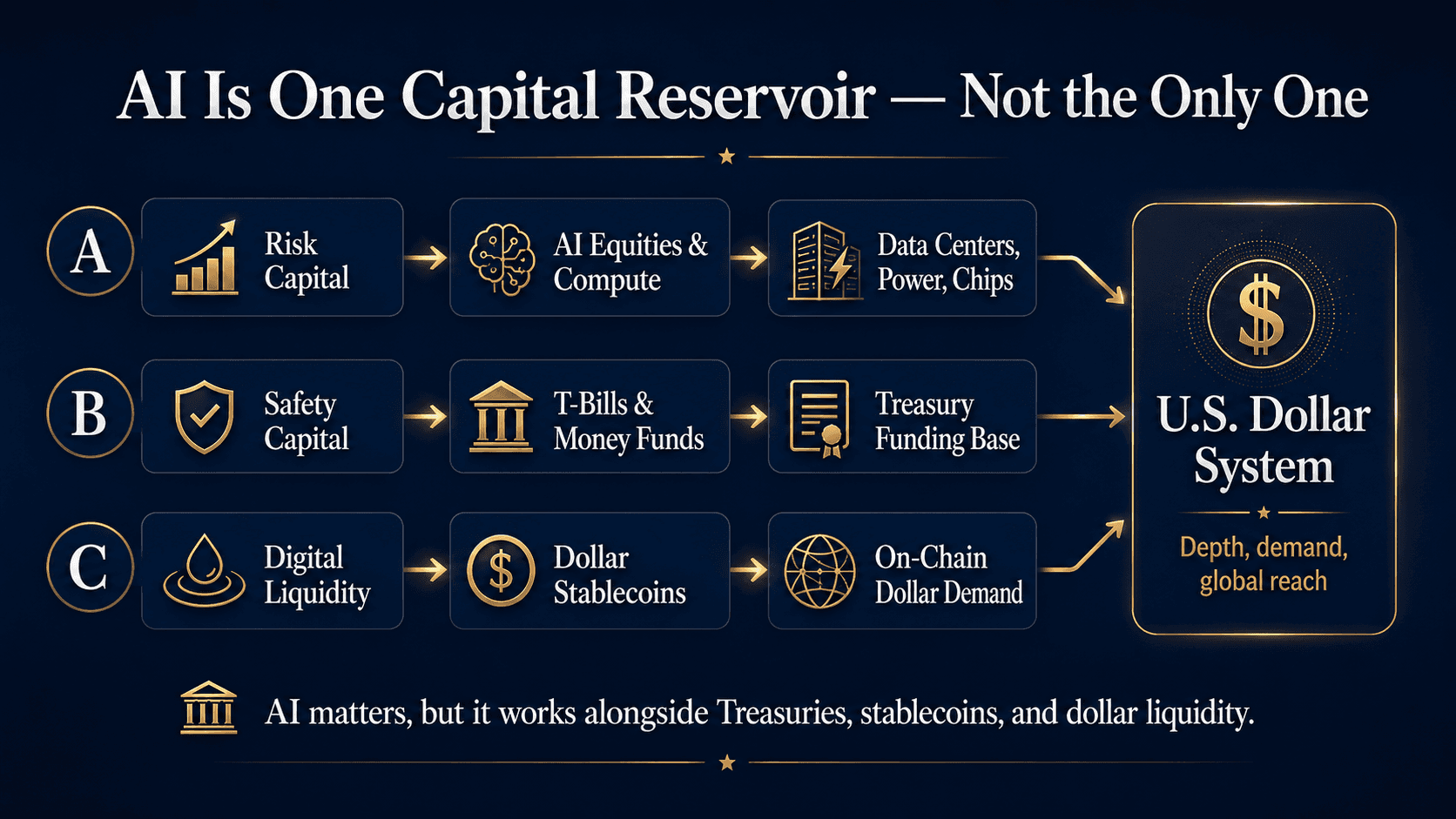
AI matters to this story, but the article should not reduce everything to AI. The larger point is that the U.S. dollar system is absorbing capital through several channels at once.
AI is one of the largest reservoirs for global risk capital. It gives investors a reason to keep buying U.S. equities, cloud platforms, data centers, semiconductors, power infrastructure, and private infrastructure funds. It also gives the United States a future-productivity story at a time when fiscal deficits, interest costs, and industrial rebuilding all require a credible growth narrative.
But the dollar system is not relying on AI alone. Safety capital is flowing into T-bills, money-market funds, repos, and Treasury-backed instruments. Digital liquidity is flowing into dollar stablecoins and tokenized dollar assets. Risk capital supports the American growth story, safety capital supports Treasury funding, and digital dollar liquidity extends the dollar network globally.
This is why the AI buildout is bigger than a technology cycle. AI helps explain why investors are still willing to finance America's future, but the broader dollar system determines where that capital ultimately settles. The U.S. does not need every dollar to go into AI. It needs global capital to stay inside the dollar ecosystem.
Bessent and Warsh: The Policy Combo
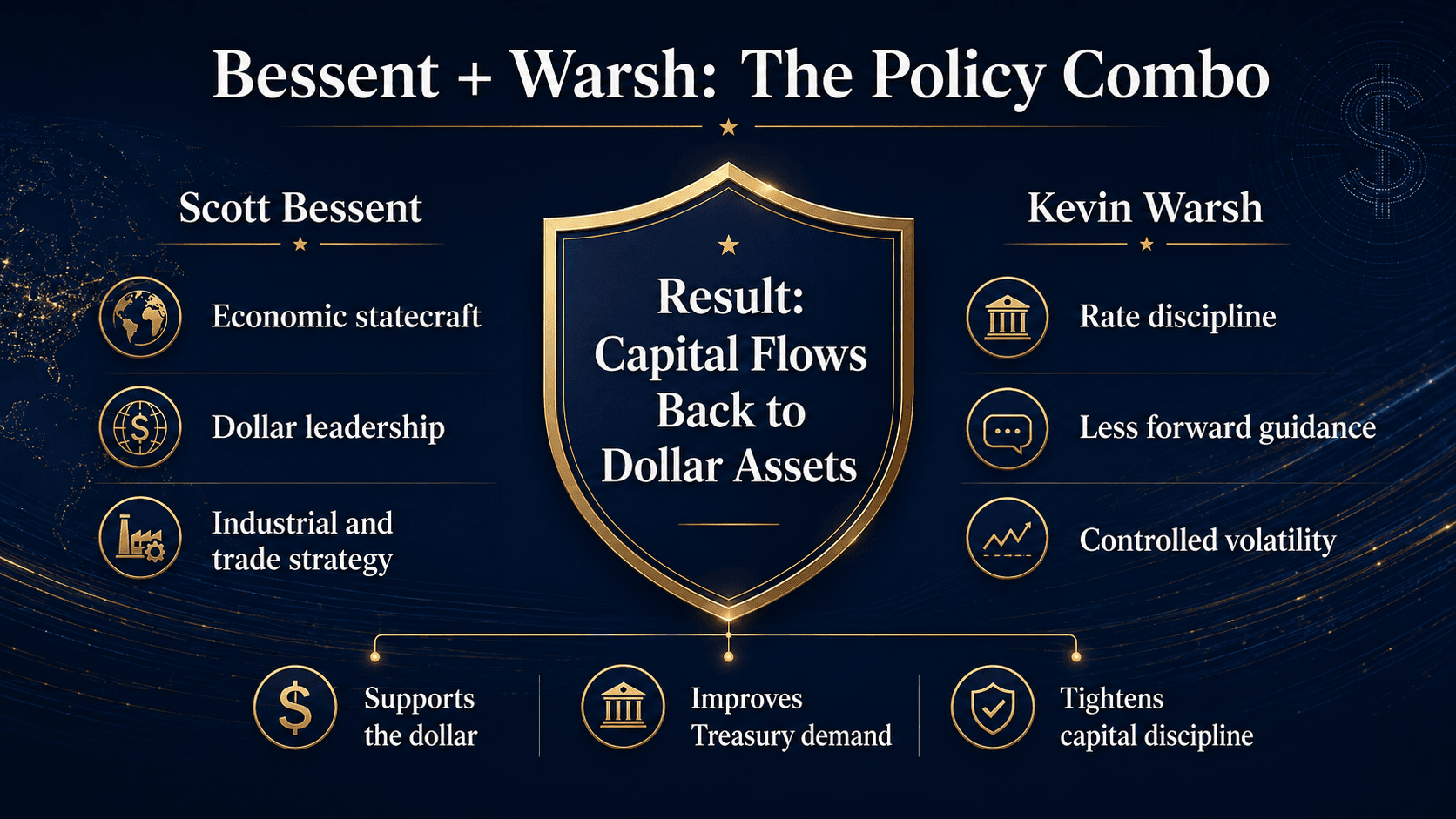
Bessent and Kevin Warsh should not be described as if they are secretly coordinating to manipulate markets. The more useful point is that their policy functions fit together.
Bessent supplies the strategic narrative. He frames tariffs, industrial policy, supply-chain resilience, financial innovation, stablecoins, and dollar leadership as part of a broader national-interest strategy. His message tells investors that America's high capital needs are not merely a fiscal burden; they are tied to a larger project of rebuilding industrial and financial power.
Warsh supplies the monetary discipline. A Fed that relies less on forward guidance forces markets to price uncertainty again. For years, investors treated the Fed as a source of guidance, comfort, and at times implicit insurance. A less predictable Fed changes that by making it harder for markets to assume that rate cuts will arrive on a pre-packaged schedule.
That uncertainty tightens financial conditions even before policy changes. Warsh does not need to deliver multiple rate hikes for the signal to matter; he only needs markets to believe hikes are possible. The threat of tightening can support the dollar, keep short-term Treasuries attractive, prevent premature easing, and reduce speculative leverage.
The purpose is not to crash the market. It is to restore discipline to capital pricing.
Why Controlled Volatility Helps the Dollar
The U.S. does not want uncontrolled panic, but controlled volatility can serve a useful purpose. It shakes out excessive leverage, increases demand for dollar liquidity, and pushes capital away from weaker assets back toward core U.S. markets.
When global investors get nervous, they usually do not run first into illiquid alternatives. They run into dollars, Treasuries, money-market funds, and the most liquid U.S. equities. This is why volatility can support the dollar system, as long as the volatility remains contained.
The distinction matters. If volatility damages only the periphery - unprofitable growth stocks, overleveraged trades, speculative crypto, fragile emerging markets, and long-duration assets - it can reinforce the core. If it breaks Treasury market liquidity, major bank balance sheets, dollar funding, or the largest technology platforms, it becomes dangerous.
The policy objective is therefore not a market with no volatility. It is a market where volatility disciplines the edges without breaking the center.
Stablecoins Are Not Anti-Dollar
Stablecoins are one of the most underappreciated parts of this story. Many investors still think of crypto as automatically anti-dollar, but that misses the direction of U.S. policy.
The form of crypto that best serves U.S. national interest is not an unregulated offshore system. It is dollar-backed stablecoins operating under U.S. rules. If regulated stablecoin issuers hold reserves in cash-like dollar assets and short-term Treasuries, they can turn global on-chain liquidity into structural demand for dollar instruments.
In that sense, the United States can take a technology that was originally marketed as a way to bypass traditional finance and use it to expand the dollar network. The likely direction is not a lawless crypto system outside U.S. oversight. It is on-chain dollars, regulated custody, tokenized Treasuries, compliant settlement rails, and institutional digital liquidity.
That creates a clear split inside crypto. Regulated dollar stablecoins and infrastructure tied to Treasury-backed liquidity may benefit. Privacy coins, offshore platforms, sanction-evasion channels, and speculative tokens that rely entirely on excess liquidity face a less favorable policy environment.
Gold: Pressured by Dollar Strength, Supported by Systemic Risk
Gold is the uncomfortable contradiction inside the new dollar regime. In the short run, it can be pressured by the same policy mix that supports dollar assets. A stronger dollar, higher real rates, renewed Fed hike expectations, and attractive short-term Treasury yields all raise the opportunity cost of holding an asset that pays no income.
That does not mean the long-term gold thesis is broken. It means the dollar system is winning the liquidity battle for now. When investors can earn income in T-bills while holding dollar liquidity, gold becomes easier to sell.
The longer-term logic is different. Gold is not only an inflation hedge; it is a reserve-system hedge. It becomes more valuable when investors and central banks worry about fiscal credibility, sanctions, asset freezes, reserve diversification, and the political use of the dollar system.
This is why the U.S. position is more nuanced than it appears. America promotes dollar credibility, but it still holds the world's largest official gold reserve. U.S. Treasury data show that the federal government owns about 261.5 million fine troy ounces of gold, or roughly 8,133 metric tons, and World Gold Council data also ranks the United States as the largest official gold holder globally.
The United States does not need gold to run the daily dollar system. It keeps gold because gold has no counterparty. In this framework, gold should not be read only through CPI or the dollar index. Dollar strength can pressure it in the short term, while dollar weaponization, fiscal stress, and reserve diversification support its long-term role as balance-sheet insurance.
What This Means for Treasuries
The Treasury market remains the center of the global financial system, but the curve is changing. The short end is easier to support because T-bills offer liquidity, yield, and low duration risk. They can absorb money-market funds, corporate cash, stablecoin reserves, foreign cash, and risk-off flows.
The long end is more fragile. Long-duration Treasuries face fiscal risk, inflation uncertainty, reduced Fed forward guidance, and term-premium repricing. This does not mean the Treasury market is collapsing. It means investors may demand more compensation to hold long-term U.S. debt.
America can still finance itself, but cheap and unconditional long-term financing is no longer guaranteed. That is why the U.S. needs a credible growth story. If AI infrastructure and industrial rebuilding convince investors that future U.S. growth and tax capacity will be higher, Treasury credibility becomes easier to maintain. If the investment wave fails to produce cash flow and productivity, the long end becomes more vulnerable.
What This Means for Markets
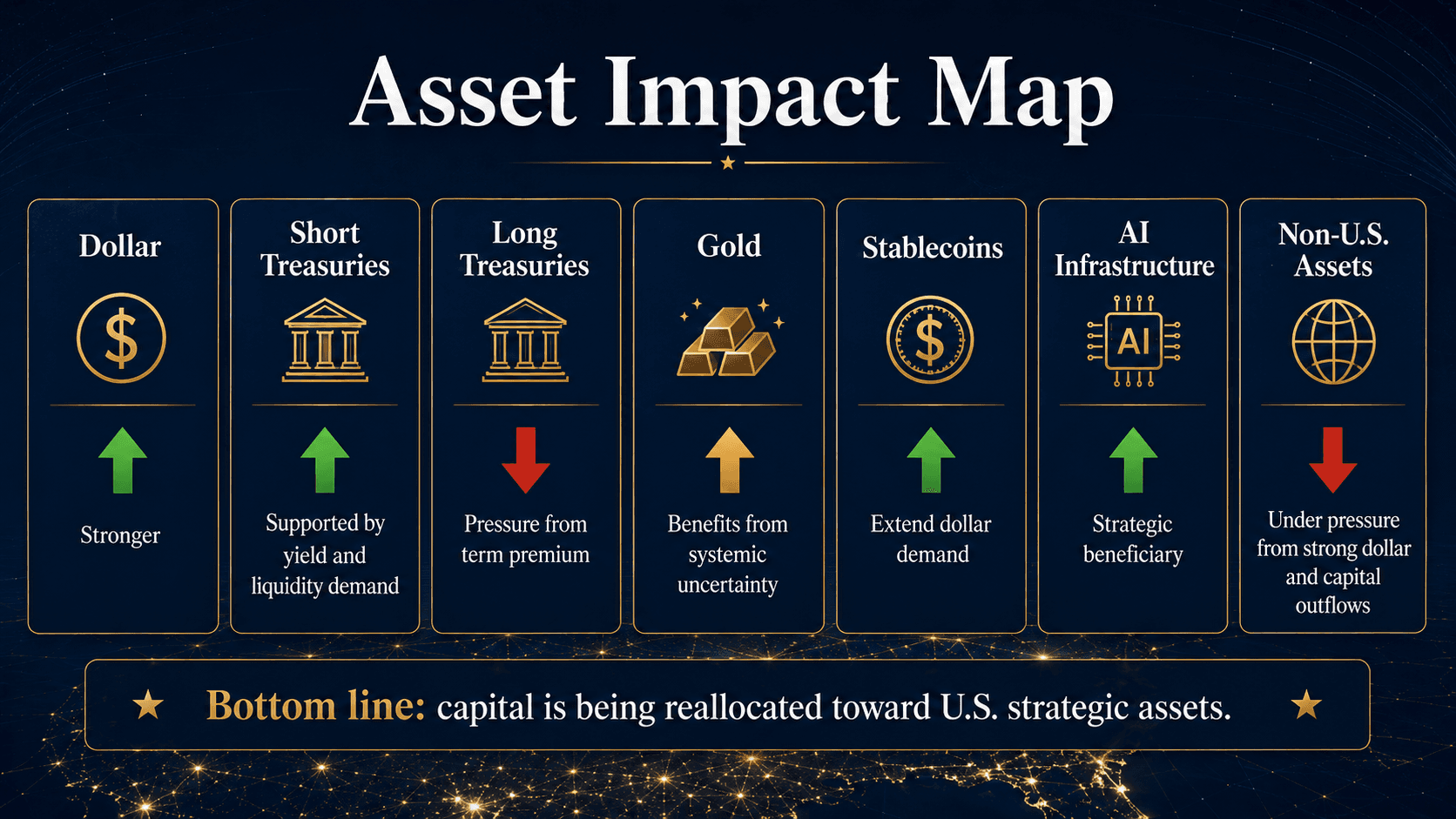
The market impact is not one-dimensional. The dollar can strengthen because of rate advantage, safe-haven demand, and global capital inflows. Short-term Treasuries can benefit from high yield and liquidity demand. Long-term Treasuries can remain under pressure because of term premium, fiscal risk, and inflation uncertainty.
Gold can fall in the short run while remaining strategically important in the long run. Stablecoins can benefit if they become regulated extensions of dollar demand. AI infrastructure can remain a strategic beneficiary, while speculative AI narratives are more vulnerable to tighter capital discipline.
Non-U.S. assets may face pressure when dollar strength and U.S. rate uncertainty pull liquidity away from foreign markets. This is not a simple "risk-on" or "risk-off" environment. It is a capital reallocation regime in which assets tied to U.S. strategic priorities may receive a premium, while assets outside the dollar-centered system face a higher hurdle.
The Main Risk
The structure depends on whether strategic capital spending can become durable cash flow. If the answer is yes, the United States can defend a powerful macro story: high capital spending today creates higher productivity tomorrow.
If the answer is no, the system becomes more vulnerable. Capital spending disappoints, mega-cap margins come under pressure, data-center financing tightens, power and chip supply-chain orders get revised, equity valuations fall, the U.S. productivity story weakens, and Treasury term premium rises. In that scenario, the dollar may still be strong, but more as a defensive asset than as a growth asset.
The danger is not simply that capital spending is large. The danger is that spending grows faster than monetization. A real technology revolution can still contain localized bubbles; the two are not mutually exclusive.
The Big Conclusion
Bessent's latest message confirms that America's macro policy function has changed. The United States is no longer optimizing only for low-cost efficiency. It is optimizing for resilience, strategic control, industrial capacity, dollar leadership, and financial leverage.
Bessent is building the national strategy narrative. Warsh is restoring monetary uncertainty and rate discipline. The Treasury market is absorbing global safety capital. AI infrastructure is absorbing global growth capital. Stablecoins are extending dollar demand into the digital economy. Gold remains the quiet reserve insurance behind the system.
This is the new American macro machine. The United States is not simply trying to lower inflation or defend the dollar. It is rewriting dollar credibility through capital flows, controlled volatility, strategic industries, and financial statecraft.
The old globalization trade was about efficiency. The new American trade is about control.
Frequently Asked Questions
Is this simply deglobalization?
No. The United States is not leaving globalization. It is trying to control the terms of globalization. Ordinary goods may still be globalized, but strategic supply chains are being repriced through national-security logic.
Why does the U.S. need a strong dollar?
A strong dollar helps contain import inflation, attracts global capital, supports demand for dollar assets, and reinforces Treasury market credibility.
Why is Bessent important?
Bessent is framing tariffs, supply chains, stablecoins, financial innovation, and dollar leadership as part of a broader economic statecraft strategy.
Why does Warsh matter?
Warsh represents a Fed communication style with less forward guidance and more market discipline. That can support the dollar by preventing investors from pricing in easy rate cuts too early.
Why are stablecoins important to the dollar?
Dollar-backed stablecoins can extend dollar demand globally, especially if their reserves are held in short-term Treasuries or cash-like dollar assets.
Why can gold fall even if the long-term gold thesis remains intact?
Gold can fall when the dollar strengthens, real rates rise, and short-term Treasuries become attractive. But gold remains a reserve-system hedge against fiscal stress, sanctions, asset freezes, and dollar weaponization.
Why does the U.S. hold so much gold?
The U.S. promotes the dollar system, but it still holds the world's largest official gold reserve because gold has no counterparty and remains a balance-sheet insurance asset.
What is the biggest risk to this thesis?
The biggest risk is that strategic capital spending, especially in AI infrastructure and industrial rebuilding, fails to turn into durable cash flow and productivity growth.
Sources
| No. | Source | Publisher | Date | Type | What it supports |
|---|---|---|---|---|---|
| 1 | Secretary Bessent remarks on economic statecraft and dollar leadership | U.S. Department of the Treasury | 2026-04-23 | Government | Used for Bessent's economic statecraft, dollar leadership, and strategic financial-power framing. |
| 2 | Bessent applauds reduction in Fed guidance, says dot plot should be abandoned | Reuters | 2026-06-24 | News | Used for the Fed communication, forward-guidance, and dot-plot discussion. |
| 3 | U.S. bond market expects rate hikes the Fed may never deliver | Reuters | 2026-06-25 | News | Used for bond-market expectations, rate-hike pricing, and Treasury-curve context. |
| 4 | Tracking trillions: assumptions shaping the scale of the AI buildout | Goldman Sachs | N/A | Research | Used for AI infrastructure and capital-spending scale context. |
| 5 | Status Report of U.S. Government Gold Reserve | U.S. Treasury FiscalData | N/A | Government | Used for U.S. official gold reserve ounces and reserve-system context. |
| 6 | Gold reserves by country | World Gold Council | N/A | Other | Used to rank U.S. official gold holdings globally. |
| 7 | Gold extends losses on Fed tightening outlook and dollar strength | Reuters | 2026-06-25 | News | Used for near-term gold pressure from dollar strength and hawkish Fed signals. |
| 8 | Trumponomics 2.0 throws out old globalization playbook | Axios | 2026-06-24 | News | Used for Bessent's globalization, supply-chain resilience, and policy-regime framing. |
This article uses public official data, news reporting, and institutional research to frame a macro-policy thesis. Sources are provided as readable links so readers can verify the policy claims, market context, AI infrastructure assumptions, gold reserve data, and asset-impact framing.
Related Reading

AI Semiconductors Are No Longer Just About Compute. They Are About System Bottlenecks.
AI semiconductors are no longer just about raw compute. The real question is which system bottlenecks customers must solve next.
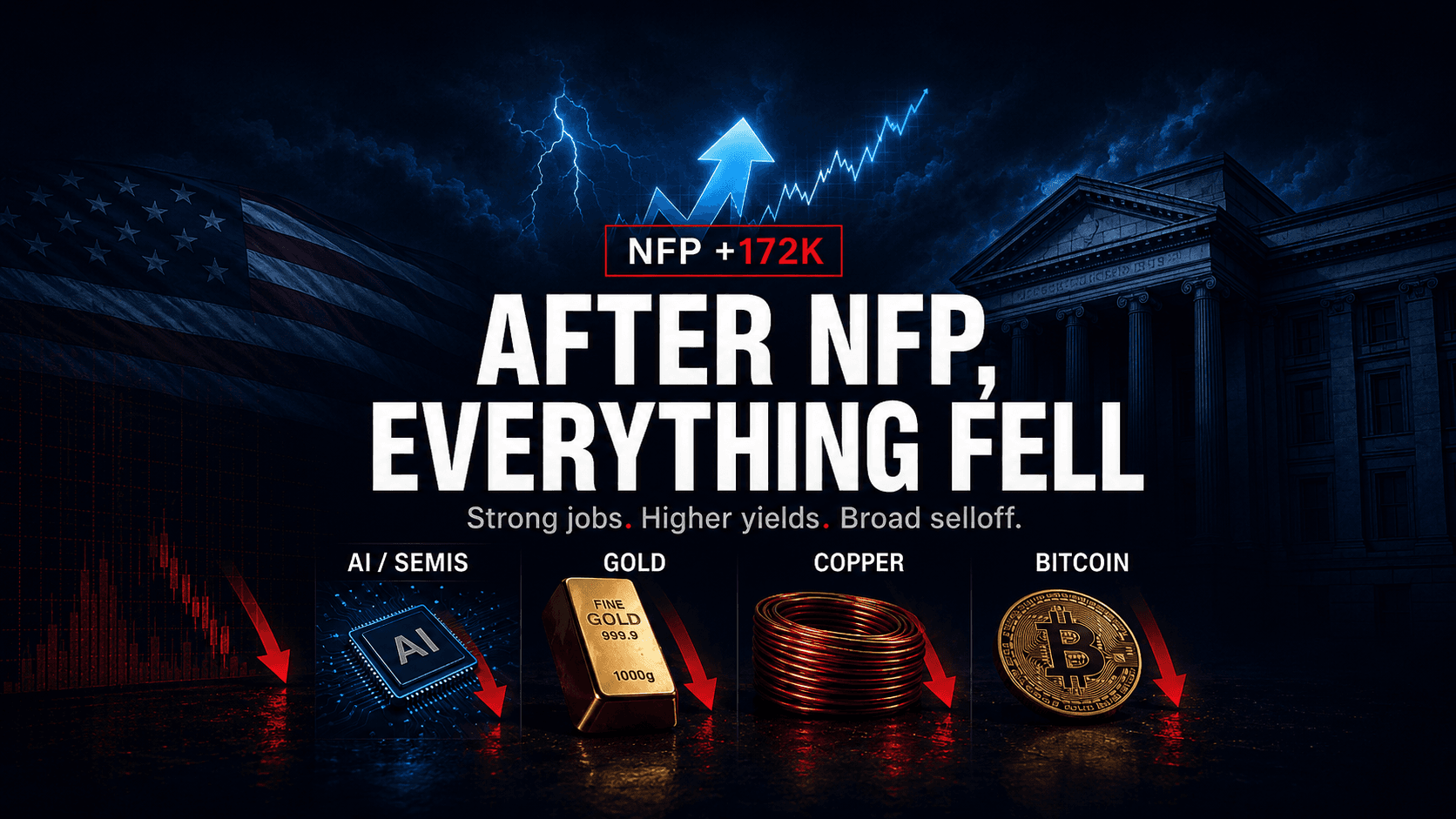
The U.S. Economy and U.S. Fiscal System Are Demanding Opposite Monetary Policies
What broke on June 5 was not AI valuation, but the market’s faith in endless Quantitative Easing

SpaceX IPO: What Are Investors Really Paying For?
Starlink, Starship, AI compute, defense infrastructure, and the valuation risk behind the world’s most anticipated IPO.
Invest better with thoughtful research.
Join readers who receive our best ideas and insights straight to their inbox.
Disclosure
This article is for research and education only. It is not investment advice.
Comments