
On July 20, DIGITIMES reported that accelerating AI data center construction is driving structural demand growth across printed circuit boards and passive components. Supply expansion has failed to keep pace in several critical categories, extending lead times and forcing customers to compete for qualified capacity. DIGITIMES
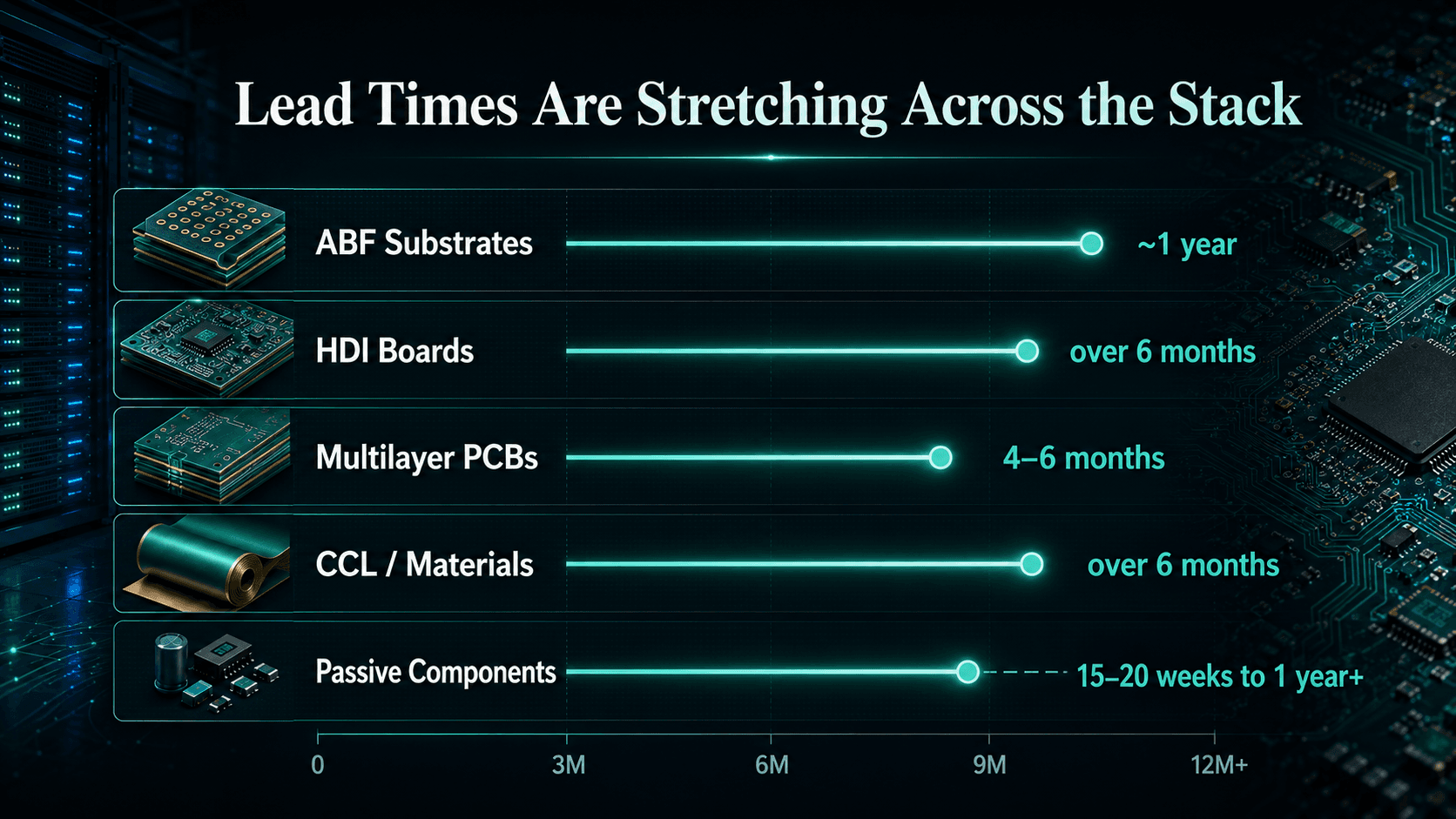
The pressure is spreading across the stack. ABF substrate lead times have reportedly approached one year, while delivery times for HDI boards, multilayer PCBs, copper-clad laminates and selected passive components have stretched from several months to more than a year in the most constrained categories. DIGITIMES
For investors, the significance extends beyond another hardware shortage. Hyperscaler capital spending is moving beyond GPUs, HBM and advanced packaging into the less visible components required to deliver a complete AI system.
Substrates, laminate materials, high-layer-count circuit boards and power components now absorb a growing share of the infrastructure budget. This broadening of spending is also visible in the site’s AI Bottleneck Tracker, which follows constraints across compute, memory, optical, power and manufacturing layers.
That does not mean every supplier benefits equally. A long lead time can indicate pricing power, but it can also reflect an inability to secure materials or deliver finished products. The investment question is where the additional spending becomes higher revenue, stronger margins and cash flow—and where it is absorbed by raw-material inflation, capital expenditure and production bottlenecks.
Key Takeaways
- AI capital spending is moving beyond processors into substrates, materials, PCBs and power components.
- Scarce, customer-qualified substrate and material capacity may capture the first layer of pricing power.
- PCB makers can show stronger revenue growth, but cash-flow conversion depends on material costs, ramp execution and capital intensity.
AI Capital Spending Is Moving From Chips to Complete Systems
AI infrastructure was initially measured by accelerator demand. That framework is becoming less complete as rack power, network bandwidth and compute density continue to rise.
A deployable AI system requires more than GPUs. It also requires package substrates, high-performance PCBs, low-loss laminate materials, capacitors, inductors, power-delivery components and networking equipment. A shortage in any one of these categories can delay the conversion of expensive processors into usable computing capacity.
AMD’s first-quarter data center revenue increased 57% year over year to approximately $5.8 billion, with the company identifying data center products as a major driver of revenue and earnings growth. AMD also expects server growth to accelerate as supply expands. That demand is still building at the processor level, while the latest supply-chain reports suggest that supporting components are becoming a more important constraint on system delivery. AMD
This changes the path of capital through the hardware stack. The first shift is an increase in component value per server, allowing suppliers to benefit from higher unit volumes, greater material consumption per system and migration toward more expensive specifications.
The second shift is more consequential: customers are beginning to compete for capacity. DIGITIMES reported that suppliers negotiating high-end FC-BGA substrate capacity have sought stronger purchasing commitments, advance payments and, in some cases, direct procurement participation from end customers. When customers are willing to underwrite capacity or assume part of the supply risk, economic leverage begins to move toward the supplier. DIGITIMES
High-End Substrates May Capture the First Layer of Incremental Profit
ABF and FC-BGA substrates connect CPUs, GPUs and custom AI accelerators to the server board. As package dimensions expand and I/O density increases, substrate complexity, yield requirements and unit value rise with them.
This layer has two characteristics that can support pricing power: customer qualification takes time, and new capacity is slow to build. Ibiden announced plans to invest approximately ¥500 billion between fiscal 2026 and fiscal 2028 to expand production of high-performance IC package substrates, with AI and high-performance servers among the targeted end markets. New capacity is expected to begin entering production from fiscal 2027. Ibiden
The scale and duration of the plan suggest that customer demand visibility is strong enough to support a multiyear investment program. They also show why near-term supply may remain constrained, because factories, equipment, process qualification and customer approval cannot be added immediately.
For Ibiden, the potential inflow of capital appears in several forms: greater customer commitment, higher utilization of advanced production lines and a richer product mix. The risk is equally material. A ¥500 billion expansion creates a large future cash requirement, and returns will depend on whether demand remains strong after new capacity comes online.
High-end substrates may therefore possess some of the strongest structural pricing foundations in the chain, while also carrying some of the largest execution and capital-allocation risks. This tension between scarcity and future returns is central to the site’s broader AI infrastructure bottleneck framework.
CCL and Advanced PCB Materials May Receive the Most Direct Pricing Benefit
Substrate and PCB manufacturers depend on copper-clad laminates, copper foil, glass fiber cloth and specialized resins. As performance requirements rise, the pool of qualified suppliers becomes smaller and the cost of switching materials increases.
This makes the material layer particularly important for understanding where the profit pool may migrate. PCB manufacturers can receive more orders, but they cannot increase shipments without securing sufficient qualified material. When high-end laminate products move into allocation or experience sharply longer delivery times, part of the additional economic value is likely to move upstream.
That is why companies such as Elite Material, ITEQ and Taiwan Union Technology deserve closer attention. Their earnings exposure depends on more than AI server unit growth; the relevant transmission mechanism runs through product specification, capacity and pricing.
The central question is whether pricing rises faster than the cost of copper foil, glass cloth and resin. A supplier that merely passes through raw-material inflation may report higher revenue without generating meaningful margin expansion.
The stronger beneficiaries will be companies that combine advanced product qualification, secure input supply and capacity that can enter production while the market remains tight. This makes high-end CCL one of the most direct potential beneficiaries of the current supply imbalance.
The thesis still requires company-level confirmation through average selling prices, gross margins, utilization rates and the share of revenue generated by advanced products. Related Industry Trends research provides additional context on how these manufacturing constraints can change competitive economics.
High-End PCB Manufacturers Have Greater Revenue Leverage—but Less Direct Margin Leverage
PCB manufacturers sit closer to server and networking demand, so their revenue can respond quickly when AI system shipments increase. They also operate between two sources of pressure: rising material costs upstream and demanding delivery schedules downstream.
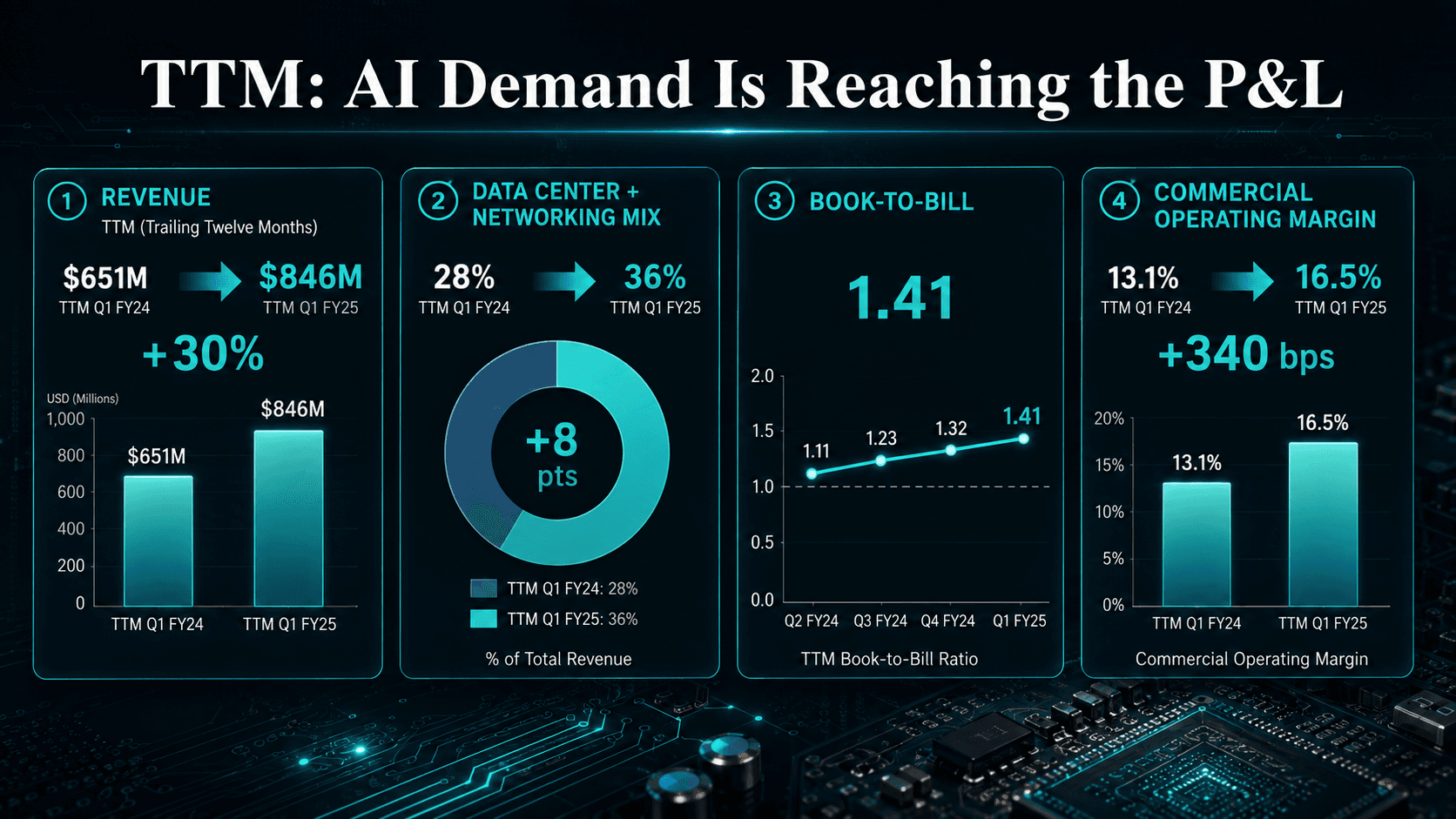
$TTMI ~ TTM Technologies provides a useful example. TTM reported first-quarter revenue of $846 million, an increase of 30% year over year and a quarterly record. Data center computing and networking represented 36% of revenue, up from 28% a year earlier, while the company’s book-to-bill ratio reached 1.41. TTM Technologies
The commercial segment provides stronger evidence that AI spending is reaching the income statement. Commercial revenue increased 48.8% to $495 million, while segment operating income rose from $43.6 million to $81.6 million. The segment’s operating margin expanded from 13.1% to 16.5%. TTM Technologies
Management attributed the improvement to demand from AI data centers and related applications, along with higher sales, a more favorable product mix and operational gains. These results show that AI capital has already moved through the supply chain into TTM’s revenue and operating profit.
The cash-flow picture is less straightforward. First-quarter operating cash flow was only $21.7 million, or approximately 2.6% of revenue. Ramp-up costs at the company’s Malaysian facility also offset part of the margin improvement. TTM Technologies Form 10-Q
For TTM, capital enters through orders, revenue growth and a richer product mix. It exits through material procurement, factory ramp costs and new capacity. The amount ultimately retained by shareholders depends on pricing, yield, utilization and delivery execution.
High-end PCB manufacturers may therefore have greater revenue elasticity than upstream material suppliers, but they do not automatically have greater free-cash-flow elasticity. The distinction is consistent with the site’s Business Models research, which focuses on how industry growth becomes—or fails to become—per-share cash flow.
Passive Components Offer a Larger Long-Term Opportunity—but Greater Earnings Dilution
The latest supply reports also identify MLCCs, resistors, tantalum capacitors and aluminum electrolytic capacitors as categories facing longer lead times. AI servers require more stable power delivery, higher voltage tolerance and greater current-handling capacity, which should increase the value and quantity of selected passive components used in power systems, networking equipment and optical modules. DIGITIMES
The challenge is that major passive-component manufacturers also serve automotive, smartphone, industrial and consumer markets. Strong AI demand can be diluted by price weakness or lower utilization elsewhere, and TDK’s latest results illustrate this divergence.
Revenue in TDK’s passive-components segment increased 6%, while operating profit rose 22.8%. Demand from AI servers and renewable energy supported growth in aluminum electrolytic and film capacitors. Ceramic capacitors, however, experienced lower average selling prices despite higher unit volumes, which reduced profit in that category. TDK
The implication is clear: “passive-component shortages” do not translate into uniform earnings growth across the sector. The products with the strongest potential exposure include high-voltage aluminum electrolytic capacitors, film capacitors, high-voltage MLCCs, low-voltage high-current inductors and selected components used in optical modules.
TDK expects passive-component sales to grow between 5% and 8% in the next fiscal year and has discussed expanding AI data center-related passive-component revenue substantially over time. It has also highlighted a potential migration toward 400- to 800-volt data center power architectures, which would increase demand for high-voltage capacitors and inductors. TDK
Management has nevertheless acknowledged that AI data center demand had not yet become large enough to drive a major increase in group-wide profit. This layer may offer substantial long-term product-mix improvement, but the near-term earnings effect remains concentrated in specific categories rather than the entire company. TDK
Where Is the AI Server Profit Pool Moving?
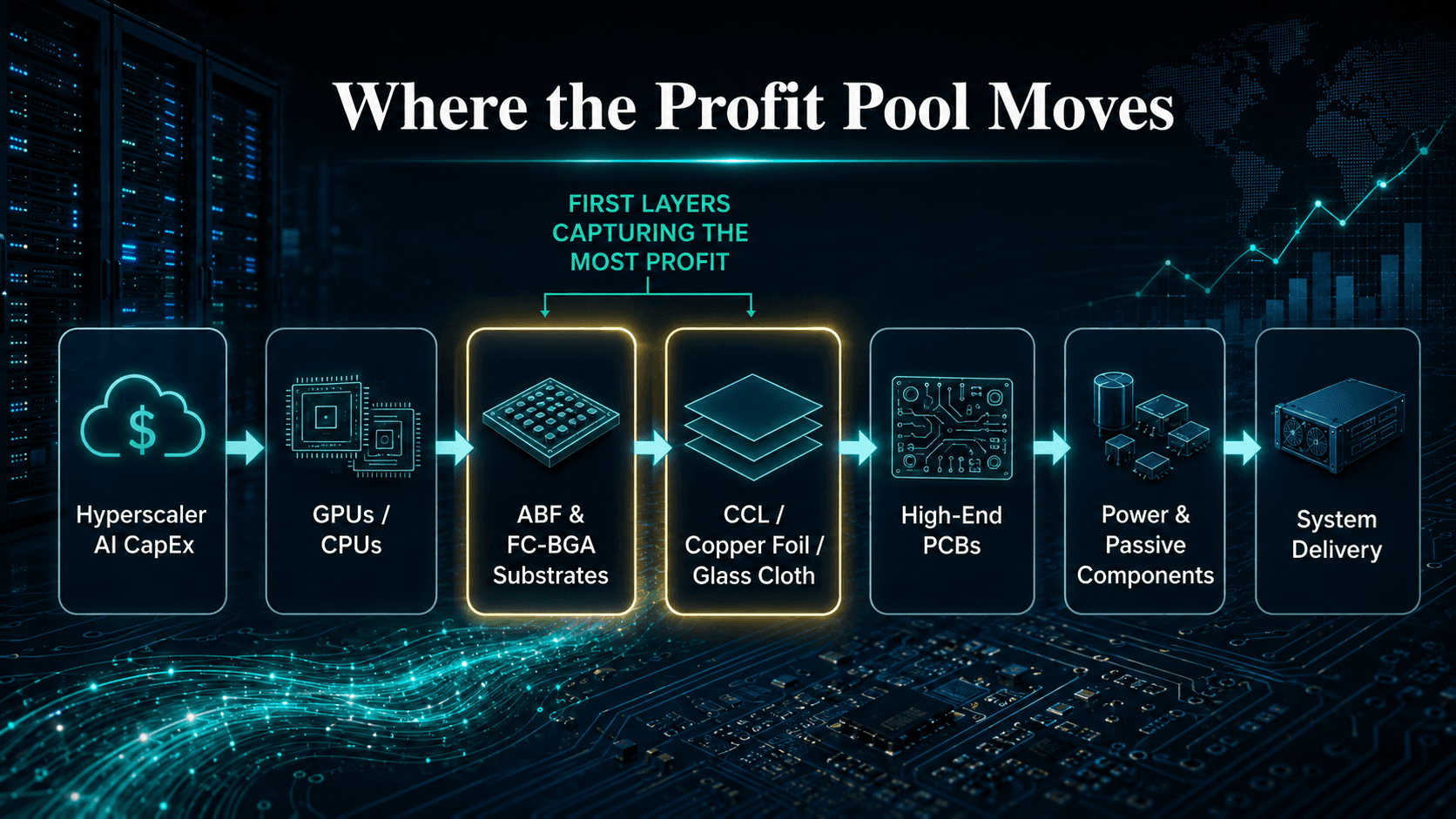
The latest evidence suggests that hyperscaler spending is moving through the chain in a clear sequence. The path extends from data center capital expenditure to accelerators, qualified manufacturing layers and complete system delivery.
Spending does not equal profit retention. Each layer has a different ability to keep the value flowing through it.
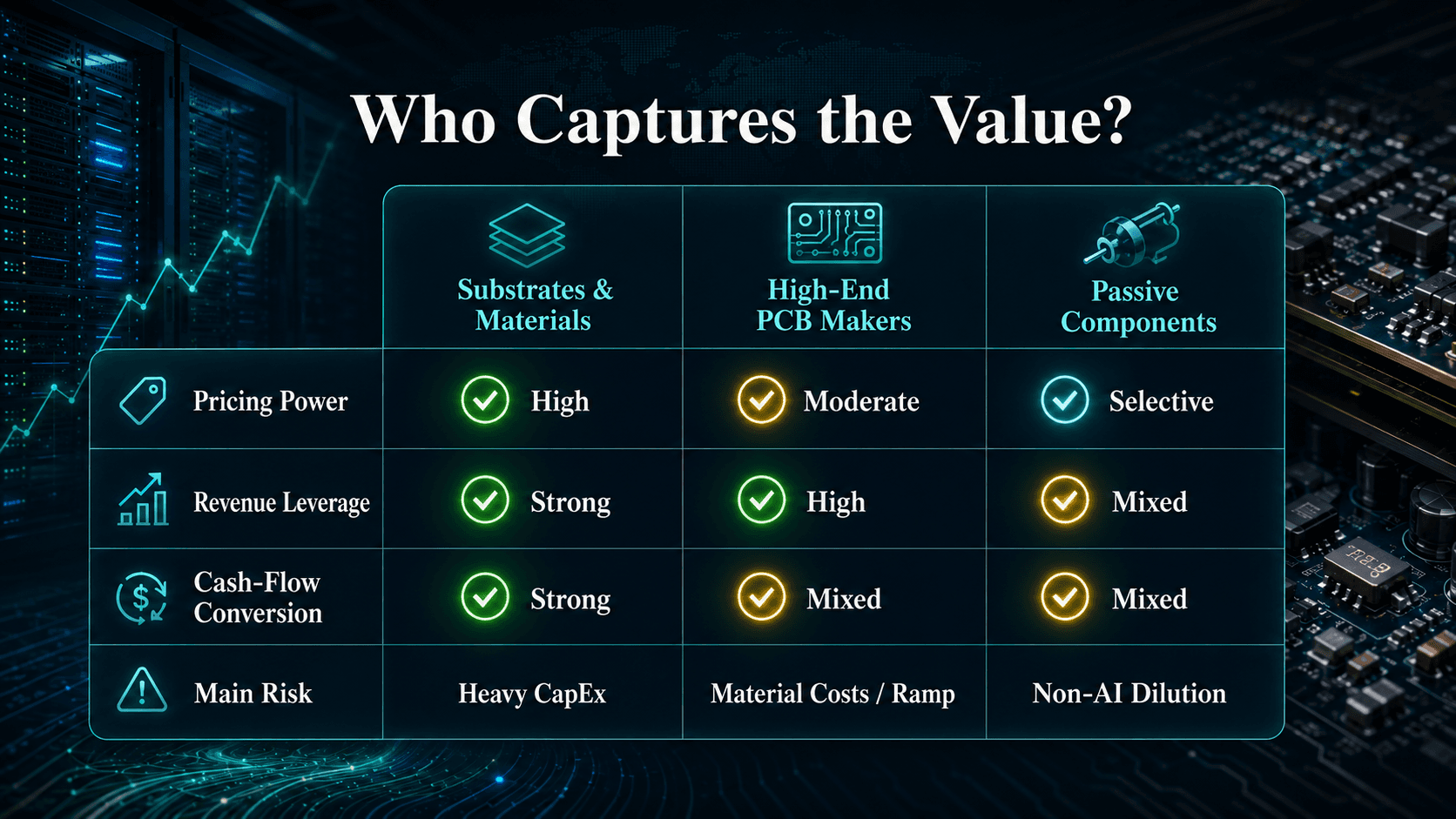
High-end substrate and advanced-material suppliers appear closest to the most constrained capacity. Their qualification cycles are long, expansion is slow and customers may be willing to offer purchasing commitments or financial support. Those characteristics provide the strongest foundation for pricing power.
High-end PCB manufacturers possess greater revenue leverage. TTM’s data center exposure, book-to-bill ratio and commercial-segment margin already confirm that AI spending is reaching its financial statements. Material costs and expansion requirements, however, absorb part of the cash generated by that growth.
Passive-component manufacturers may eventually capture a broad increase in component value per rack, but earnings transmission remains highly product-specific. TDK’s aluminum electrolytic and film capacitors are already benefiting, while other categories remain exposed to price declines and weaker non-AI end markets.
The current evidence therefore supports a differentiated conclusion:
The first layer of incremental profit is likely to move toward suppliers that control scarce, customer-qualified substrate and material capacity. The next layer of revenue growth will reach PCB manufacturers capable of securing materials and delivering complex products. Passive components offer a wider long-term opportunity, but their contribution to group earnings will take longer to become visible.
What Investors Should Watch Next
The latest reports establish that lead times are extending and customers are competing for capacity. That is an early signal that money is beginning to move through previously overlooked parts of the AI hardware stack.
The decisive evidence will appear in company financials. For substrate and material suppliers, the key variables are price increases, customer prepayments, utilization rates and the speed at which new capacity reaches full production.
For PCB manufacturers, investors should watch whether margins rise alongside orders, whether shipments keep pace with backlog and whether operating cash flow begins to cover expansion spending. For passive-component companies, the critical evidence is the share of revenue generated by AI-specific products and whether that growth is large enough to offset pricing pressure in automotive, consumer and industrial markets.
The AI infrastructure profit pool is expanding beyond processors and memory. It is moving toward the suppliers that control the qualified capacity required to turn chips into functioning systems.
The companies with the largest order growth will not necessarily retain the most value. The stronger investment candidates will be those that control capacity customers cannot quickly replace, raise prices faster than costs and convert expansion into cash once new production comes online.
Frequently Asked Questions
Why are AI servers increasing demand for advanced PCBs?
Higher compute density, faster networking and larger accelerator packages require boards with more layers, tighter tolerances and higher-performance materials. More complex power delivery also increases the number and specification of components needed throughout the server.
Those changes raise manufacturing difficulty, material consumption and unit value per system. Advanced PCBs therefore benefit from both greater AI server volume and a richer product mix.
Which parts of the PCB supply chain may benefit most from AI server demand?
High-end substrates and advanced materials may have the strongest pricing power because customer qualification is slow and scarce capacity is difficult to replace. These suppliers are also closest to several of the longest reported lead times.
PCB makers have strong revenue leverage when system shipments rise, but material costs and factory ramps can limit cash conversion. Passive-component benefits remain concentrated in selected power, networking and optical products rather than applying uniformly across each manufacturer.
Does a longer lead time automatically mean higher profits?
No. A longer lead time can reflect pricing power, but it can also reveal material shortages, production constraints or an inability to deliver finished products. Investors must verify average selling prices, margins, utilization and cash-flow conversion before treating a shortage as higher earnings.
How is TTM Technologies exposed to AI server growth?
TTM reported 30% year-over-year revenue growth, with data center computing and networking reaching 36% of revenue. Its book-to-bill ratio was 1.41, while commercial operating margin rose from 13.1% to 16.5%. TTM Technologies
What should investors monitor next?
Investors should monitor pricing, customer prepayments, utilization and product mix at substrate and material suppliers. They should also track shipment conversion, operating margins and free cash flow to determine whether order growth is becoming durable profit.
Sources
- DIGITIMES — AI boom pushes PCB, passive component lead times into a new normal — July 20, 2026
- DIGITIMES — Semiconductor, passive, PCB and other IC component coverage
- AMD — First Quarter 2026 Earnings Slides — Q1 2026
- Ibiden — Capital Investment Plan for High-Performance IC Package Substrates — February 2026
- TTM Technologies — First Quarter 2026 Results — Q1 2026
- TTM Technologies — First Quarter 2026 Form 10-Q — Q1 2026
- TDK — FY2026 Fourth Quarter Results — FY2026 Q4
- TDK — FY2026 Third Quarter Q&A — FY2026 Q3
Company figures are linked to the relevant primary materials in the article. DIGITIMES provides the current lead-time and capacity-negotiation reporting.
Related Reading
Can AI CapEx Pay Off? Start With Token Cost, Then Watch the Payback Period.
Nvidia is showing that the unit cost of AI production is falling. Investors are asking whether cheaper tokens can turn into visible profits and free cash flow fast enough.
AI Semiconductors Are No Longer Just About Compute. They Are About System Bottlenecks.
AI semiconductors are no longer just about raw compute. The real question is which system bottlenecks customers must solve next.
How to Read the AI Cycle: CapEx, Supply Bottlenecks, and the Semiconductor Trade
AI infrastructure spending is still expanding, but the semiconductor equity trade is becoming more fragile. The next phase depends on CapEx, supply bottlenecks, usage, pricing, and earnings revisions.
Invest better with thoughtful research.
Join readers who receive our best ideas and insights straight to their inbox.
Disclosure
This article is for educational and informational purposes only. It does not constitute investment advice, a recommendation, or a solicitation to buy or sell any security.
Comments