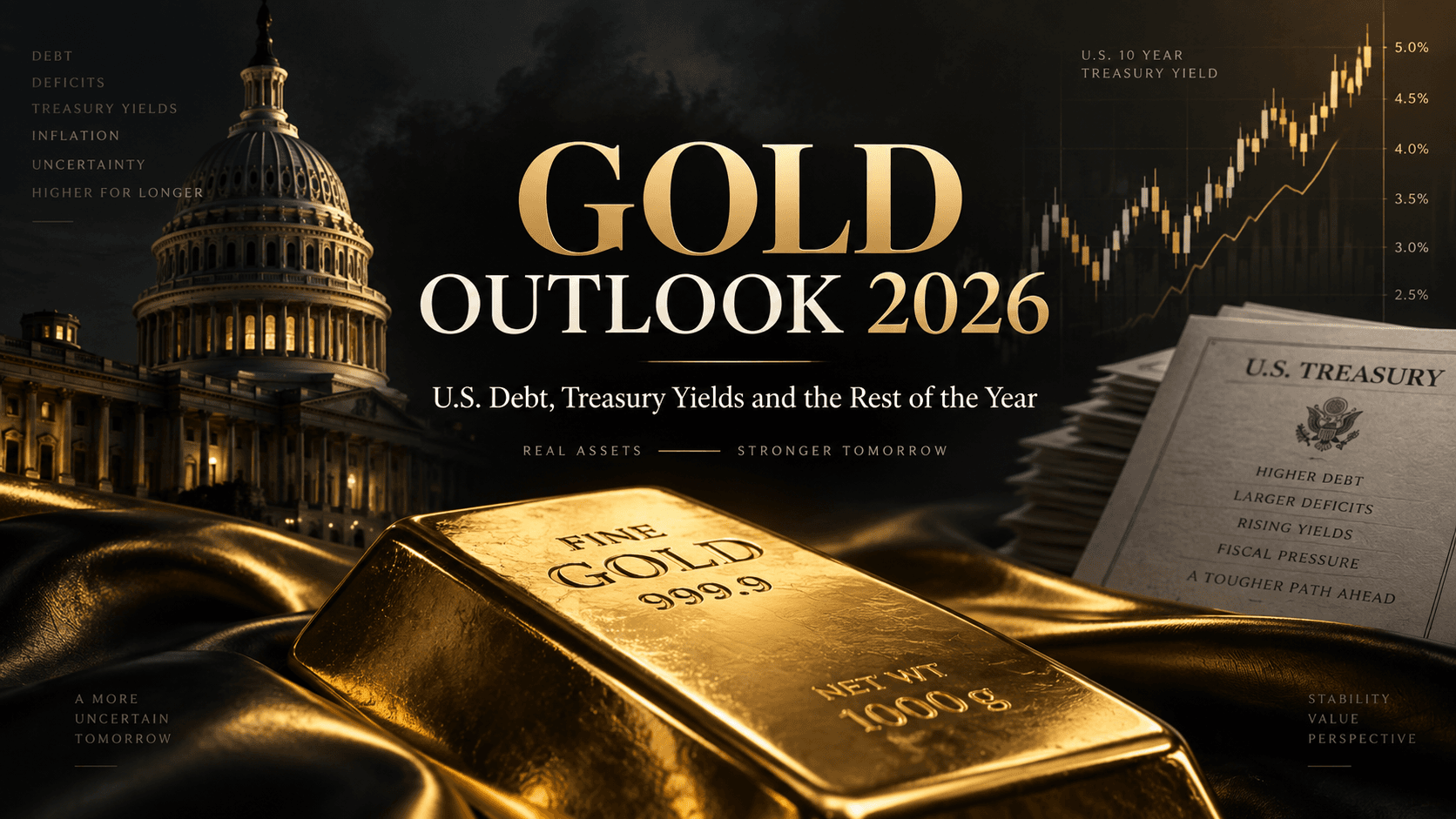
Gold has already had an extraordinary year.
Spot gold surged above $5,500 an ounce intraday in late January, then fell below $4,000 in late June before recovering toward $4,400 by early September. According to the World Gold Council, spot gold reached an intraday high of $5,595.47 on January 29 and a low of $3,959.33 on June 24. That is a swing of almost 30% in less than five months. World Gold Council
The volatility matters because it challenges several common explanations for gold.
Geopolitical risk remained elevated. U.S. debt continued to rise. Central banks continued buying gold. Yet none of those forces prevented gold from losing more than $1,500 from its January peak.
The missing variable was the cost of money.
For the rest of 2026, my base case is that gold remains volatile but gradually regains an upward bias rather than entering a new structural bear market. I expect the Federal Reserve, real yields and the U.S. dollar to remain the dominant short-term constraints. But for investors with a 6–12 month horizon, the more important question is increasingly whether the United States can sustain high real interest rates while carrying more than $40 trillion of federal debt.
That tension is why I would not chase gold after geopolitical spikes, but I would also be reluctant to treat a substantial correction as evidence that the longer-term gold thesis has failed.
My base case for the remainder of 2026 is a broad $4,100–$4,800 range, with the balance of risks gradually shifting upward if U.S. monetary tightening approaches its peak while long-term fiscal pressure remains unresolved. Over the next 6–12 months, I believe the probability of gold challenging $5,000 again is higher than the probability of a sustained breakdown below its June lows.
The reason comes down to a changing relationship between gold, Treasury yields and U.S. debt.
Why Did Gold Fall From Above $5,500 to Below $4,000?
Gold does not generate cash flow.
That simple fact explains much of its relationship with interest rates.
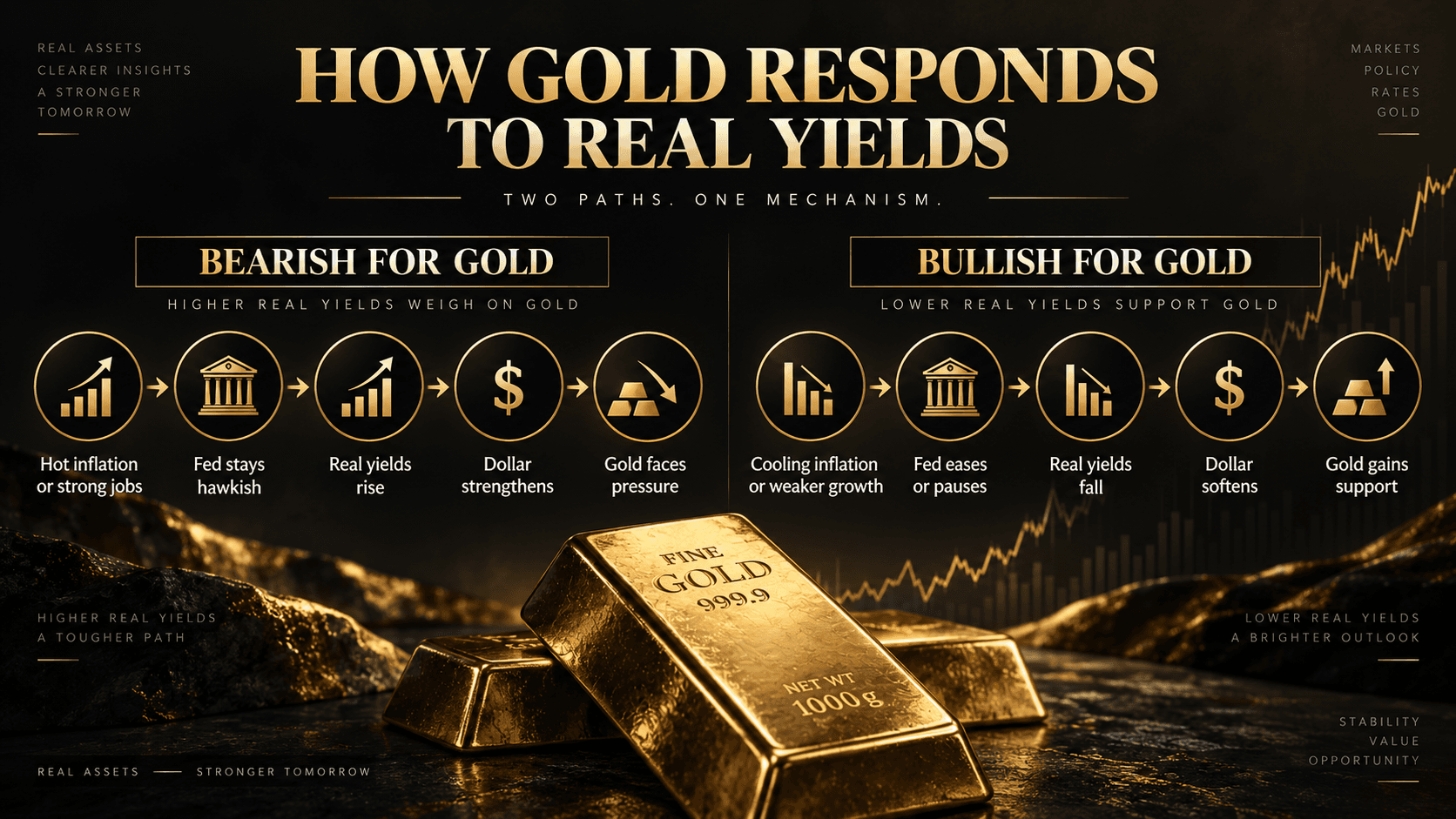
When investors can earn an attractive real return from U.S. government bonds, holding a non-yielding asset such as gold becomes more expensive in opportunity-cost terms. When real yields rise and the dollar strengthens at the same time, gold faces an especially difficult environment.
That is essentially what happened during the first half of 2026.
The World Gold Council found that the dramatic swings in gold during the first half were driven by a combination of geopolitical risk, foreign exchange moves, interest rates, investor positioning and momentum rather than by inflation alone. Gold rose above $5,500 in January, but a stronger dollar and increasingly hawkish expectations for Federal Reserve policy helped drive it below $4,000 by late June. World Gold Council
The same mechanism remains visible today.
On September 3, Federal Reserve Governor Christopher Waller said he could support leaving rates unchanged at the September meeting if incoming inflation data continued to show moderation. Markets reduced the probability of an immediate rate increase, Treasury yields and the dollar declined, and spot gold jumped 2.3% to $4,488.54. Reuters
One day later, the August U.S. employment report showed nonfarm payrolls rising by 162,000, far above expectations. Treasury yields rose again, the dollar strengthened and gold fell as markets increased the probability of another Fed hike. Reuters
That two-day reversal tells us something important.
Gold is still, in the short run, primarily a real-rate trade.
The U.S. debt story matters. Central-bank demand matters. Geopolitics matters. But none of them has eliminated gold's sensitivity to the return investors can earn on dollars and U.S. government bonds.
Gold and Treasury Yields: The Relationship Is More Complicated Than It Looks
A common rule says that Treasury yields rise when gold falls and fall when gold rises.
It is useful, but incomplete.
Gold is more sensitive to real interest rates than to nominal Treasury yields alone. A simplified version of the relationship is:
Real yield ≈ nominal Treasury yield − expected inflation
Suppose a Treasury bond yields 5% while inflation expectations are 2%. Investors are earning roughly a 3% real return before other considerations. A non-yielding asset such as gold has a difficult competitor.
Now suppose that same Treasury yields 5%, but long-run inflation expectations move toward 4%. The real return is much smaller. If investors also begin demanding compensation for fiscal risk, currency risk or an unusually large supply of government debt, a nominal 5% Treasury yield no longer carries the same meaning.
This leads to the most important question for gold investors:
Why are Treasury yields rising?
| Why Treasury yields are rising | Likely implication for gold |
|---|---|
| A more hawkish Fed pushes real yields higher | Clearly bearish |
| Strong U.S. growth lifts real returns and the dollar | Bearish |
| Inflation rises and the Fed responds aggressively | Usually bearish in the short term |
| Heavy Treasury issuance pushes term premium higher | Neutral to potentially bullish |
| Investors demand more compensation for fiscal risk | Increasingly bullish over the medium term |
| Policy eventually limits real financing costs | Strongly bullish |
This distinction matters much more today than it did when U.S. debt and interest expense were materially smaller.
If Treasury yields rise because the economy is strong and monetary policy is credible, gold should struggle.
If Treasury yields rise because the market requires increasingly high compensation to absorb government borrowing, the signal becomes much less bearish for gold.
That is where the U.S. debt problem enters the gold outlook.
Why $40 Trillion of U.S. Debt Matters for Gold
U.S. federal debt crossed $40 trillion for the first time in August. Of that amount, roughly $32.3 trillion was debt held by the public. Interest costs have also risen above $1 trillion annually and now rank among the largest categories of federal spending. Reuters
Debt does not mechanically push gold higher.
The more important effect is that a larger debt stock changes how long the government and economy can tolerate high interest rates.
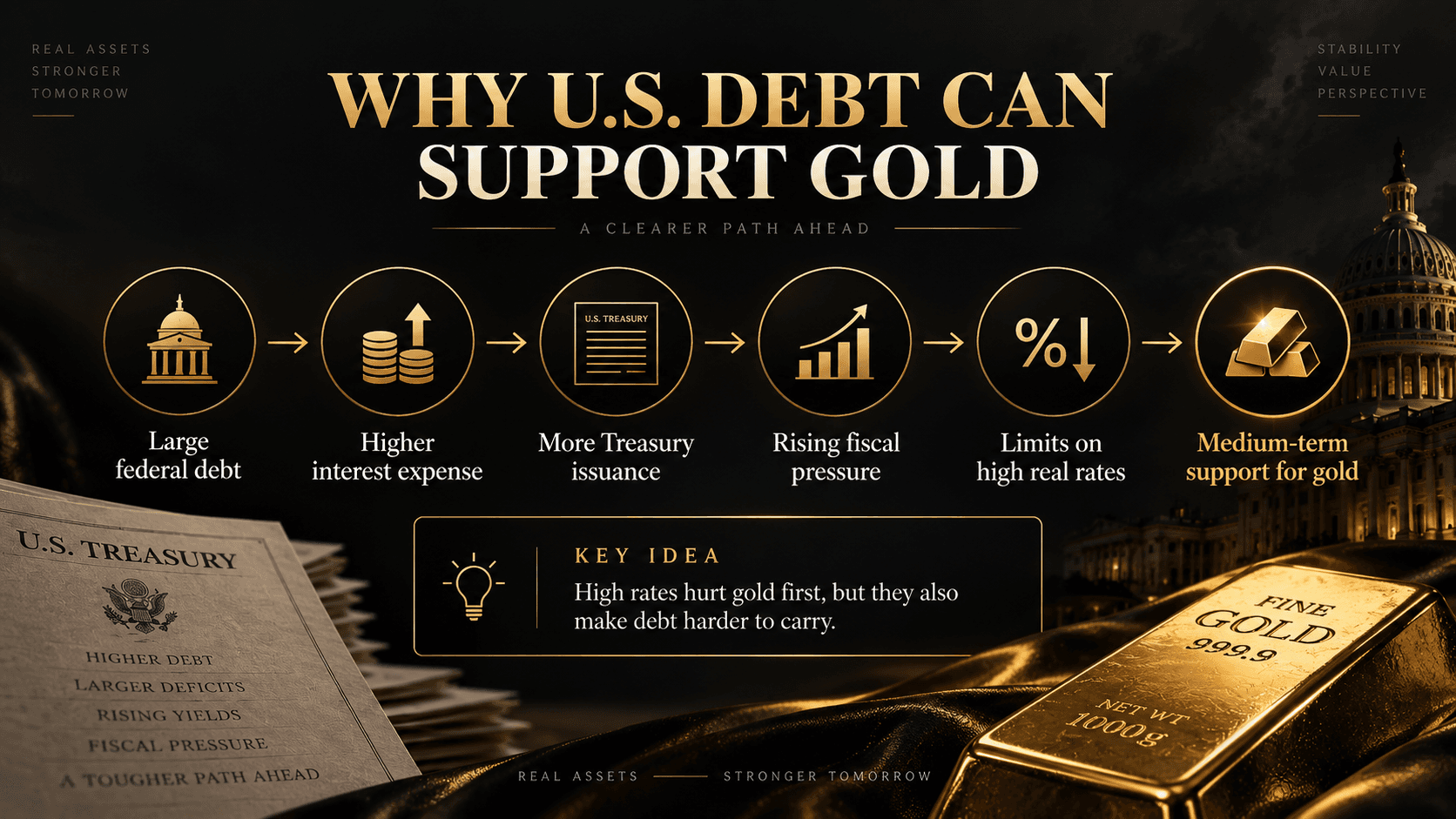
The Federal Reserve needs sufficiently restrictive financial conditions to control inflation. The Treasury, however, continuously refinances a very large stock of debt. As old securities mature and are replaced at higher rates, elevated borrowing costs gradually migrate into federal interest expense.
Higher interest expense raises deficits.
Larger deficits require more issuance.
More issuance requires investors to absorb additional Treasury supply.
And if investors demand higher yields to hold that supply, financing costs rise again.
The scale is already substantial. The Treasury expects to borrow $739 billion in privately held net marketable debt during the July–September quarter and another $628 billion during October–December. U.S. Treasury
This creates a tension at the center of the gold outlook:
High real rates are bearish for gold, but maintaining high real rates becomes progressively more expensive for a highly indebted government.
That does not mean the Federal Reserve must cut rates because Treasury borrowing is expensive. The Fed has a separate mandate, and there is no mechanical level of federal debt that forces monetary easing.
But it does mean that the economic consequences of maintaining very high real rates become larger.
That distinction is crucial.
The long-term bullish case for gold does not require the United States to default or experience a sovereign debt crisis. It only requires investors to conclude that the real interest rate necessary to eliminate inflation cannot be maintained indefinitely without creating increasingly severe fiscal, economic or financial costs.
The August Treasury Buyback Was an Important Test
One episode in August illustrates how markets are beginning to think about this tension.
U.S. 30-year Treasury yields climbed above 5.3%, reaching levels not seen since 2007. The Treasury subsequently doubled the size of some buyback operations in longer-dated securities to at least $4 billion per operation. Reuters
The Treasury's official purpose for these operations is important: buybacks are designed primarily to support market liquidity and improve Treasury debt management. They should not automatically be interpreted as yield-curve control or an attempt to set a specific market interest rate.
But the market reaction was still relevant for gold investors.
Long-term yields declined as the expanded buybacks were announced, while the dollar weakened and gold rallied sharply.
The signal was not that the United States had started monetizing its debt. That would be an exaggerated conclusion.
The more interesting question was simpler:
How much long-term borrowing cost can the U.S. financial system comfortably absorb?
That question will become increasingly important if 30-year yields remain around 5% or move materially higher.
A decade ago, a high Treasury yield could largely be read as attractive competition for gold.
Today, high Treasury yields can represent two very different things: attractive real returns, or a rising risk premium attached to a rapidly expanding supply of government liabilities.
Those two regimes should not produce the same gold price.
Inflation Does Not Automatically Mean Higher Gold Prices
Another common mistake is to treat gold as a mechanical inflation hedge.
Inflation can actually hurt gold when it produces an even more aggressive monetary-policy response.
If inflation is 4% and the central bank maintains interest rates at 7%, real rates are strongly positive. The dollar can remain attractive, Treasury securities provide substantial real income, and gold may fall even though inflation is elevated.
The environment that is more favorable to gold is different:
Inflation remains above target while nominal interest rates cannot stay high enough to generate persistently large positive real returns.
That distinction also explains why inflation can help reduce the real burden of government debt without necessarily helping gold at every point in the process.
What matters for debt sustainability is not inflation alone. Nominal economic growth, the government's average borrowing cost, fiscal deficits and the maturity structure of debt all matter.
For gold, however, one relationship is particularly important:
Can investors earn a sufficiently high real return by holding government liabilities?
If the answer remains yes, gold faces competition.
If the answer gradually becomes no, gold becomes more attractive as a store of purchasing power.
That is why I view gold less as a simple CPI hedge and more as a hedge against a regime in which real returns on money and government debt are structurally constrained.
Geopolitical Risk Can Push Gold in Both Directions
Gold's behavior during the U.S.–Iran conflict is another reason investors should avoid simple formulas.
A war can increase safe-haven demand for gold. But an energy-producing region at the center of a military conflict can also push oil prices higher, raise inflation expectations and force central banks to remain restrictive for longer.
Those two channels can move gold in opposite directions.
On September 1, renewed U.S.–Iran fighting pushed Brent crude up 4.6% to $94.65 a barrel as markets worried again about disruption to Middle Eastern energy supplies. At the same time, rising global bond yields and a stronger dollar helped drive gold more than 2% lower to around $4,342. Reuters
That is not a contradiction.
The geopolitical shock was simultaneously bullish for gold through the safe-haven channel and bearish through the oil-inflation-interest-rate channel.
At that moment, the second channel was stronger.
This is why I would not value gold simply by counting wars or geopolitical crises.
The better question is how geopolitical risk changes the monetary environment.
If a conflict generates a temporary oil shock that forces the Fed to maintain higher real rates, it can be negative for gold.
If geopolitical fragmentation instead drives reserve diversification, weakens confidence in sovereign assets, or eventually contributes to monetary accommodation, the effect becomes much more structurally bullish.
Central Banks Are Changing the Long-Term Demand Floor for Gold
The other major difference between the current gold cycle and earlier ones is the behavior of central banks.
Central banks and other official institutions purchased a net 289 tonnes of gold in Q2 2026, up 62% from a year earlier and five times the revised Q1 level. Although first-half central-bank purchases were weaker than the exceptional pace seen in some recent years, Q2 showed that official demand remains substantial. World Gold Council
The World Gold Council's 2026 survey of reserve managers reinforces that point. 89% expect global central-bank gold holdings to increase during the next 12 months, while a record 45% expect their own institution to increase gold reserves. World Gold Council
Central banks do not necessarily buy gold for the same reasons as ETFs or hedge funds.
An ETF investor may react immediately to the next CPI release or Fed speech.
A reserve manager is more likely to think about diversification, sanctions risk, liquidity, geopolitical fragmentation and the long-term composition of national reserves.
Treasuries remain uniquely deep and liquid and generate income. But they are also liabilities of the U.S. government.
Gold generates no income.
It also has no sovereign issuer.
That difference has become more valuable in a world where reserve assets are increasingly evaluated not only by their yield, but also by geopolitical and counterparty considerations.
Central-bank buying therefore does not eliminate corrections in gold. It does, however, help explain why the long-term demand structure has remained resilient even while real rates are high.
My Gold Price Outlook for the Rest of 2026
Two forces are now pulling gold in opposite directions.
The first is still bearish.
The U.S. economy has not collapsed. The August payroll report surprised strongly to the upside. Energy prices have returned as an inflation risk, and the Federal Reserve still has room to remain restrictive. Treasury yields near current levels provide serious competition to an asset that pays no income. Reuters
That makes another meaningful correction entirely plausible.
I would not be surprised to see gold revisit the low-$4,000s if inflation remains stubborn, the Fed becomes more hawkish and the dollar strengthens.
The second force is slower but more important for investors with a longer horizon.
U.S. federal debt has passed $40 trillion. Interest expense exceeds $1 trillion a year. Treasury issuance remains enormous. Long-term yields have already reached levels that have increased political and market sensitivity to financing costs. Reuters
This creates an unusual setup.
Every time the Fed becomes more hawkish, gold faces pressure.
But the longer high real rates persist, the more pressure they put on government financing, interest-sensitive sectors and the broader economy.
Eventually, those two forces collide.
That is why my base case is not a straight-line rally back to the January peak. It is a high-volatility market in which corrections remain sharp, but the medium-term floor gradually becomes harder to break.
For the remainder of 2026, I see roughly $4,100–$4,800 as the most reasonable base-case range.
A more persistent inflation shock, renewed Fed tightening and a stronger dollar could send gold toward $4,000 again.
But if the Fed approaches the end of its tightening cycle while fiscal pressure and elevated long-term Treasury yields remain in place, the combination becomes much more constructive for gold.
Under that scenario, a move above $4,800 would materially improve the probability that gold returns to price discovery above $5,000.
What This Means for Long-Term Gold Investors
At roughly $4,400 an ounce, I would not call gold cheap simply because it remains below its January record.
The metal has already experienced an extraordinary repricing over the past several years, and another 5%–10% correction is entirely possible if real yields rise again.
But I also would not interpret such a correction as evidence that the structural gold thesis has ended.
The important change in 2026 is that the old relationship—
higher Treasury yields = lower gold
—is becoming less reliable without asking what is driving those yields.
When Treasury yields rise because the economy is strong, inflation is falling and investors are receiving attractive real returns, gold should struggle.
When Treasury yields rise because deficits are large, issuance is heavy and investors demand more term and fiscal risk compensation, the implications for gold are very different.
For investors with a 6–12 month horizon, my preferred approach is therefore to maintain a core gold allocation and treat substantial corrections as opportunities to reassess and gradually add exposure rather than chasing rallies driven by geopolitical headlines.
The bullish case does not depend on an imminent U.S. debt crisis.
It does not require hyperinflation.
And it does not require the government to deliberately weaken the dollar.
It rests on a simpler proposition:
The real interest rate the United States can sustain over the long run may ultimately be lower than the real interest rate required to eliminate inflation quickly.
As long as that conflict remains unresolved, gold has a structural source of demand that high nominal Treasury yields alone may not be able to eliminate.
In the short run, gold is still an interest-rate trade.
Over the medium and long term, it is increasingly becoming a trade on the limits of U.S. fiscal policy and the future purchasing power of money.
Frequently Asked Questions
Do higher Treasury yields always push gold prices lower?
No. Gold is most sensitive to real yields rather than nominal Treasury yields alone. If yields rise because the Federal Reserve is tightening policy and real returns increase, that is usually bearish for gold. But if long-term yields rise because of heavy Treasury issuance, higher term premiums or growing fiscal concerns, the relationship can become less negative and may even become supportive for gold over the medium term.
Why can inflation sometimes cause gold prices to fall?
Inflation is not automatically bullish for gold. If higher inflation leads the Federal Reserve to raise interest rates aggressively, real yields and the U.S. dollar can rise, increasing the opportunity cost of holding non-yielding gold. Gold tends to benefit more when inflation remains elevated but real interest rates cannot stay persistently high.
Why does U.S. federal debt matter for gold prices?
Debt does not directly cause gold prices to rise. The key issue is that a larger debt stock makes sustained high borrowing costs more expensive for the federal government. If high real rates continue to increase interest expense, deficits and Treasury issuance, markets may eventually question how long those rates can be maintained. That dynamic can strengthen gold's appeal as a store of purchasing power.
What is the gold price outlook for the rest of 2026?
The base case in this article is a broad range of roughly $4,100 to $4,800 for the remainder of 2026. Gold could revisit the low-$4,000s if inflation stays persistent, the Fed remains hawkish and the dollar strengthens. Over a 6–12 month horizon, however, the probability of gold challenging $5,000 again is judged to be higher than the probability of a sustained breakdown below the June lows.
Is geopolitical risk always bullish for gold?
No. Geopolitical shocks can increase safe-haven demand for gold, but they can also raise oil prices and inflation expectations. If that leads to higher real yields and a stronger dollar, gold may fall even during a period of rising geopolitical tension. The impact depends on whether the safe-haven channel or the inflation-and-interest-rate channel dominates.
What does the gold outlook mean for long-term investors?
The article does not treat gold as cheap at current levels and does not recommend chasing sharp rallies. The medium-term thesis is to maintain a core allocation and reassess or gradually add exposure during substantial corrections, as long as the structural drivers—fiscal pressure, central-bank demand and constraints on persistently high real rates—remain intact.
Invest better with thoughtful research.
Join readers who receive our best ideas and insights straight to their inbox.
Disclosure
This article is for research and education only. It is not investment advice.
Comments