Editor's note: This article was originally published on Substack on June 10, 2026 and migrated to VIUS Investing on June 18, 2026. Some market references reflect the original publication date.
Most investors find a stock after the story has already become obvious.
The chart has moved. The headlines are everywhere. Analysts have started publishing reports. Social media is repeating the same explanation.
At that point, the opportunity may still exist. But the easiest part is often gone.
The real question is not:
“What is the hottest stock right now?”
The better question is:
“Where does demand first appear before it becomes revenue, before it becomes consensus, and before it becomes a stock chart everyone can see?”
That is where real investment research begins.
Not from headlines. Not from price action. Not even from financial statements alone.
But from small changes in the real world.
A developer starts using a new tool. A tutorial suddenly gets popular. A hardware recommendation keeps appearing in technical communities. A boring upstream material becomes strategically important. A supply-chain bottleneck appears before the market understands it.
These signals are usually small, messy, and easy to ignore.
But they can tell us where future revenue may flow.
The Problem With Consensus Research
Most traditional investment research begins with things that are already measurable:
Revenue growth. Margins. Guidance. Valuation multiples. Comparable companies. Earnings revisions.
These are important. No serious investor should ignore them.
But there is one problem: they are often late.
By the time the numbers look obvious, the market may have already repriced the stock.
Early-signal research works differently.
It starts before the income statement changes.
It follows this path:
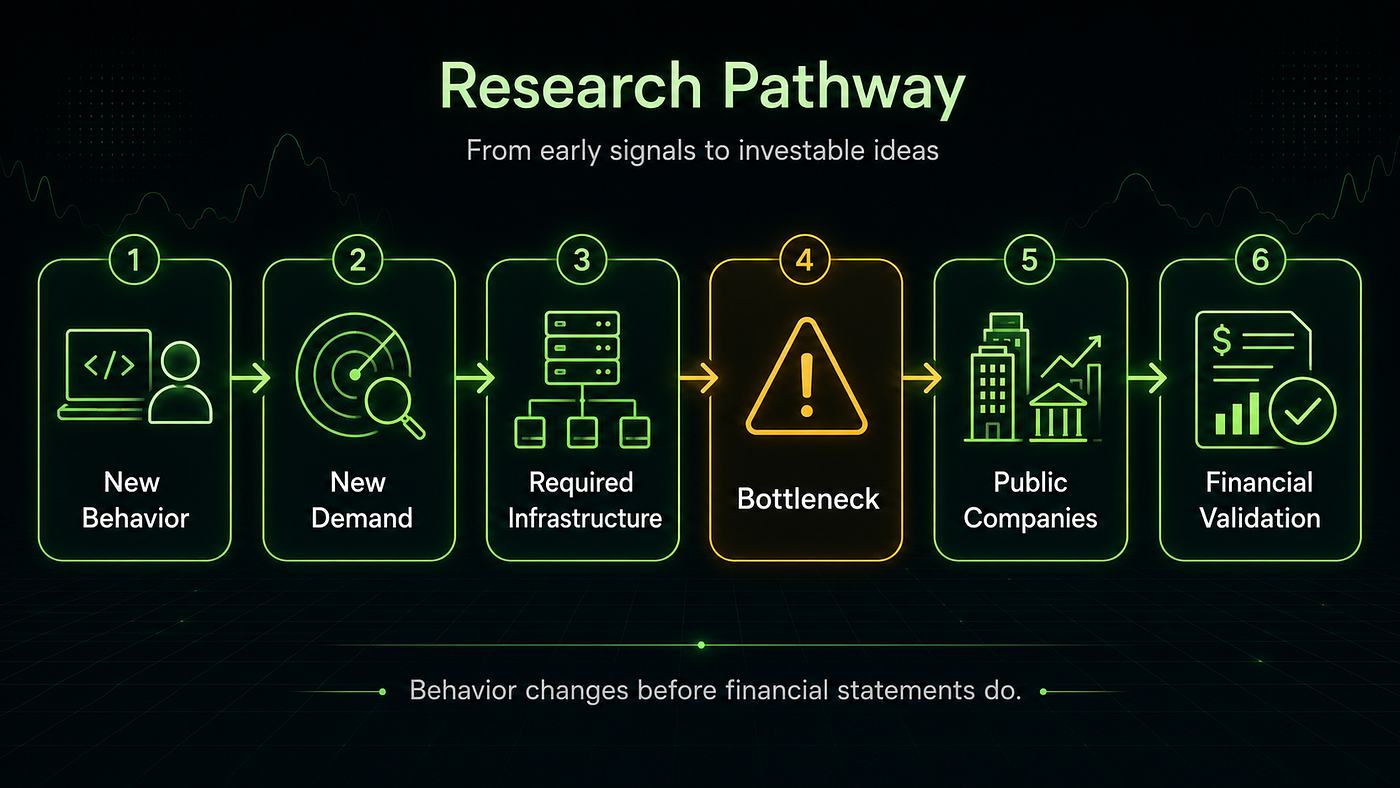
Instead of asking:
“Which company has the best current numbers?”
It asks:
“What is the world starting to need that the market has not fully priced yet?”
That small difference changes everything.
Step One: Watch What People Are Starting to Use
Some of the best early investment signals do not come from investors.
They come from users.
A developer tries a new open-source tool. A creator builds a local AI workflow. A small business tests automation. A hardware enthusiast buys a low-cost device to run a new application. A technology that used to be experimental begins to move into real usage.
At this stage, the revenue may still be tiny.
Mainstream investors may ignore it because it does not look material yet.
But behavior changes before financial statements change.
For example, the rise of personal AI agents may not only benefit large cloud platforms. It may also create demand for local hardware, small servers, always-on devices, storage, privacy tools, networking equipment, and edge computing.
The key question is not whether one specific device or product becomes the winner.
The key question is:
If this behavior spreads, what must people buy, install, upgrade, connect, or consume?
That is where the investment trail begins.
Step Two: Move From the Application to the Infrastructure
Many investors stop at the application layer.
If AI is hot, they buy the most obvious AI stock. If electric vehicles are hot, they buy the most obvious EV company. If robotics is hot, they buy the most obvious robot company.
But some of the best opportunities are not in the visible product.
They are in the infrastructure behind it.
Every new technology has a hidden stack.
AI needs compute, memory, power, cooling, networking, optics, storage, and software infrastructure.
Robotics needs sensors, actuators, reducers, batteries, edge inference, simulation, and motion control.
Electric vehicles need batteries, power semiconductors, charging infrastructure, copper, thermal management, and manufacturing equipment.
Data centers need transformers, grid capacity, backup power, optical interconnects, advanced packaging, and cooling systems.
So when a big trend becomes obvious, the better question is:
What is the less obvious part of the chain that could become the next bottleneck?
That is where non-consensus ideas often begin.
Step Three: Look for Hidden Bottlenecks
A bottleneck is a part of the system that the whole trend depends on, but that the market has not fully appreciated yet.
AI infrastructure is a good example.
At first, investors focused on GPUs.
Then they started paying attention to high-bandwidth memory, advanced packaging, power, cooling, and optical networking.
That pattern matters.
Markets rarely price the entire supply chain at once.
They move layer by layer.
First, the most obvious winner gets repriced. Then investors discover the next constraint. Then they move further upstream. Eventually, even obscure materials, equipment, and components can become important.
This is why industry research cannot stop at the company level.
It has to move through the supply chain.
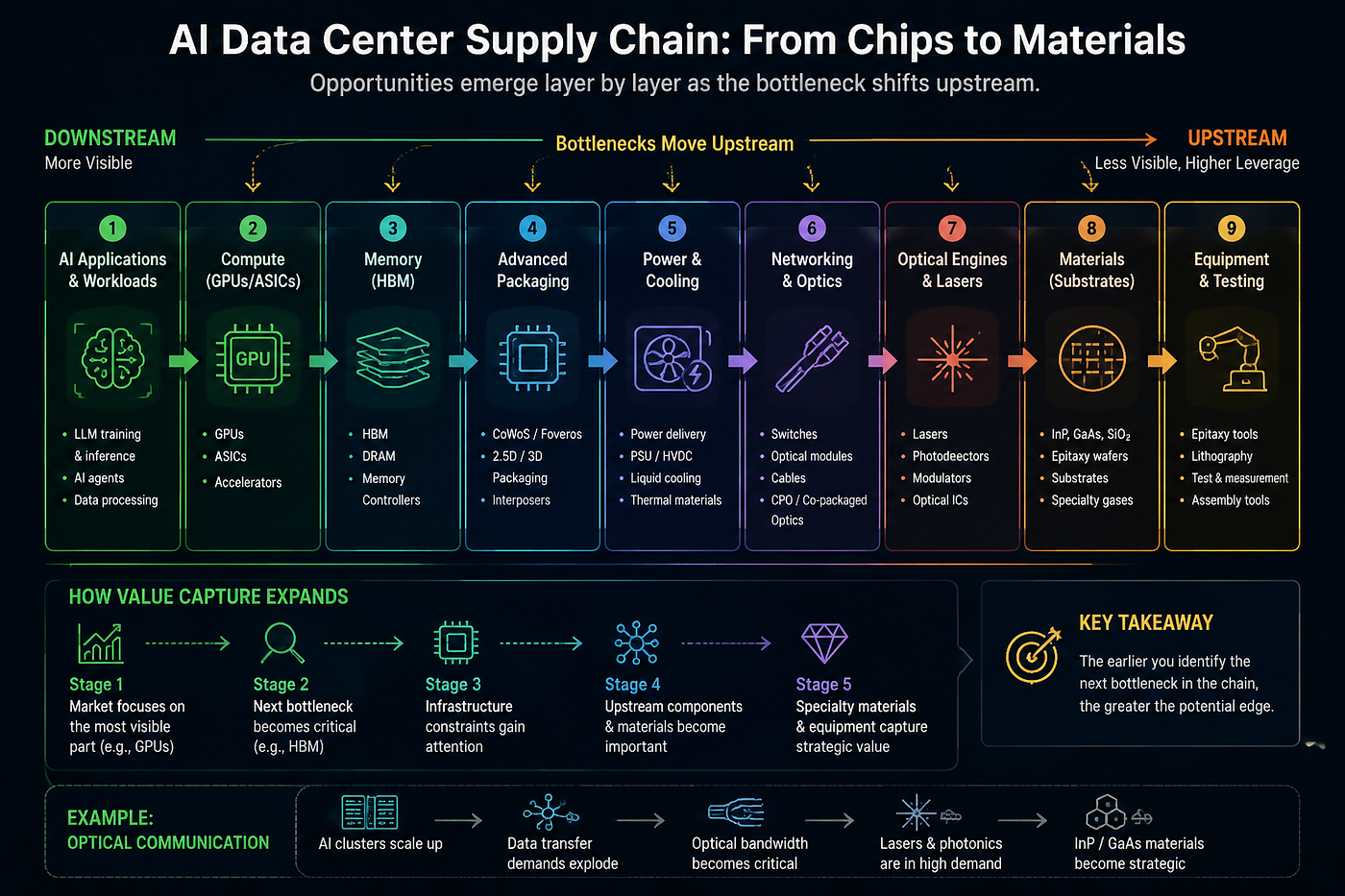
Take optical communication and silicon photonics as an example.
At first glance, this may sound like a story about optical modules and chips.
But behind those products are lasers, photodetectors, compound semiconductors, substrates, packaging, testing, and manufacturing capacity.
Most ordinary investors have never heard of materials such as indium phosphide or gallium arsenide.
But in high-speed optical communication, lasers, radio-frequency devices, satellite communication, and optoelectronics, these materials can matter.
Why?
Because silicon is not perfect for everything.
In some high-frequency, high-speed, light-emitting, and optical-conversion applications, compound semiconductors may be more suitable.
That is the key lesson:
The earliest signals are often not popular. They are technical, boring, and upstream.
Step Four: Use Weak Signals, But Do Not Trust One Signal Alone
Early research is powerful, but it is also dangerous.
It can easily become imagination.
A few social media posts do not prove demand. A technical relationship does not prove revenue. A promising market does not prove that one specific company will capture value.
That is why early-signal research must be built like a mosaic.
One weak signal is just a story.
Several weak signals pointing in the same direction may become a thesis.
Useful weak signals include:
Developer tutorials are increasing. GitHub activity is rising. Technical forums show repeated installation problems or hardware recommendations. YouTube creators begin making setup guides. Suppliers mention new demand in earnings calls. Job postings show hiring for a specific technology. Customers begin testing or validating a new product. Government policy supports local supply chains. Lead times lengthen in upstream components. Competitors begin moving into the same field.
The goal is not to find one perfect proof.
The goal is to collect enough independent signals to form a reasonable hypothesis.
If users, suppliers, customers, engineers, and management teams are all pointing toward the same direction, then the trend deserves deeper research.
Step Five: Turn the Story Into a Revenue Path
A good investment thesis cannot stop at:
“This technology is important.”
That is not enough.
The real question is:
“How does this technology become revenue and profit for this specific company?”
That means asking:
What exactly does the company sell? Who are the customers? Is the product already commercialized? Can the company scale production? Does it have pricing power? Will gross margin improve or decline? How much of future revenue could come from this new demand? Is the market already pricing in the opportunity?
This is where investing separates itself from storytelling.
Many technologies are real, but not all of them create shareholder value.
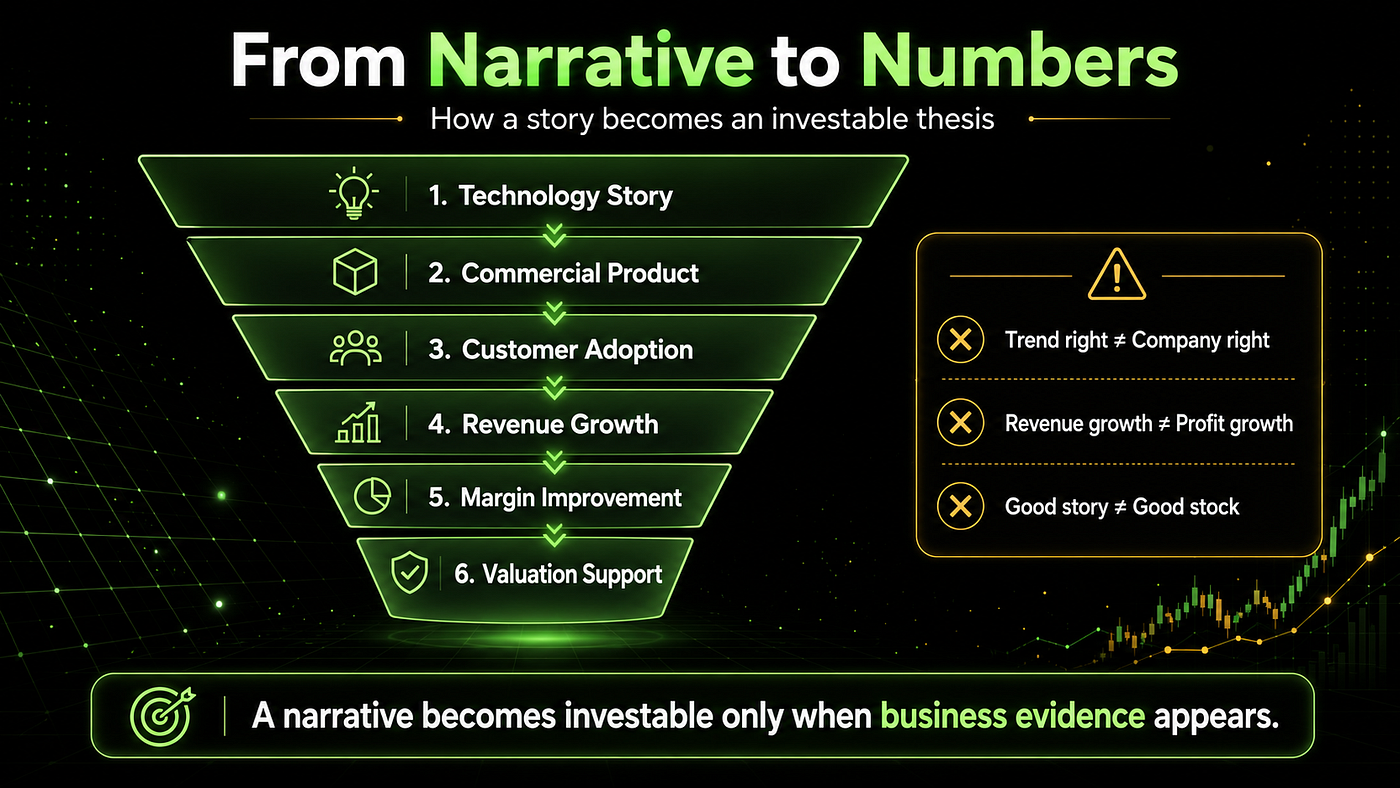
Sometimes the trend is right, but the company is wrong.
Sometimes the company is real, but the timing is too early.
Sometimes revenue grows, but margins collapse.
Sometimes the story is exciting, but the stock has already priced in five years of perfect execution.
A real thesis must connect technology to business economics.
Otherwise, it is only a narrative.
Step Six: Define the Validation Points Before Buying
One of the biggest mistakes in thematic investing is falling in love with the story.
Once investors love a thesis, every negative signal becomes “temporary.”
Every delay becomes “still early.”
Every weak quarter becomes “the market does not understand.”
That is not research.
That is attachment.
A strong thesis should include validation points before the position is built.
For example:
Will the company mention this new demand in the next earnings call? Will the relevant segment show accelerating revenue? Will backlog improve? Will gross margin confirm pricing power? Will the company announce commercial partnerships? Will the product move from pilot stage to volume production? Will customers confirm adoption? Will competitors capture the real market instead?
If the validation points fail, the thesis must be updated.
The goal is not to be right forever.
The goal is to be early without being blind.
A Practical Framework for Finding Small Nodes in Big Trends
When studying any hot theme, do not start with the stock price.
Start with the system.
Ask these questions:
- What new behavior is emerging?
- What new problem does this behavior create?
- What hardware, software, materials, or infrastructure are required?
- Which part of the chain is difficult to scale or replace?
- Which companies have exposure to that bottleneck?
- Is that exposure meaningful, or only a small side business?
- Is there evidence from users, suppliers, customers, hiring, or earnings calls?
- How could this trend become revenue?
- Has the market already priced in the opportunity?
- What would prove the thesis wrong?
This framework helps avoid two common mistakes.
The first mistake is chasing obvious winners after everyone already understands the story.
The second mistake is buying every small company that touches a fashionable theme.
The better path is to find hidden but verifiable links between a real-world trend and a company’s future economics.
The link must be early.
But it must also be testable.
The Real Edge: Move Your Information Sources Upstream
If your information comes only from financial media, you are probably late.
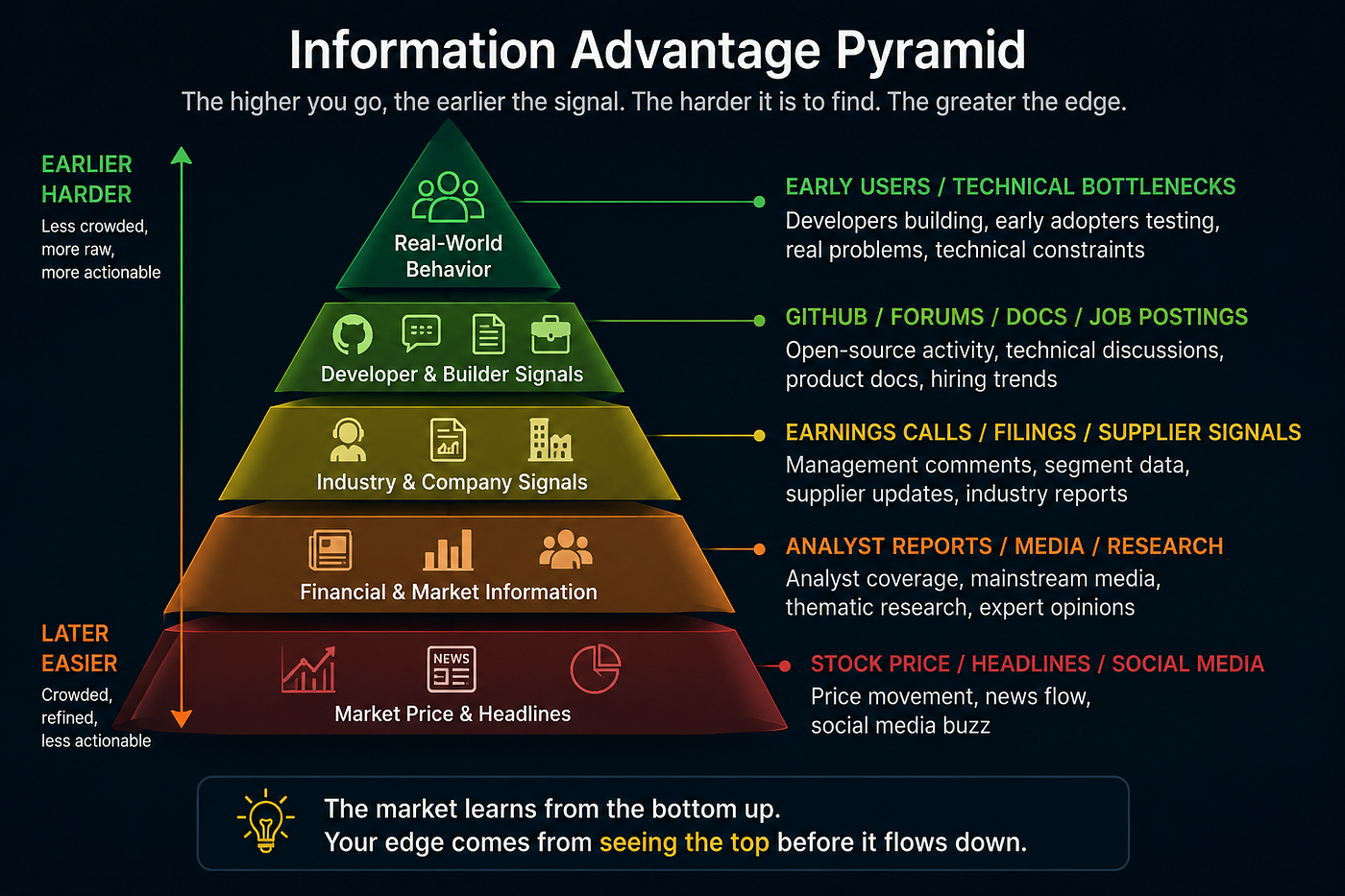
To find earlier signals, you need to read where users and builders spend their time.
Developer forums. GitHub. Technical blogs. Product documentation. Engineering YouTube channels. Industry conferences. Supplier earnings calls. Job postings. Trade publications. Government industrial policy documents.
The investor’s job is not to become an engineer.
The investor’s job is to understand enough of the technical chain to ask better business questions.
What are people building? Where are they stuck? What do they need to buy? Which component is hard to replace? Which company owns that scarce capability? Can that capability turn into revenue and profit?
That is where non-consensus research begins.
Final Thought
The best investment ideas often begin as small, strange, and uncomfortable observations.
A tool only developers are using. A material ordinary investors have never heard of. A supply-chain constraint hidden inside a larger trend. A product that looks too niche until the demand curve changes.
The market eventually notices the numbers.
But before numbers appear, there are behaviors.
Before behaviors become mainstream, there are early users and builders.
Before a bottleneck becomes obvious, there are technical constraints.
Early investing is not about random guessing.
It is about learning to see the small nodes inside big trends — and then waiting for financial evidence to confirm whether the market has missed something real.
The real edge is not explaining a stock after it has already gone up.
The real edge is discovering a new demand before the market fully understands where that demand will flow.
Disclaimer: This article is for educational and research purposes only. It is not financial advice or a recommendation to buy or sell any security.
Sources
| No. | Source | Publisher | Date | Type | What it supports |
|---|---|---|---|---|---|
| 1 | Original Substack archive post | VIUS Investing | 2026-06-10 | Other | Original migrated article; verify thesis-critical claims against linked primary sources where applicable. |
This migrated article preserves the original Substack argument and links where possible. If a complete source table was not present in the archive, thesis-critical claims should be checked against the linked primary sources, company materials, filings, transcripts, or financial data before being reused as current evidence.
Invest better with thoughtful research.
Join readers who receive our best ideas and insights straight to their inbox.
Disclosure
This article is for research and education only. It is not investment advice.
Comments